
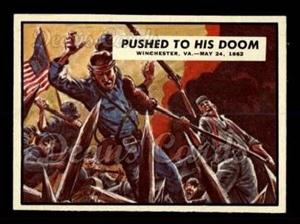
 The Civil War News card fronts featured scenes from many of the well-known Civil War battles, hand painted by a combination of two artists, Maurice Blumenfeld and Norm Saunders. The card backs featured a synopsis of the scene being portrayed on the card fronts, and were meant to look like newspaper articles, and always featured the “Civil War News” header. This header ultimately gave the card set its name, although the set was never intended to be titled Civil War News, as the wrappers and boxes never had “Civil War News” printed on them.
 While there are a few cards in the set that depict famous Civil War speeches and non-violent events, such as card #2 President Jefferson Davis, the majority of the cards depict graphic events. With titles such as “Exploding Fury” (Card #5), and “Flaming Death” (Card #65), these cards were highly popular amongst kids, but much less popular amongst their mothers.
 While a great deal of Civil War artwork tends to romanticize bloody battles and victories, the Civil War News cards hardly hold back. Len Brown and Woody Gelman, the masterminds behind the set’s creation, grew up collecting the famed 1930’s Horrors of War cards. Thus the duo created a graphic set of cards, rivaling Gum, Inc’s earlier set in terms of grotesqueness. Both men felt that the graphic nature of the cards added to the success of the cards, as neither Len nor Woody felt that the cards would sell well with young boys if they were “too educational”.
 An English company, A. B&C Limited bought the rights to the cards as well as the artwork and reproduced them in Britain. The British version of the set was nearly identical, aside from the fact they were slightly smaller in size than the American cards. Creators Brown and Gelman were surprised by success of the cards overseas. Brown stated, “we wouldn't have thought that British children would give a hoot about our Civil War...But I guess blood and guts and good artwork will win every time.”

Here at DeansCards.com we’ve had a lot of Civil War News cards come through the door, including a PSA Registry set that averaged 7.31 in condition. The most expensive cards in the Civil War News set are the first and last cards—because they are very condition sensitive. These cards would have been on the top (or bottom) of a card stack, and generally took the brunt of any damage done to the card sets. Thus collectors may have to pay quite a bit more for “The Angry Man” (Card #1), and the Checklist card (Card #88) in pristine condition.
With the success of the Topps Civil War News cards in 1962, Brown and Gelman decided to produce another set the very same year. The pair combined the gore aspect of their Civil War News set, with the nation’s intense fascination with outer space and produced a 55 card set entitled “Mars Attacks.”
The Civil War News cards remain a favorite with today’s collectors, although fewer seem interested in currency bills that came with the set as inserts. For the last two years, Civil War News has been the #1 selling non-sports card set at Deans Cards.com in both the number of cards sold and total dollar amount. Although there are more high-profile non-sports card sets, such as “Horrors of War” and “Mars Attacks”, Civil War News cards are a much more affordable option for collectors, with the timeless and interesting subject matter of the American Civil War.


