Although the sport of boxing is currently going through a lean time, that certainly wasn't always the case. In fact, prize fighting was one of the most popular sports in America. Evidence of this fact are the once popular 1910 Mecca & Hassan Champion Athlete and Prize Fighter Series cards. Fortunately, Dean's Cards was recently able to acquire a handful of them.
The 1910 Mecca & Hassan Champion cards were issued by tobacco manufacturers as both a tactic to promote their brand as well as serving as a valuable piece to the packaging. The inserted card would give structure to the loose packaging that the cigarettes were wrapped in. Another famous example of a tobacco card is American Tobacco Company's T206 Honus Wagner.
However, the T218 Mecca & Hassan Cards have a lot of really great features. Perhaps the most striking feature of the Prize Fighting collection is the beautiful color artwork of the cards. The full color images are set in front a bold background and set inside of a white border. The rich colors that fill the cards are particularly enjoyable because they're an excellent example of colorized photos, a technique used before the invention of color photography.
Another cool characteristic of the T218 cards is the level of detailed information printed on the back of the cards. They include a paragraph biography of the prize fighter as well as a recapped listing of his bouts; including their date, the opponent, the result and the length of the bout.
Another unique hallmark of the 153 card Mecca & Hassan Champion Athlete & Prize Fighter collection is that they included champion athletes from a wide array of the day's most popular sports, including aviation, track & field, swimming, billiards, golf and even roller skating. Without a doubt, the 1910 Mecca & Hassan cards are a lasting mark of a very different time in America's sporting life.
Please click here to fill out the rest of your boxing card collections.
T206 is the most famous set ever produced. Dean's Cards recently sent off approximately 150 of the big name T206 baseball cards to PSA to be graded. The majority came back as PSA 4 and PSA 5. We have multiple cards of many of the Hall-of-Fame players. It was just so cool having so many of these amazing old cards, we had to make a video to share it with you guys. These cards are listed online and ready to buy - just click on the Dean's Cards T206 Page.
If you are interested in Tobacco Cards, you really need to pick up the new book The T-206 Collection: the Players & Their Stories. The amount of detail put into this book is astounding, and it will be used as a reference book for years to come.
Although the book has an image of each T-206 card, it focuses more on the players. Most of us baseball historians are familiar with most of the 76 Hall-of-Fame Players in the set, but the book contains a paragraph of information on all of 524 players in the T-206 baseball card set. This is an astounding accomplishment when you consider the fact that many of the T-206 cards feature minor league players that played the game a century ago.
This great book is written by Tom & Ellen Zappala - who I had the opportunity to meet at this National Sports Card Show. You can get more information or buy the book at T206Players.com. When we find a good thing, I always try to pass the information on to our customers and friends in the hobby.
The 1939 Play Ball Baseball Card Set of 161 cards was the first set ever produced by Gum, Inc. of Philadelphia and was a nice improvement over earlier baseball cards. The Goudey Gum Co. had by then lost interest in baseball cards and had not had a major issue in several years.
The 1939 Play Ball Baseball Card Set had a plain design but featured a larger card, crisper black and white photos and more detailed player descriptions than previous baseball cards. About half the players in the 1939 Play Ball Baseball card set make their first appearance on a baseball card and are technically considered Rookie Cards. If it were not for Play Ball, many players from this generation would have never had a baseball card. The two blue chip 1939 Play Ball rookie cards are Joe DiMaggio and Ted Williams.
One possible flaw of the 1939 Play Ball set is that the players' names are not on the front of the card. Even if you know your baseball, you often have to turn over the card to determine who the player is. This flaw must have been made known to the company by collectors of the day, because the 1940 set featured the names on the front of the cards. If you watch my 1939 Play Ball Set Break video, you will see that I fell into this trap by incorrectly identifying a card as Dizzy Dean! The card is actually his brother Paul!
Another knock on the 1939 Play Ball Baseball card set is that so many of the stars of the day did not have cards issued in the set because their cards were scheduled to be in this missing third series. The most noticeable missing player was Lou Gehrig. In 1939 no one realized that the big guy was sick and that 1939 would be his last season. Some of the other Hall of Fame players that did not appear in the 1939 Play Ball set are Ernie Lombardi, Johnny Mize, Joe Cronin, Luke Appling, Bob Feller, Lefty Gomez, Lefty Grove and Joe Gordon – just to name a few.
Hank Greenberg
On the back of each 1939 Play Ball baseball card, it states that the set contains 250 cards, but Gum, Inc. never issued the 3rd Series of cards. Baseball cards were a new product for the company. My guess is that the production of the cards took longer than expected and as the season was nearing its end, the company became fearful that the planned 3rd series would not be issued in time to sell enough cards to cover costs.
The 1939 Play Ball baseball set is also very unbalanced in terms of players per team. For example, there are 19 cards of Dodgers players, 15 cards for the Red Sox and Giants – while the Browns only have 5 players on cards, the Indians have 4, and the White Sox have only 2 of their players featured on cards.
The reason for this misallocation remains a mystery. If you stood up and said, “Play Ball only bothered making cards of the best players!”, it is a good thought, but please sit back down, this logic does not hold. The 1938 NL Champion Chicago Cubs had NONE of their players on cards in the 1939 Play Ball set! So, where are the Cubs?
None of the articles or books that I looked at even mentioned this fact. Neither do the Beckett or SCD Price Guides. The only reason that I noticed there were no Cubs players in the 1939 set was because of the advanced functionality of the Dean’s Cards website.
If you go to the 1939 Play Ball Reprint set (because it contains every card in the set) on DeansCards.com and look at the refinements tool in the right hand margin, you can see how many players are represented for each team. There had to be some reason for this misallocation, but it seems to be lost to history.
The 1939 Play Ball set has been largely ignored in collecting circles over the years. Much more attention has been paid to the later, more advanced Play Ball sets. Information about the 1939 set is limited and much of the insight in this article is my own. Please feel free to add to or correct anything that I missed in the comments section below.
The 1939 Play Ball Baseball card set was a bold and innovative first issue for Gum, Inc. and began a grand new (but short-lived) era for baseball cards. The Play Ball cards expanded the number of cards issued in the 1940 Play Ball set and added color to the cards for 1941 set. Gum, Inc. was definitely gaining momentum, but that all changed (as did much of American life) the moment Admiral Yamamoto’s planes dropped their bombs on Pearl Harbor. Play Ball was done after only three years, having its life cut short by the paper and ink rationing of World War II.
The very nice 1939 Play Ball Reprint set is available at Dean’s Cards for the budget collector. The 1939 Play Ball Reprint cards are an affordable way to buy a Complete Set or build a Team Set at an affordable price.
The 1933 Goudey Baseball Card Set is recognized as the first important gum release. America was deep in the depression in 1933 and kids did not have many pennies to spend. For a product to get that penny, there had to be value. The Goudey Gum Company of Boston launched its revolutionary “Big League Gum” product.
The 1933 Goudey Baseball Cards were printed on thick cardboard stock, with bright colorful pictures and came with a nice big slab of gum. They were a great improvement over the smaller, thinner cardboard tobacco and candy cards that preceded them. It is important to remember that 1933 Goudey cards were the first color portraits of these stars that most people ever saw.
The Goudey Gum Company tried hard to give the customers what they wanted. The greatest stars of the game had multiple cards. There are 4 different 1933 Goudey Babe Ruth cards and #144 Ruth was double printed. The 1933 Goudey Baseball card set also has three cards of Joe Cronin and two cards each of Jimmy Foxx, Lou Gehrig, Rogers Hornsby, Carl Hubbell and Mel Ott.

 Although the sport of boxing is currently going through a lean time, that certainly wasn't always the case. In fact, prize fighting was one of the most popular sports in America. Evidence of this fact are the once popular 1910 Mecca & Hassan Champion Athlete and Prize Fighter Series cards. Fortunately, Dean's Cards was recently able to acquire a handful of them.
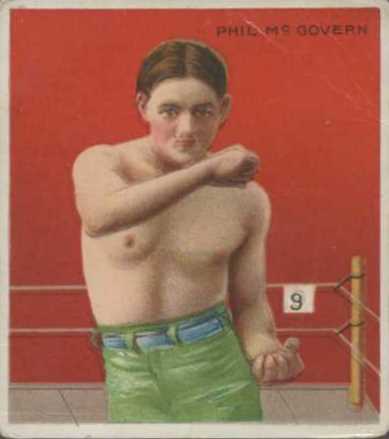 However, the T218 Mecca & Hassan Cards have a lot of really great features. Perhaps the most striking feature of the Prize Fighting collection is the beautiful color artwork of the cards. The full color images are set in front a bold background and set inside of a white border. The rich colors that fill the cards are particularly enjoyable because they're an excellent example of colorized photos, a technique used before the invention of color photography.
  Another cool characteristic of the T218 cards is the level of detailed information printed on the back of the cards. They include a paragraph biography of the prize fighter as well as a recapped listing of his bouts; including their date, the opponent, the result and the length of the bout.
