Showing posts with label Pre-War Baseball Cards. Show all posts

Friday, June 9, 2017

Hidden Gem: Rare Ty Cobb E95 Promo Card Discovered

By Jon Hanley

Last week an exciting discovery was made deep in the dungeons of Dean’s Cards. As Dean’s son, home from college, I was given the task of researching this unique Ty Cobb card, a relic previously undiscovered. When Dean first acquired this artifact over ten years ago, he knew it was old and most likely rare, but remained unsure what he had on his hands. After several experts admitted they had never seen anything like this item before, Dean hesitated from releasing it to the market. As a result, this cardboard depiction of the 4,000 hit club’s founding member sat on a shelf and waited ten more years until its mysteries were finally unraveled.

Photo by Dean's Cards
According to our research, Philadelphia Caramel expert Erik Varon recently discovered a nexus between this lookalike E95 Ty Cobb card and a Philadelphia Caramel Company advertisement issued circa 1910. Varon concluded this card was cut from an ad similar to the one pictured below, which was probably distributed to convince potential vendors to carry the company’s soon to be released baseball cards. This would make this item one of the earliest known promo cards. These 1909 Philadelphia Caramel cards were later designated by collectors as E95’s, and feature twenty-five stars of the day including Cobb. While our find may appear almost identical to the E95 Cobb card, further inspection will reveal that the lettering was enlarged and moved from the bottom margin to above Cobb’s head, probably to make the image more suitable for a larger print.


Photo by Erik Varon
The most peculiar part of this card is the jumble of wordage featured on the backside, the characteristic which enables the item’s identification. While the front of the ad featured Cobb, the backside described the company’s caramel and other products with phrases like “jelly confections” and “soft cream centered chocolates”. These words match up almost perfectly with the Philadelphia Caramel Co. advertisement mentioned above.


Photo by Net54
As learned from an online forum, the ad included a second promo card beside Cobb featuring prizefighter Jim Jeffries, who came out of retirement to challenge the 1908 Heavyweight Champion, Jack Johnson. The Philadelphia Caramel Co. simultaneously released a set of boxing cards, later designated as E79’s, since baseball and boxing were the two most popular sports in the United States at the time. When the backsides of the two cards are placed side-by-side they fit together like pieces in a puzzle.

Unfortunately, the full advertisement will likely never be found, as these cut-outs are extremely rare on their own. To our knowledge, this Cobb card is only one of three in acknowledged existence, making it the rarest item ever stumbled upon at Dean’s Cards.

One of these sold through Heritage Auctions in 2009, with the item description reading, “Until the full piece is discovered, this lone remnant will remain as our inspiration to keep searching those dusty attics and flea markets looking for long forgotten treasures.

Our find is not only another remnant of this lost treasure but is in much better condition than the item sold eight years ago. Dean’s Cards will most likely auction this rare piece of history on eBay later in the month, but for the time being, we remain too caught up in the excitement of discovery to consider a starting price.

We hope our discovery will encourage others to join this Crusade to uncover further artifacts of America’s greatest pastime. After all, discoveries like this are one of the many pleasures of our favorite hobby and yet another reason why grown men still play with baseball cards. 

If you would like to read more about the Philadelphia Caramel Company, check out Erik Varon's new book, Jakob's Story and the American Dream, recently released on Amazon.

Thursday, August 16, 2012

The Rebirth of the T207- Brown Background Set – 100 years later

                             
A couple years ago, when I was co-writing my first e-book, Before there was Bubble Gum: Our favorite pre-World War I baseball cards, I became fascinated by the unique look of the T207 set. The T207 set, commonly known as the brown background set, was originally manufactured by the tobacco industry giant, the American Tobacco Company, in 1912. The T207 baseball cards measure 1½” by 2-5/8”. Shortly after this set was printed, the American Tobacco Company would be dissolved due to the Sherman anti-trust legislation that broke the monopoly on tobacco.

 The T207 baseball card set is a true hobby classic. The 200-card T207 set contains 13 players that are in Baseball’s Hall-of-Fame, including Walter Johnson, Tris Speaker, Frank Chance, John McGraw, Smokey Joe Wood and Joe Tinker. Two interesting T207 cards are Eddie Cicotte and Buck Weaver, who were members of the 1919 White Sox and banned from the game for life.


 Being a big fan of reprint sets, as they give collectors who may not have the time or money to collect the original set the opportunity to enjoy the cards; I was always disappointed that the T207 cards are the most famous of the pre-war sets that has never been offered in the form of a reprint set. This is something special about being able to hold the cards in your as you go the set and look at the players. I must not be alone in my opinion, as DeansCards.com sells quite a few reprint singles and complete sets every year. For that reason, I decided we should recreate and issue a T207 reprint set. To do so, we created a new company called Dean’s Reprints and began securing the needed images.

The T207 reprint set turned out to be quite an undertaking, and took us two years to complete! The other thing that delayed the T207 reprint set was that I also attempted to finish my first book to be issued in print form. Both projects are now complete and available for purchase.

 Due to the quality of the century old cards, almost all of the T207 images needed to be retouched. Great care was given making sure that the reprint cards remained true to the original set. The original T207 set includes eight possible backs containing the name of tobacco brands in which the original cards were enclosed. We included a variety of these backs in the reprint set including three cards containing the ultra-scarce “Red Cross” backs. We were careful to use those backs on cards, whose originals have been discovered with a Red Cross back.

 One of the most interesting features of the T207 baseball card set are the player biographies on the back of the cards. Each of these bios needed to be retyped. We were careful to stay true to the original fonts and leave the original century old misspelled words. The one “improvement” that I could not resist was suggested by my teenage son, Jonathan. Jonathan collects cards and commented what a pain it was to keep un-numbered sets organized. For that reason, we numbered each of the cards in the set. I did not feel too bad about adding this one improvement since we felt that we clearly needed to also indicate that every card was a “REPRINT” and not an original. I hope that the hobby purists will forgive us for these minor changes.

Take Care,
Dean Hanley


 TO PURCHASE A T-207 REPRINT SET PLEASE CLICK HERE.

Dean Hanley is an authority on vintage sports cards and has written numerous articles on the topic. Mr. Hanley is the founder DeansCards.com, and with well-over one million vintage cards in inventory, DeansCards.com is the largest seller of vintage cards on the web. Dean is author of the new book, Bowman & Topps Baseball Card Sets of 1948-1955”, which is now available for sale at Amazon.com. Dean has also published Before there was Bubble Gum: Our Favorite Pre-World War I Baseball Cards, which is also available in eBook form at Amazon.com .Please visit www.DeansCards.com to purchase this T207 Set.


If you are looking to sell your cards we would be happy to hear from you. Please fill out our sell your collection form here and we will be in touch.

Thursday, July 21, 2011

The 70th Anniversary of "The Streak"

Joltin' Joe.  
The Yankee Clipper.  
Joseph Paul DiMaggio.  


Whatever name you choose to use, this is the hero of a whole generation of baseball fans.  This past weekend, on July 16, commemorated the 70th anniversary of the end of a hitting streak likely never to be seen again.

# 274 Joe DiMaggio XRC - 1938 Goudey Heads Up


In 1941, Joltin' Joe DiMaggio reeled off a string of hitting in 56 straight games. Amazingly enough, after "The Streak" ended, DiMaggio would start another 16-game hitting streak his next appearance.  This means that the Yankee Clipper would have a hit in an astonishing 72 out of 73 games!


# 1 Joe DiMaggio - 1940 Play Ball Autographed Card


Our most prized piece of Yankee Clipper memorabilia would have to be this 1940 Play Ball Baseball card, signed by DiMaggio himself. Not to say that this is the only beautiful and nostalgic DiMaggio item for sale.  Dean's Cards also has Joe DiMaggio Goudey cards, Joe DiMaggio Topps Cards, and Joe DiMaggio Upper Deck Cards for sale.  We also have an extensive offering of Joe DiMaggio old Sporting News, Who's Who, Baseball Digest, Street & Smith's Baseball Yearbook, and Sports Illustrated magazines.

For more information on Joe DiMaggio Baseball Cards and to buy or sell Joltin' Joe DiMaggio Baseball Cards, Publications or Memorabilia, please check out our vintage baseball inventoryDeansCards.com also has a large selection of reprint and retro cards bearing the likeness of the Yankee Clipper.

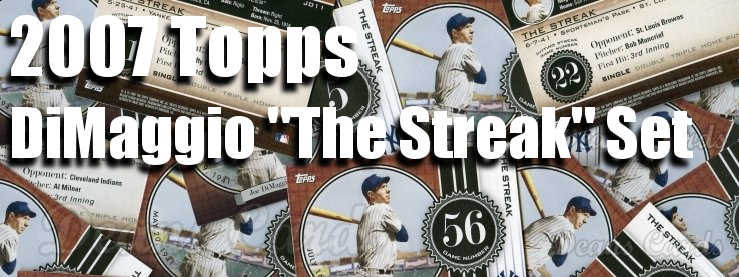
In 2007, Topps produced a set commemorating "The Streak."

Wednesday, September 16, 2009

Pre-War Baseball Cards

Pre-War (WWII) Baseball Cards have the most value on a per card basis. Although the prices quoted for these cards are typically high, much depends on the condition of the cards. Dean's Cards will purchase these cards in almost any condition. Many of the cards that have survived are not in top condition and this definitely affects the value of the cards.   Please feel free to contact me.


It is difficult for the collecting novice to determine what years these cards were issued by just looking at the card. Another confusing problem is that most of the pre-war sets have been reissued in the form of reprint (or archives) sets. These sets have been released over the last 20 or so years.

Unfortunately, sellers will send us a Ruth or Gehrig Card that they bought for $100 at a Flee Market a few years back, only to discover that it is a reprint card issued in the 1990's that was roughed up to look old. Please be careful when buying these cards. Most of the cards for this era show wear, so if you have a card like this in great shape, chances are that it is not an original. The value of the reprinted cards in very low when compared to the original cards.

When you hear about a particular card being worth a lot of money, it is most often from the Pre-War Era. But the card that is worth thousands of dollars is definitely the rare exception. Most of the very valuable cards are super stars that are in near perfect condition. The cards of the common players in average condition are worth far less money.

Most of the newspaper articles or TV interviews that I have seen, paint an unrealistic value on these cards. For example, I once saw an “expert” on the Antiques Road Show overestimate the value of a collection by 25 times! I personally know many people in this hobby, but never heard of this “expert”. It may make for good TV, but it confuses many of the people that are seriously trying to sell a collection.

It is important to remember the old “Economics 101” Lesson about Supply and Demand. The supply of the pre-war cards is low, which drives up the value. But, because of the higher price of the pre-war cards, the demand is also fairly low, when compared to the newer cards.

When one thinks about this, it makes sense. Suppose that you were starting a card collection, and had a limited amount of money that you could spend. Would you spend it on a few expensive pre-war cards that contained pictures of players that are long sense dead? The answer for most collectors is “No”.

If you are looking to sell your cards, please contact Dean