Showing posts with label Sell Baseball Cards. Show all posts

Wednesday, July 10, 2013

Dean’s Cards Introduces Advanced Card Search Options

By Dean Hanley
Founder and Owner, Dean’s Cards

Since I began Dean's Cards in 2001, my goal has always been to provide fellow collectors with a simple, cost effective and enjoyable way to build their collections. That’s why I’m proud to introduce a new advanced website search feature that will make it even easier for you to find the cards you need for your collection.

We are now completing a project to assign “Specialty Codes” to our inventory of more than 1.5 million cards. So you can now go to the Search Box on the top of every page of our site and search for specific types of cards for all sports by their Specialty Code. (Please note that the Specialty Code project is ongoing so you may see some cards that have not been coded yet.)

For example, let’s say you wanted to find Hank Aaron’s rookie card. You would just enter “Hank Aaron RK” in the search box and click search, as you see here:


You would then get the following result showing all of his rookie cards available in our inventory:


Then you just click on Hank Aaron’s name to see scans of the actual cards so you can choose the card in condition and price range you want, as you see here:


We have added the following Specialty Codes to make searching through our inventory even easier:
CL – Checklist Card
CO – Coaches Card
IA – In Action Card
DP – Double Print Card
HL – Highlights Card
HOF – Hall of Fame Card
LG – League Leaders Card
MG  –  Managers
MP – Multi-Player Card
PF  –  Playoffs
RB –  Record Breakers
RK – Rookie Card
SP – Short Print Card
TM – Team Card
WS – World Series Card

Here is an example of a Multi-Player (MP) card and how we would code the card internally:


And here is an example of a World Series (WS) card and how we coded the card internally:


As you can see, you can not only search by the Specialty Code, but also by the actual title of the card and the name of the players on each card. And thanks to the custom programming of our site by our in-house development team, you will instantly see the results of your search displayed on your screen – and all of these features are compatible with the latest mobile devices, as well.

As you search for cards on our site, you will see actual images of the cards in our inventory. When you click on the images, you will see enlarged scans of the front and back of each card. This feature allows you to inspect and compare the condition of each card before you make your purchase.

Dean's Cards has made this continual investment in advanced technology because we want to take the guesswork out of your purchase. When you buy a vintage card from Dean's Cards, "What you see is what you get!"

Dean Hanley, founder and owner of DeansCards.com, is considered one of the foremost experts on the subject of vintage baseball cards, other sports and non-sports cards and has a regular column in the Sports Collectors Digest and publishes articles on his blog. Dean has also written two books on vintage sports cards: The Bubble Gum Card War: The Great Bowman & Topps Sets from 1948 to 1955 and Before There Was Bubble Gum: Our Favorite Pre-World War I Baseball Cards.

Thursday, June 20, 2013

Sell Baseball Cards for Top Dollar at Dean's Cards: Seller Testimonials

By Dean Hanley
Founder and Owner, Dean’s Cards

Some collectors are understandably concerned about sending their baseball card collections to get a bid from us. But a recent experience from a collector in San Francisco, California will show you how easy the process is.
Part of the collection of star cards and Hall of Fsmers recently sold to Dean's Cards.
This collector did a Google search to find companies that would buy his star baseball cards that went back to the 1950s through the 1980s. He had virtually every baseball card star and Hall of Famer from this era in a rather large collection. He had never done business with Dean's Cards before this.

He completed the form on the sell your baseball cards page, we responded, and he sent us his cards to evaluate. We gave him our generous bid and he accepted it. We then sent the check the next day. So in a matter of days the transaction was complete.

Again, this is another example how we earn trust from baseball card collectors every day.

If you want to sell baseball cards or sell football cards, I encourage you to read testimonials from what baseball card and football card sellers have to say about working with Dean’s Cards. We are proud of the trust we have earned from customers who sell us baseball cards, going back to our founding in 2001.
More star cards from the collection recently sold to Dean's Cards.
Whether you are thinking of selling your boyhood baseball card collection or you have been handed the responsibility of liquidating the collection of a family member, it can be a very daunting task. While there is no shortage of dealers who will buy vintage baseball card collections, Dean's Cards is able to offer a higher percentage of the baseball card collection's actual value than most traditional baseball card dealers. Dean's Cards can usually pay more for vintage baseball card collections simply because what we buy goes directly into our own online inventory of more than 1.5 million baseball cards.

We sincerely hope that we end up writing you a large check! This means you have some nice baseball cards, and we always need the inventory. If the amount that we offer for your baseball cards falls below your expectations, we will pay the postage to return the baseball card collection to you.
Collectors send their cards to Dean's Cards and we quickly provide a bid.
So when you’re ready to sell your baseball cards or sell your football cards, I encourage you to visit our “Sell Baseball Cards” page for more details and complete the form to describe your cards. I promise we will get back to you quickly.

We’re humbled by the trust baseball card collectors and football card collectors place with us and we look forward to you becoming a Dean’s Cards customer.

Click here to Sell your baseball cards

Click here to BUY baseball cards

Dean Hanley, founder and owner of DeansCards.com, is considered one of the foremost experts on the subject of vintage baseball cards, other sports and non-sports cards and has a regular column in the Sports Collectors Digest and publishes articles on his blog. Dean has also written two books on vintage sports cards: The Bubble Gum Card War: The Great Bowman & Topps Sets from 1948 to 1955 and Before There Was Bubble Gum: Our Favorite Pre-World War I Baseball Cards.

Friday, May 17, 2013

Selling Baseball Cards: Earning Your Trust at Dean's Cards

By Dean Hanley
Owner of DeansCards.com

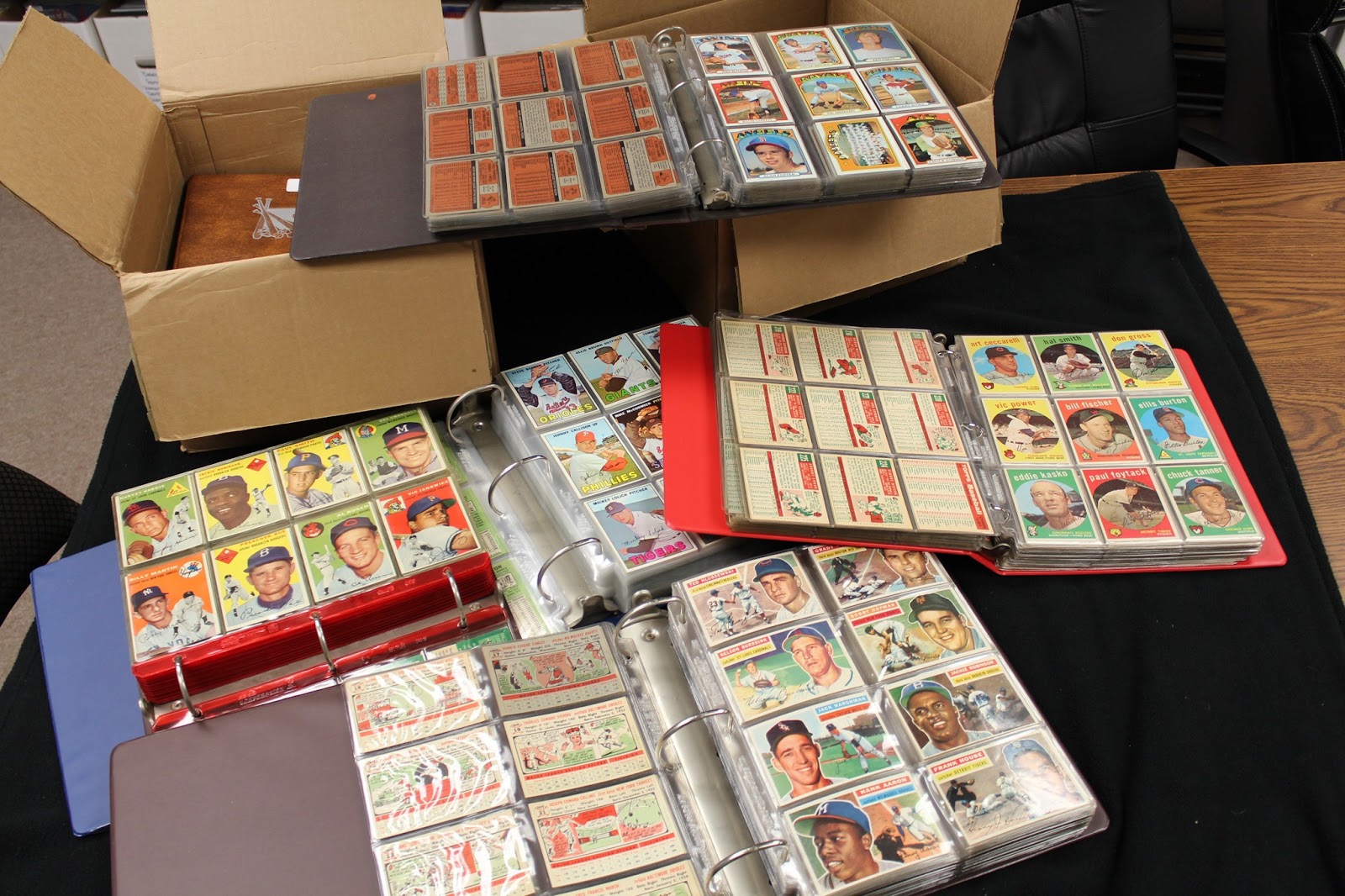
Dean’s Cards recently purchased a large baseball card collection from a collector that included full sets of baseball cards from the 1950s and 1960s, as well as various baseball star cards and rookie cards, which you can see in the photos in this blog.
Part of a collection we recently purchased from a Seller. Click here to sell your baseball cards to Dean's Cards.
Even though this was a large baseball card collection that we purchased for a cost well into five figures, it was handled with the same, simple, trusting and personal process as all collections we buy:
  • The seller completed the form on our Sell Baseball Cards page with details of baseball cards in his collection.
  • Elana, the head of our baseball card buying team, replied to the seller by email, and then Elana and I spoke to him by phone to get further details on the baseball card collection.
  • The seller then sent us the baseball cards by mail so Elana and I could personally evaluate them.
  • We offered a bid for the collection based on our review of the seller’s collection.
  • The bid was accepted, and we mailed the seller a check.
Dean’s Cards buys more than 500 card collections every year, and we are proud that sellers trust us to send their collections for our evaluation that they often personally have built over many years.
Some of the baseball star cards in a recent large collection we purchased. To sell your baseball cards to Dean's Cards, please click here.
Of course, it is a valid concern to be skeptical of sending anything of value to someone that you do not know personally. That’s why we work so hard to earn trust from our customers – which is proven by the fact that we receive card collections worth thousands of dollars almost every day, as well as glowing testimonials form sellers.

The best reason that I can give you for why we try so hard to treat people fairly is that it is simply good business. We do all our business by mail -- both buying and selling -- and I have taken great care to protect the reputation of our business. Dean's Cards has never kept a card that does not belong to us, and we never will. If we treated people wrong, we would be finished as a business.

As far as giving you a firm offer on your collection, there is simply no way to do it without physically seeing your cards. For us to determine the value of your cards, you need to send them to us. Any reputable dealer will tell you the same thing. Bidding on scanned images of cards is way too uncertain and would force me us bid very conservatively – and that would just cost you money.
We are proud to sellers trust us to send their collections. Please contact us if you are ready to sell your baseball card collection.
It usually costs a dealer about $1000 (not counting at least a day of his time) to fly out to bid on a collection. No matter what a dealer says, this expense has to be passed along to the seller. What about the people who decide NOT to sell their collections? Guess who pays for those trips? If you said, "the seller,” you are correct. We would much rather give the travel money saved to a seller for cards, than to the airlines for transportation costs.

Our "secret" to buying so many baseball card collections is that we simply pay more for cards. Our goal is to keep our costs down, so that we can continue to pay a higher dollar amount than other dealers. We have the bidding process down to a science and an art and it works extremely well for us – and for sellers. Please understand, we are very motivated to buy your cards, which is why we offer more than other dealers – simply put, if we can’t buy cards, we can’t sell cards.

If sending the cards by mail makes you uncomfortable, then we suggest sending us part of your collection first.  We will value the cards and contact you with an offer. If you agree to our offer, I will send you a check. Usually, after sellers receive the first couple of checks, mailing the cards becomes a non-issue. If my offer is unsatisfactory, then I will pay for the postage to send the collection back to you.
More star cards in a recently acquired collection. Please visit our Sell Baseball Cards page if you are ready t sell your  baseball cards.
The bottom line is that there is nothing that I can really say to totally assure you, the seller. At some point it will take an element of trust on your part. In reality, it all comes down to business ethics. If you do decide to send us your collection, we will certainly not violate your trust – and you can visit our testimonials page to read the positive comments from sellers and see how they feel about doing business with us.

If you have a collection of baseball cards, football cards, other sports cards or non-sports cards from 1869-1969 and you’re ready to sell, please fill out the form on our Sell Baseball Cards page so can begin talking. You have my personal guarantee that we will work hard to earn your trust, just as we have for thousands of sellers since I started Dean’s Cards in 2001.

We look forward to learning more about your card collection!

Sincerely,

Dean Hanley
Owner of Dean's Cards

Dean Hanley, founder and owner of DeansCards.com, is considered one of the foremost experts on the subject of vintage sports cards and has a regular column in the Sports Collectors Digest and publishes articles on his blog. Dean has also written two books on vintage sports cards: The Bubble Gum Card War: The Great Bowman & Topps Sets from 1948 to 1955 and Before There Was Bubble Gum: Our Favorite Pre-World War I Baseball Cards.

Click here if you have vintage baseball cards to sell -- 1869-1969.


Tuesday, April 16, 2013

Build a Custom Vintage Baseball Card Set: Dean's Cards

Let Us Build a Vintage Baseball Card Set Just for You!

by Dean Hanley,
Founder and Owner of Dean's Cards

Dean’s Cards has hundreds of vintage sets available online, but some of our customers ask us to meet some exact specifications for their sets. That’s when we reach into our vintage cards inventory of more than 1.5 million cards and custom build a set for you.

As an example, a new customer recently came to us and asked us to custom build sets for more than 20 consecutive years in a specific condition for each year. Our grading team quickly went to work and met the customer’s needs.
Some vintage baseball card sets recently built at DeansCards.com.
Due to the value of the cards, most Pre-War baseball card sets and 1952 Topps sets are custom built. Often, when collectors spend this amount of money, they are very particular on what they want.

Our staff of card grading experts reviews the cards personally to make sure you receive a set with the consistent grade you requested. And we grade our cards conservatively, on par with PSA standards – but we even go one step further. We take into account a card's "eye appeal” when we assemble a set.

Card collectors who are accustomed to purchasing ungraded sets from other vendors, are usually amazed at our tough grading standards – and the consistency of the condition of the cards in the sets we build for them. Other grading companies do not always take "eye appeal" into account when grading cards. Even if a card meets all of PSA's technical requirements for a particular grade, we also require that it have an overall look that represents that grade.

Our goal for your Dean's Cards custom set purchase is the exact same goal as we have when we buy cards -- we want you to be completely satisfied with the set you receive and never have to be hassled with returning unwanted cards for replacements. Our entire staff will do everything that we possibly can to exceed your expectations on the first try. No mistakes and no excuses. Your time is too valuable and your business is greatly appreciated. In short, we build your card set as if we were building it for our own collection.
1957 Toppses baseball card set at Deanscards.com
If you are looking for a card set that is not listed online, please contact us and let us know how we can build a set for you.

Please note that many expensive, custom-built sets require a deposit and/or milestone payments. Depending on their complexity, the set construction projects can take weeks, months, or sometimes even years.

Dean Hanley, founder and owner of DeansCards.com, is considered one of the foremost experts on the subject of vintage sports cards and has a regular column in the Sports Collectors Digest and publishes articles on his blog. Dean has also written two books on vintage sports cards: The Bubble Gum Card War: The Great Bowman & Topps Sets from 1948 to 1955 and Before There Was Bubble Gum: Our Favorite Pre-World War I Baseball Cards.

Click here if you have vintage baseball cards to sell -- 1869-1969.

Thursday, March 21, 2013

How to Sell Your Baseball Cards: Advice from Dean Hanley, Owner of Dean’s Cards


Whether you are selling your boyhood collection or liquidating the collection of a family member, selling baseball cards or other card collections can be a difficult task. Every day at Dean’s Cards we are asked to offer advice on selling baseball cards. That’s why we are publishing this article to share the options open to you in selling a vintage baseball card collection – and, most importantly, how to get the most money possible for your collection.

Although this article contains my opinions, I hope the information provided here will save you considerable time and effort and also help you get the best possible price for your collection. Since I believe that what we pay for a baseball card collection is more than you will get elsewhere, it is in both our interests for me to give you as many facts as possible to help you make the best possible decision.

While there is no shortage of dealers who will buy vintage collections, Dean's Cards can offer a higher percentage of the collection's actual value than most traditional card dealers. How is that possible? What we buy goes directly into our own online inventory of more than 1 million cards. In fact, quite a few card shop owners who buy collections will regularly send them to us – because they know they will make a nice profit on the cards.

The Dean’s Cards Buying Team strives to make selling your collection an extremely easy process. We ask you to send the cards to us so we can review them, and we are usually able to provide you with our bid within two business days. We make our top offer right away – there are no games played and we won’t low-ball you. If you accept our offer, we will mail you a check. It’s that simple.

My hope is that we will be writing you a large check. This means you have some nice cards, and we always need the inventory. If the amount we offer for your cards falls below your expectations, we will pay the postage to return the collection to you.

Selling Baseball Cards You Have Inherited
Dean's Cards offers a large Selection of Mickey Mantle cards.
Quite often people that have never collected vintage baseball cards and other sports cards inherit the responsibility of selling a card collection. It can seem like an overwhelming responsibility. The first thing that some people do is go to their local baseball card shop (if they can still find one) to ask what the collection is worth. Most are surprised to discover that they are often offered a few pennies on the dollar of a collection's stated book value.

The dealer at the card store usually offers a brief economic lesson of card collecting in order to explain the low amount that he is offering. The dealer may explain that there are numerous reasons that the cards are worth such a low amount and gives examples such as: buyers seldom pay "full book price" on cards and the shop must pay rent, labor, insurance, and other types of store overhead to cover the stores' expenses. He may also tell you that a card may sit in inventory for months or even years before it eventually sells.

All of these reasons may be true, but there is a much more important reason that the "strip mall" card dealer can only pay the collector a few pennies on the dollar for a vintage card collection. The main reason that their offer is so low is that retail card stores sell mostly the newer collectibles. Unlike Dean's Cards, vintage baseball cards are not their specialty. Most card shops keep a few vintage baseball cards in the display case for show, but it is impossible for a retail card store to do enough traffic to sell more than a few vintage baseball cards.

Largest Inventory of Vintage Baseball Cards at Dean’s Cards
Visit DeansCards.com to see more than 1 million cards online.
At Dean's Cards, we offer a different concept than you will find with other dealers. We buy collections from dealers all the time and pay the same percentages to them as we do the individual collectors. Dean's Cards can pay more for vintage card and memorabilia collections, because what we buy goes directly into our own online inventory. This way we can both avoid the middleman.

Dean's Cards is often called the "Amazon" of vintage sports cards and is recognized within the hobby as the #1 Online Seller of vintage cards. Although some other dealers came to be #1 in online sales, no other dealer has more than a fraction of our online inventory.

Baseball Cards Rarely Sell at “Book Value”

Often when it comes time for people to sell a card collection, they are surprised to learn that no one will offer them anywhere near the Book Value Price for the cards. Here are a couple reasons why this may occur:
  • The Book Value are refers to cards that are in Near Mint condition. Cards that grade "NEAR MINT" still have sharp corners, good centering, and no gum stains or pen marks on the card. Less than 2 percent of vintage cards (less than 2%) grade as high as NEAR MINT. Since most cards were originally bought and handled by kids, a very low percentage of the cards remain in high quality condition. 
  • The "Book Value" is the Suggested or the "Pie in the Sky" Price. Few collectors are willing to pay the book value price for cards. 
  • Card Dealers need to make a profit on the cards to cover their time and expenses. Most card dealers have the expense of renting a table at a card show or, in the case of Dean's Cards, the advertising, labor, and hosting expenses of a website. Not to mention it takes months (or years) to sell the cards that we have in inventory. 
Less than 2 percent of Vintage Baseball Cards Grade as Mint Condition

Non-collectors tend to over grade the condition of cards. Card Collectors can be very picky! It is very common for a novice card seller to contact us and state, "My cards are in MINT Condition". Very seldom does this turn out to be the case. Dean's Cards will certainly buy vintage cards in almost any condition, but it is important to realize that the condition affects the value of the card.

The good news is that - if you bought your cards as kid - you are going to make a great return on your investment. How many of your other childhood toys can you say this about?

eBay and Auction Houses May Not Be Your Best Choices

Many people also are tempted to sell cards online through eBay on their own, thinking they can get the most for their cards there. But there’s a lot more to selling on eBay or other such sites than most people think.  A large collection could easily take months or years to liquidate. Online auctions are usually not the best option, because they generally appeal to bargain hunters and rarely bring top prices for collectibles.

Auction houses also get lots of attention, but they usually don’t work out well for collections. Auction houses normally handle the rarer, high dollar items – and large fees also are charged for listings and commissions.
When you consider the time and expense involved in eBay and auction houses, you’re usually much better off selling to a dealer for the best price you can get.

Reasons to Sell Your Vintage Baseball Cards
Send an email to the DEan's Cards Buying Team to sell your baseball cards.
But you should always remember that the bottom line is that they are your cards and you certainly do not have to sell them – especially if you are emotionally attached to them. Many collectors never do sell the cards, until there is a special event which encourages them to do so for the money. Typical examples include: weddings, sending Kids to college or paying off a big bill. Many collectors keep the cards until they die and then let their heirs worry about what to do with the collection.

If you have not looked at your cards in years, it may make sense to do something useful with the proceeds that you could get for them. It is often the family member that inherits the collection that ends up selling the cards. If you come to the point where you feel that the value of the collection could be put to better use, please contact us. You have my word that you will be treated fairly and honestly and that we will pay top dollar for your collection.

Dean’s Cards Back-of-the-Baseball-Card Facts:
  • We buy more than 500 collections every year and have been doing so since 2001.
  • Dean’s Cards sells more vintage cards online than any other dealer.
  • We have 12 employees and a 5000 square foot office in Cincinnati, Ohio.
  • If we don’t buy cards, we can’t sell cards – and that’s why we strive to offer you the best, no hassle price upfront.
  • Vintage cards – before 1969 – have the greatest value. But cards from 1950s and 1960 are condition sensitive – meaning cards in best condition are worth much more than cards in poor condition.
  • Pre-World War II cards are the most valuable and often have good value regardless of their condition.
  • Semi-vintage cards – from the 1970s – have more of a modest value and need to be in excellent condition to get the best price.
  • Modern cards – 1980s and on – are beautiful cards and fun to collect, but they were made in such great quantity that the value is not high – so we generally do not buy these from collectors.
  • Vintage cards peaked in value in the 1990s, then declined a bit, and now have been holding steady ever since.
Ready to sell your baseball cards? Visit us at Dean's Cards to start the process. We promise a prompt reply -- and our best offer..

Dean Hanley, founder and owner of Deanscards.com, is considered one of the foremost experts on the subject of vintage sports cards and has a regular column in the Sports Collectors Digest and publishes articles on his blog. Dean has also written two books on vintage sports cards: The Bubble Gum Card War: The Great Bowman & Topps Sets from 1948 to 1955 and Before There Was Bubble Gum: Our Favorite Pre-World War I Baseball Cards.

Monday, March 4, 2013

Sports Collectors Digest Features Dean and 1953 Bowman Baseball Cards


Sports Collectors Digest featured Dean’s article about the unique 1953 Bowman baseball card set in its March 8, 2013 issue. The article, also available online, is titled, “Bowman bounces back,”and features Bowman’s “counter attack” to the groundbreaking 1952 Topps set.

The 1953 Bowman set that featured great photography, multi-player cards and “pure color” is still considered one of the most beautiful vintage baseball card sets -- yet it was not a money-maker for Bowman, which had to return to a black and white card set later in 1953.

Dean also produced a video on the 1953 Bowman baseball card set which shows off the beauty of the set and serves as a timeless reminder to a bygone vintage baseball card era.


The story behind the 1953 Bowman baseball card set makes the set even more important for sports card collectors. Bowman had been slowly evolving its bubble gum cards, but that came to a sudden end in the spring of 1952, when the Topps Company aggressively seized its opening and issued a competitive set of baseball cards. Bowman seemed caught off guard, as the company was shocked at how quickly the superior giant-sized 1952 Topps baseball cards snatched the majority of the baseball card market share in just a year’s time.

Bowman was now forced to create a better card. The 1953 set was Bowman’s direct response to the 1952 Topps surprise attack and Bowman spared no expense. The 1953 Bowman cards were much larger than their 1952 cards and roughly matched the size of the Topps cards.
1953 Bowman Mickey Mantle available at Dean's Cards.
When you review the 1953 Bowman cards, you quickly get overwhelmed with the wonderful, bold color photos of the players. And there is no writing on the front of the cards which makes the photography stand out even more.

Without names on the card fronts, it’s sometimes tough to determine who the player is in the photo. The 1953 Bowman set forces you to concentrate on the player’s faces more so than any other set. As you go through the set, you find yourself turning over most of the cards to verify the identity of the player.

The photos were taken during the 1952 season, when color photography was extremely rare due to the high expense of the process. The Philadelphia-based Bowman Gum Company had to act quickly to get all of the photos taken before the 1952 season ended, so the company chose a New York based photographer for the job. That's why almost all of the 1953 Bowman baseball cards were shot in the two classic stadiums that sat across the Harlem River from each other: Yankee Stadium and the Polo Grounds.
Yogi Berra, Hank Bauer and Mickey Mantle on this 1953 Bowman baseball card from Dean's Cards.
It is fun to look at the cards of the National League players and piece together a panoramic view of the uniquely shaped Polo Grounds. And cards for American League players feature views of Yankee Stadium that most are too young to remember.
1953 Bowman Warren Spahn with Polo Grounds in the background
You can learn more about the 1953 Bowman baseball card set, as well as other vintage card sets from 1948-1955, by purchasing Dean's book at Amazon.com: The Bubble Gum Card War: The Great Bowman & Topps Sets from 1948 to 1955.
Dean's vintage baseball card books available at Amazon.com.
If you are interested in purchasing the 1953 Bowman baseball card set or individual cards from the set, you can see the cards on the Dean's Cards website. You'll also find vintage baseball cards from every other era, as well, including the important baseball card collecting period of 1948-1959

And if you have vintage cards from 1869-1969 that you'd like to sell, please visit our "sell your baseball cards" page at Deans Cards for more information.

Wednesday, November 21, 2012

Dean's Top 10 For Black Friday!


                                                   10. 2012 Topps Factory Football Set


 9. Dean's Book "Before There Was Bubble Gum: Our Favorite Pre-World War I Baseball Cards"


                               8. Baseball Card Near Complete Sets


             7. Sports Illustrated Covers to hang in the "man cave"


                              6. Vintage Baseball Complete Sets


5. Dean's new book "The Bubble Gum Card War: The Great Bowman & Topps Sets from 1948 to 1955."


4. 2012 Topps Baseball Complete Set


 3. Vintage Team Sets for your favorite team


2. Dean's Cards Gift Certificates


And the # 1 thing on Dean's Black Friday List!
T207 Reprint Set 

Happy Holidays Everyone! Please click here to return to Deanscards.com.

Tuesday, October 23, 2012

So why did Topps win the Baseball Bubble Gum Card War?

by +Dean Hanley
In 1950, Bowman Gum Company was the only bubble gum manufacturer that issued a set of baseball cards. By the time Topps produced their first set of bubble gum baseball cards in 1952, Bowman had every conceivable advantage. Bowman had four years of experience of designing, producing and manufacturing sports cards. Bowman had the majority of the players under contract and was also the most profitable gum company. Bowman seemingly had the finances to outlast any competitor in a war for market share – both at the candy counter and in the courts. If someone who was familiar with the situation had been giving gambling odds on who would win a Baseball Bubble Gum Card War in the fall of 1951, Topps would have been considered an under-dog at best and a long-shot by most, especially after their feeble attempt to market cards in 1951.

 So why did Topps win the Gum Card War and not Bowman? The short answer is that Topps sold more baseball cards and the companies that owned Bowman gave up. But, why did this happen?

After researching all the available material that I could find for this book, I came to the realization that the answer to this question was still not totally apparent to me. Generally, when one company wins a battle for a market niche, there are multiple factors playing into their victory. Possibilities range from better financing, management, marketing and sales, better distribution, manufacturing procedures or even a combination of several of these factors.

 In order to better understand these numerous factors, I decided to speak to Sy Berger personally to get the answer. When I reached him by phone, I was prepared to discuss each of these areas in great complexity and detail with Mr. Berger; however, Berger’s response was much simpler than I was prepared to hear. Berger quickly answered the question by saying, "Because they (the Topps cards) are so beautiful. They are just beautiful!"

The simplicity of Mr. Berger’s answer shocked me into silence. After a few seconds, I replied, “Yes sir, they certainly are.” Sometimes the answer can be just that simple.

The greatest advantage that Topps possessed and Haelan Labs did not was Sy Berger. Each year from 1952 to 1955, Topps managed to produce a better and more attractive set. The kids responded by sliding their coins across the candy counters of America. Producing Topps baseball cards was Sy Berger’s passion in life. He was involved in every aspect of the product, from the design, production, manufacturing and even securing the player’s signatures on contracts.

Although George Moll and his agency continued to design the Bowman cards until the company was sold to Topps, the Bowman baseball cards lacked the creativity that Moll had displayed in the Horrors of War set. Most card collectors prefer the design of the Topps cards to those produced by Bowman.

 This is what caused the downfall of the Bowman Baseball Card Empire and goes to show how much of a difference that one person can make on history. Warren Bowman made this type of impact in 1938, with his Horrors of War set and Sy Berger did it again in the 1950s. This is why hobbyists refer to Seymour “Sy” Berger as the “Father of the Modern Baseball Card”.

Topps begins a new era 

As the years went on, Topps never forgot how quickly a market leader can fall from power. Topps saw first-hand how the Bowman Gum Co. lost its dominant position in the market. It all began with the appearance of the 1952 Topps baseball set. One superior issue of baseball cards was all it took to make a major impact in the market and Topps never forgot this valuable lesson.

Unfortunately for collectors, during the 25 year reign of Topps, the company invested far more effort on streamlining costs and protecting its monopoly than developing innovations for the cards. This is one reason why the 1952 Topps Baseball Card set has remained a hobby standard for so many years.

Cost cutting and profit optimization is the typical strategy of monopolies in any market. Real innovation in the card collecting hobby did not reemerge until other companies were allowed to issue sets of cards. This put more power in the hands of collectors, who were once again allowed to vote for the best product with their dollars in the 1980s. The end result was an exciting reset to the hobby and the beginning of a card collecting boom.

Most collectors feel that the hobby has had way too many sets issued in the last couple decades. However, it is doubtful that the exclusive license recently granted to Topps in the baseball card market will increase the quality or creativity of the products that they produce in the near future or bring kids back into the hobby. Innovation is most often the child of competition, not monopolies. Using history as an indicator, I predict if we ever have another sports card collecting boom, it will take another pioneer like Sy Berger to come along with a great idea, and the passion and drive to implement it.

A loyal following and an American Tradition

As Topps continued to increase the number of cards in their sets, collectors could once again possess a set of cards that contained all of the major league players and this is what mattered most to the collectors. In reality, there was only room in the hobby for one company. The hobby of collecting baseball cards would have never been as popular, if the collectors could not get cards of every player in the league. The kids were hooked and a firmly established American tradition was born. The results were dramatic. Baseball card related sales rose from $950,000 in 1955, the last year of the Bubble Gum Card War, to $3.8 million in 1959.

A survey of 339 boys from the early 1960’s showed that 89% of the boys who were surveyed collected baseball cards. Can you imagine getting that percentage of the population to agree on anything else? To put this huge percentage into perspective, only 60% of today’s kids (ages 10 to 14) own cell phones.

Topps marketed their cards to the boys and they responded. We played with them for hours on end. Baseball card trading sessions were one of our main sources of entertainment. I learned to read by studying the player’s profiles on the back of the cards. I expanded my vocabulary with words like, "Most Valuable Player”, “bullpen” and “southpaw". By the age of six, I also knew who played each position for every team and that player's uniform number.

Baseball cards also taught me geography. By age seven, I learned which state each team's city was located. I knew that there were countries to the south, such as Puerto Rico, the Dominican Republic and Venezuela, where the people spoke Spanish. I was too young to know exactly where these places were (until my mom helped me find them on a map), yet I knew that these countries seemed to produce all of the great shortstops!

By the next year, my trusty Topps cards began teaching me math. I began calculating batting averages and ERAs (by using long division) for the players in my Ethan Allen All-Star Baseball Game. I sometimes wonder how many of today's kids can calculate an ERA. There were no calculators, so learning long division was a must if you wanted to play the game properly. These statistics played an integral part in knowing who was leading my fictional league in batting and pitching. And so went my education...

This article is taken from Dean’s  book “The Gum Card War and the Great Bowman & Topps Baseball Card Sets of 1948-1955”, which is now available for sale at Amazon.com.

Dean Hanley is an authority on vintage sports cards and has written numerous articles on the topic. Mr. Hanley is the founder DeansCards.com, and with well-over one million vintage cards in inventory, DeansCards.com is the largest seller of vintage cards on the web. Dean has also published “Before there was Bubble Gum: Our Favorite Pre-World War I Baseball Cards”, which is also available in eBook form at Amazon.com and has just released a T207 reprint set. For more information, please visit www.DeansCards.com

 If you are looking to sell your cards we would be happy to hear from you. Please fill out our sell your collection form here and we will be in touch.

Monday, October 15, 2012

Results of Year Five of The Great Bubble Gum Card War: 1955

by +Dean Hanley
All wars have to end, if for no other reason, because the combatants cannot continue to fight on forever. This was also the case for the great Bubble Gum Card War. The end of the Great Bubble Gum War came quickly and surprised most collectors of the day.

When I first wrote about the 1955 Topps All-American set in Sports Collectors Digest, I accepted the popular conclusion that was adopted by most previous baseball card historians. That since Topps sold more cards, Bowman eventually went out of business and that the All-American Football card set was “the final nail in the coffin for the Bowman Gum Co.” Although, there is truth to that statement, further research indicates that there was more to the story of Bowman’s demise that had not been previously known to most hobbyists.

 Enter Connelly Containers

In the winter of 1955, Haelan Laboratories was acquired by Connelly Containers, Inc. as the result of a merger. The problem for Connelly Containers was that the damage portion of litigation of the Haelan Laboratories VS Topps Chewing Gum court case had yet to be resolved. Given that Connelly had no interest in baseball cards or bubble gum, especially given Bowman’s declining market position and sales, Connelly Containers quickly sought to divest themselves of the highly competitive, low-profit Bowman product line and all of the legal issues and costs associated with it. Connelly was more concerned with exiting a lawsuit without any strings attached and a business line that they did not want, than getting the highest possible price for Bowman’s assets.

On January 20, 1956, almost three years after the court’s decision, Connelly agreed to settle the lawsuit with Topps. In exchange for a measly $200,000, Connelly assigned all assets of Bowman, including the baseball and football player contracts to Topps.

Topps had little interest in Bowman's manufacturing facilities or even Bowman's Blony Bubble Gum brand name. The most valuable Bowman asset was their player contracts. Gaining access to Bowman's player contracts would now allow Topps to issue a complete set of baseball cards, as well as a football card set that featured the current NFL players in 1956. The Great Bubble Gum Card War was over and Topps had achieved a total victory.

Potential competitors are shut out

The courts decided that the contracts the players signed with both Topps and Bowman, were in fact “iron-clad,” thus ensuring Topps had the rights to the player's image on every sports card. Whether or not the cards were packaged alone or with chewing gum, candy or any other type of confection, all of the image rights now belonged to Topps. This made it increasingly difficult for a competitor to enter into the baseball card market because they were forced to sell their cards with some other type of product. The product could not be gum or candy.

The Gum Card War greatly increased both production and legal costs for both companies. The four-year old Gum Card War had also taken a financial toll on Topps as well as Bowman. By 1955, Topps was at its weakest and Bowman had more players under contract than Topps, giving them a strong tactical position. It would have been possible for any of the gum manufacturers, such as Leaf, Fleer or Donruss to buy out Bowman and continue the war, but they were never given the opportunity. These other bubble gum manufacturers would have to wait 25 years to get another chance to issue baseball cards with their gum.

Leaf immediately approached Topps about some sort of collaborative agreement for Leaf to again issue baseball cards with their bubble gum. Topps had no intention in relinquishing their hard won spoils of the Bubble Gum Card War and totally refused to cooperate with their competitor. Topps made it clear to Leaf, and any other potential competitor, that they would quickly sue on the same exact grounds that Haelan had used against Topps a few years before. The threat worked, as none of the gum companies issued a set of baseball cards.

When Leaf finally did produce a baseball card set in 1960, it was packaged with marbles, or with a cookie, instead of gum. Due to the restrictions of the player contracts the Fleer cookies contained so little sugar that they were considered inedible by many of the kids at the time. One collector of the day claimed that even his dog would not eat the cookies.

Aftermath

Now with the ability to issue a complete set of cards and the lack of a strong competitor, Topps baseball cards became even more sought-after than before. Topps sales soon doubled and by the end of the decade, seven of the remaining bubble gum manufacturers were out of business.

The end of the Bubble Gum Baseball Card War greatly slowed down the evolution of the baseball card itself. With a virtual monopoly in the bubble gum sports card market, Topps could now focus on controlling costs and increasing profits.

1957 Topps Print Sheet
When the war ended, the 1956 Topps cards had already been designed. Without a competitor, Topps was able to reduce the number of cards that came in their nickel packs from seven to six. The next year, in 1957, Topps reduced the size of their cards so that more cards could fit onto a printing sheet, thereby enabling Topps to print more cards at the same cost.

Only modest creative innovations in design were seen in the sports card hobby until 1981, when a new court ruling broke the Topps' monopoly and allowed competitors to enter the market and introduce a new crop of innovative products.


This article is taken from Dean’s  book “The Gum Card War and the Great Bowman & Topps Baseball Card Sets of 1948-1955”, which is now available for sale at Amazon.com.

Dean Hanley is an authority on vintage sports cards and has written numerous articles on the topic. Mr. Hanley is the founder DeansCards.com, and with well-over one million vintage cards in inventory, DeansCards.com is the largest seller of vintage cards on the web. Dean has also published “Before there was Bubble Gum: Our Favorite Pre-World War I Baseball Cards”, which is also available in eBook form at Amazon.com and has just released a T207 reprint set. For more information, please visit www.DeansCards.com 

If you are looking to sell your cards we would be happy to hear from you. Please fill out our sell your collection form here and we will be in touch.

Tuesday, October 9, 2012

Results of Year Four of The Great Bubble Gum Card War: 1954


by +Dean Hanley
By 1954, baseball card collecting continued to achieve new heights. A new magazine, Sports Illustrated, debuted in August of 1954. The first issue of SI featured an article about the Bubble Gum War between Topps and Bowman.

 The SI article details how the hobby of collecting cards had become the obsession of American boys. The first two issues of SI also featured Topps baseball cards. The cards were getting better each year and most kids were collecting the cards of both manufacturers, but as more players began to sign exclusive contracts the number of players appearing in both sets was steadily decreasing each year.

 Some historical perspective 

While the kids of the day were enjoying the selection of the beautiful new baseball cards available, Topps and Bowman were locked in a competitive death struggle. Topps and Bowman cards sat side-by-side on every local candy counter across America, each desperately trying to grab the attention of the boys that would appear every day after school with coins in hand.

Production costs were high for both Bowman and Topps because of the competitive environment. Since the Baseball Gum Card War had begun, Bowman was forced to make their cards bigger and better. The nickel packs now contained seven cards instead of five. Both companies were under pressure to sign the best players to contracts, then to out-design, produce, innovate and market the other in order to survive.

It had become clear to both companies that the gum card market would be much more profitable with only one company making cards. Unlike many industries, a monopoly was possible because the most important ingredient to the cards, the images of the professional athletes, could be signed to exclusive contracts that courts would uphold.

If a monopoly could be re-established by either company, kids would only have one type of baseball and football card to buy and that company would get all the sales. The winning company could steadily reduce design, production and marketing costs and increase the price of the product.

 Bowman bounces back from 1953

It had been three years since Topps had launched its surprise attack on the Philadelphia-based Bowman Gum Company, shaking up the entire card collecting hobby with its groundbreaking 1952 Topps baseball card set. It was the 1952 Topps Baseball card set that catapulted Topps into a lead over Bowman in the baseball card market, one that they would never relinquish. By 1954, Topps baseball card related gum sales had surpassed the one million dollar mark.

The good news for Bowman was that their revenues from baseball cards rebounded in 1954 to $602,000, which was exactly double the sales of 1953, but far less than their 1951 sales revenues, back in the days before Topps was a serious competitor. Bowman had also reduced production costs in 1954 by issuing a more cost effective set of cards.

As noted earlier, Bowman was also doing a better job of signing the star players of the day to exclusive contracts than Topps, but Bowman was still finishing second in sales. Second place is not a good position to finish, especially when it is a two team race.

Bowman as a company was still strong, but was definitely feeling the competitive pressure around it in the market. Sales of all Bowman products had declined from over $3 million in 1951 to just less than $2.5 million in 1954.

When Haelan Labs bought the Bowman Gum Co. in 1952, they ended up getting much more than they initially bargained for. In 1951, Bowman Gum was the leading bubble gum producer in a growing, profitable market niche, including the sports cards business that was well-protected by exclusive contracts. This was the company Haelan thought that they were buying, but when Topps issued its 1952 set, everything had changed. Bowman was now losing money and was locked in the fight of its life, with an aggressive and innovative competitor. Worse yet, baseball cards and bubble gum were an area market in which Haelan executives had little experience.

Warren Bowman had succeeded at one of the hardest decisions that any entrepreneur has to make. He had cashed out of the business that he built at just the right time.


This article is taken from Dean’s book “The Gum Card War and the Great Bowman & Topps Baseball Card Sets of 1948-1955”, which is now available for sale at Amazon.com.

Dean Hanley is an authority on vintage sports cards and has written numerous articles on the topic. Mr. Hanley is the founder DeansCards.com, and with well-over one million vintage cards in inventory, DeansCards.com is the largest seller of vintage cards on the web. Dean has also published “Before there was Bubble Gum: Our Favorite Pre-World War I Baseball Cards”, which is also available in eBook form at Amazon.com and has just released a T207 reprint set. For more information, please visit www.DeansCards.com

If you are looking to sell your cards we would be happy to hear from you. Please fill out our sell your collection form here and we will be in touch.

Monday, September 24, 2012

1955 Bowman – The T.V. Set


by +Dean Hanley
Black and White TV’s were starting to populate American homes, and television was quickly becoming another way for Americans to enjoy their national pastime. The first color television set appeared in the stores in 1954 and Bowman felt that it would be a fun and classy way to highlight their 1955 baseball card set.

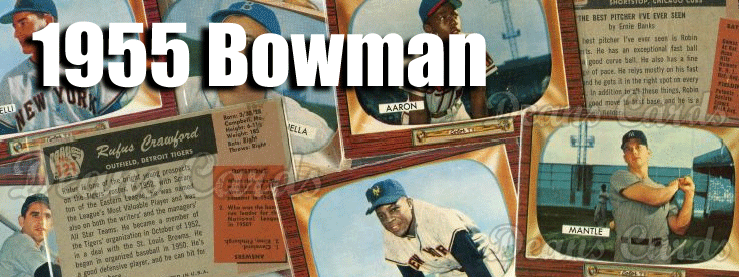
Collectors of vintage cards know the 1955 Bowman baseball cards as the “T.V. Set”. The set itself consists of 320 cards, with the high number series (cards #225 - #320) as the most expensive.

The wood grain border being the distinctive mark of this set hides corner wear better than one would expect. Cards #1 to #64 feature a lighter blond-colored wood border and cards from #65 -#320 feature a darker-colored wood border. Inside the card’s border, the player's color photo is shown on the TV’s “screen”.

Set Features

The 1955 Bowman baseball cards were sold in one card penny packs or a six card pack that cost a nickel. Both, of course, included a stick of Blony bubble gum. The cards size remained at the standard 3 3/4" by 2 1/2" dimension Bowman had adopted in 1953. In comparison to Topps cards, Bowman’s cards are slightly thinner.

By 1955, Bowman had signed more players to exclusive contracts than Topps, yet Bowman still had to scrape the bottom of the barrel to find enough images for 320 cards. The set contains cards for players who had very short, unremarkable careers, such as managers, coaches and even umpires. Many of the players would never have another card printed.

All of the player pictures were taken in Shibe Park in Philadelphia, the home of the Bowman Gum Company. Many of the player photos feature Shibe Park’s characteristic green wall in the background.

Card Backs

For one of the few times in a vintage card set, the backs of the 1955 Bowman cards are not standard. Many cards have the standard career highlights but some quote the featured player. "The Best Hitter I've Ever Seen," "My Favorite Baseball Story," "My Childhood Hero," "My Biggest Thrill in Baseball" and "My Advice to Youngsters".

Although I am all for creative and innovative ideas, not having the statistics on every player’s card is a bad one, witnessed by the fact that the idea was never repeated. Part of the fun of collecting cards is to flip it over and look at a player’s statistics.


Another problem is that most of the stories are fairly routine and somewhat boring, even to a baseball historian, like myself. The player’s advice usually is along the lines of "practice hard and be good", which are still popular clichés used by today’s players. I guess it is unreasonable to expect advice on how to sneak out past curfew, which player they considered the biggest jerk or most over-rated, or what they really thought of their manager. Now that would have made for a great set of cards!

The stories often refer to a memorable event like the player’s first game or home run. One of the funniest stories is told by Virgil Trucks:

"It was my first year in the big leagues. I was pitching against the Boston Red Sox. The first hitter was Bobby Doerr. He doubled on the first pitch. The next hitter did the same, and the next one tripled, again on the first pitch. Ted Williams came to the plate. He hit the first pitch too, for a home run. Manager Del Baker came to the mound and asked Bob Swift, my catcher, 'Doesn't Virgil have it today?' Swift answered, 'How do I know? I haven't caught one yet!'"

The most unique story has to be that of Eddie Waitkus (#4), whose "greatest thrill" begins: "In 1949, I was shot by a deranged girl." I imagine that Waitkus's story, which was the basis for the movie "The Natural," confounded more than a few of the boy collectors of the day.

 In my opinion, the most interesting information contained on the 1955 Bowman card backs is finding who the players considered the toughest hitter or pitcher in the game. While there was no clear consensus as to who was considered the toughest pitcher to face in either league, Warren Spahn and Bob Feller were mentioned the most often.

The pitchers of the day were much more unified on whom they did not wish to see standing in the batter’s box holding a piece of lumber. Almost every pitcher named either Stan Musial or Ted Williams as the best hitter in his respective league. It is not a credit to the 1955 Bowman set that neither player has a card in the set for this year.

 Rookie Cards

One of the major negatives voiced about the Bowman sets issued during the Bubble Gum Card War is the lack of outstanding rookie cards, as compared to Topps. On the surface, the 1955 Bowman set seems to also be afflicted, especially with the 1955 Topps set featuring future Hall-of-Famers such as: Roberto Clemente, Harmon Killebrew and Sandy Koufax. While it is true that all of these players had outstanding careers, they took a while to become great and none played in the All-Star Game until 1959.

The two biggest rookie cards in the set are #68 Elston Howard and #296 Elroy Bill Virdon, both of whom had good years in 1955.

The Men in Black

The umpire cards are the most difficult cards in the set to find. Not only were they issued in fewer numbers, as part of the high-number series, the umpires were understandably ignored by the kids who purchased baseball cards. Part of what makes the umpire cards so difficult to find is that they were often thrown away by kids looking for their baseball heroes. The umpire cards feature short biographies and included facts such as the national heritage of the umpires as well as personal hobbies, family and professional sports, or umpiring experience.

Curiously, the Bowman Company put the umpires in the last series, which historically competed with the football card sets that were being released at the same time. Kids who had already bought the previous two series full of players and had no interest in the coach and umpire-heavy last series. Topps was busy releasing the 1955 Topps All-American football card set and Bowman was releasing their 1955 football card set, so most kids spent their nickels on those sets instead.

The 1955 Bowman umpire cards represent a fun challenge to collectors and another example of baseball cards that went from unpopular to considerably valuable. Although baseball cards have had many innovations over the years, issuing umpires in the set has never been attempted again.

Aftermath 

As much as I like the unique design of the 1955 Bowman baseball card set, it still falls a bit short when compared to the Topps issue for that same year. Although color televisions were a very big deal at the time, the concept did not translate that well to baseball cards.

The biggest flaw, with the front of the 1955 Bowman cards, is the same one that Bowman had the previous year. There is too much wasted canvas space. Most of the pictures of the players are standing upright, resulting in small pictures and a lot of empty background. The design of the 1955 Topps set did a much better job of filling the canvas and creating a more attractive product.

 Despite Bowman’s advantage in exclusive player contracts and Bowman’s many innovations on the design of the cards, Topps again produced a more attractive baseball card. For the fourth straight year, the kids choose the Topps product over the cards issued by Bowman and that is where they spent their money.

Although few realized it in 1955, the TV set would be the last baseball card set for the floundering Bowman Gum Company. The 1955 Bowman Baseball card set has since become a hobby classic with its unique design and charming quirks.

This article is taken from Dean’s book “The Gum Card War and the Great Bowman & Topps Baseball Card Sets of 1948-1955”, which is now available for sale at Amazon.com. 

Dean Hanley is an authority on vintage sports cards and has written numerous articles on the topic. Mr. Hanley is the founder DeansCards.com, and with well-over one million vintage cards in inventory, DeansCards.com is the largest seller of vintage cards on the web. Dean has also published “Before there was Bubble Gum: Our Favorite Pre-World War I Baseball Cards”, which is also available in eBook form at Amazon.com and has just released a T207 reprint set. For more information, please visit www.DeansCards.com 

 If you are looking to sell your cards we would be happy to hear from you. Please fill out our sell your collection form here and we will be in touch.