The
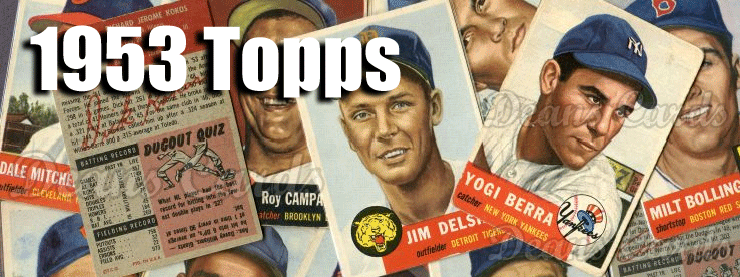
1953 Topps baseball card set is considered the most personal set of the 1950s. Everything, from the hand drawn sketches on the front, to the signature, biographical paragraph and thorough statistics on the back, demonstrates that Topps had hit their stride with the
1952 set and now was ready to push the envelope with the
1953 set. While these cards do not have the notoriety of their predecessor, they have their own special place in sports card history.
With the exciting success of the
1952 Topps set, Sy Berger and Topps wanted to refine what they had already done so well in 1952. Instead of colorizing black and white photographs as they did for the
1952 set, Topps went to the expense of paying artist Gerry Dvorak $25 per card to sketch and paint the players. Although the
1953 Topps baseball card set contains some attractive action shots, the set is primarily noted for its carefully drawn expressions, which are chronicled on the head shot cards.
The major drawback of the
1952 Topps set was that many of the players depicted in it inaccurately look very similar, particularly in terms of hair and skin color. The
1953 Topps set rectifies this flaw, especially on the head shots.The color paintings of the player’s faces have warm, relaxed and friendly expressions and completely dominate the large cards. The 1953 Topps cards showcase more “flesh” than any other set ever made.
In order to fully appreciate the beauty of the
1953 Topps baseball card set, one should take a complete set and go through it card-by-card. The players’ faces are so large and life-like, that the cards give the impression of standing right in front of the players at the ballpark. Rarely, even today, can we see so much detail in players’ faces.
The 1953 Topps Archive (or reprint) set, with its wider white borders, smaller card-size, and shiny gloss, does not offer the same experience as one gets looking at an original
1953 Topps set.

A perfect example of a detailed head shot is card
#220, Satchel Paige. The Topps artist captures the forty-seven year old Negro League star perfectly. He looks like the wise, well-travelled pitcher that was playing for the St. Louis Browns in 1953. The only imperfection with the card however is that Topps misspelled his first name as “Satchell”, by adding an extra “L,” making it the only real error card in the set.
Although the
1952 Topps cards did have stadium settings and natural backgrounds, there was little emphasis on making the background look as good as the players. However, that was not the case in 1953. When making this set, the Topps artists paid close attention to every detail on the cards, including the backgrounds. When looking at the
1953 set, you will see that many cards feature fully occupied stadiums with the colorful advertisements on the outfield walls behind the player.
 The 1953 Topps
 set also features a number of innovations on the card backs, starting with the vertical orientation. The banner on the top with the card number, the player’s name, height and weight were similar to the 1952 cards; however this time they were enlarged to make them easier to read. The biographical paragraph was updated and features a facsimile signature over the black text in red ink. Topps kept its statistical information consistent with the previous year’s table but also included a “Dugout Quiz” on the back of each card.
Fewer cards than in 1952
Due to the court ruling, the
1953 Topps Baseball Card Set significantly decreased in size, down to only 280 cards, from the previous year’s 407 cards. The 1953 Topps set was issued in four series: cards #1-85, #86-165, #166-220, and #221-280.
The competition for player contracts between Bowman and Topps would create a unique problem for Topps in 1953. Topps would begin to print a series of the set and then find out that they had failed to secure the contractual rights for a player whose card was about to be printed. There was no sense in wasting a valuable spot on the printing sheet, so Topps would either promote a player from the next series or “double print” one of the current cards in the series.
None of the series were actually fully completed, as five cards each from the first and second series were "bumped" back to later series. This action created what is known in the hobby today as chase cards. With no printed checklist available, set collectors of the day probably went crazy looking for the missing cards, only to have them appear in a wax pack of the next series of cards.
The five cards skipped in the 1953 first series were:
#10 Smokey Burgess,
#44 Ellis Kinder, #61 Early Wynn, #72 Fred Hutchinson and
#81 Joe Black. The skipped cards of series two included: #94 William Kennedy, #107 Danny O’Connell,
#131 Harry Byrd, and
#156 Jim Rivera.
This makeshift practice continued up until the fourth and final series of the set, when Topps finally ran out of players under contract and was forced to leave a total of six holes in the set. Cards numbered 253, 261, 267, 268, 271, and 275 were never printed. These spaces in the printing sheet were again filled with plates of current cards in the series, thus adding even more “double printed” cards to the set. There were no checklists available in 1953. Set collectors had no idea that these cards were not forthcoming and most likely bought a couple dozen extra packs of cards before giving up on finding the six missing cards.

The fourth and last series in the
1953 Topps set was also distributed late, making those cards several times more expensive than the earlier series. Card
#244, Willie Mays, is in the fourth series and unfortunately for collectors was not “double printed”. Therefore Willie Mays proves to be the most difficult card to find in the
1953 Topps set.
Double-Print confusion
There were three “double printed” cards in the last series of the
1952 Topps sets and they made perfect sense. In all my life, I have never heard a collector complain about Topps printing too many
Mickey Mantle,
Jackie Robinson or
Bobby Thomson cards in its 1952 set. While Thomson is not as popular today, in 1951 he hit the shot heard ‘round the world and was a hot property in 1952.
The major flaw of the
1953 Topps cards were the underwhelming “bush-leaguers,” who were printed in greater quantities and have a higher population of 1953 Topps cards. So unlike the 1952 double printed cards of stars, the cards chosen to be double printed in 1953 did not make logical sense in terms of the player’s popularity.
There were a few exceptions to this however. The few Hall-of-Fame player’s cards that were randomly double-printed in 1953 were
#37 Eddie Mathews,
#54 Bob Feller and
#77 Johnny Mize. But most of the “DP’s” are of very forgettable players; starting at the beginning of the set.

We’re overwhelmed with the likes of double-printed no-names such as
#7 Bob Borkowski, #8 Clem Koshorek, #12 Howie Judson, and
#13 Connie Marrero. Next we get the likes of #15 the “awesome”
Bobo Newsom, #16 the “immortal” Harry Lowery and #18 the “unforgettable” Ted Lepico. A cool exception to this of no name DP’s is #1 card in the set - the great
Jackie Robinson.
I could continue on for several more paragraphs with more examples of players such as these, but it seems a crime to waste the ink. As a card collector and dealer, it’s very frustrating to have the DeansCards.com inventory bloated with cards of these types of players, as I’m sure the kids felt the same way back in the day.
Knowledge Quiz: Just for fun, out of those last seven cards, Borkowski to Lepico, how many of these guys could you match to the team that they played for in 1953 without looking at their cards? If you could correctly name four or more teams, you’re “good”. If you can name six teams correctly, then you’re a vintage baseball card expert.
Knowing the care and attention that Sy Berger typically gave to these early sets, it makes me think that the double-printed cards were randomly chosen by the printer, who likely knew little to nothing about baseball. As a set builder, I consider these random “double prints” a missed opportunity for the
1953 Topps set. Just think of how collectible (and affordable) the 1953 Topps baseball card would be today, if the 40 double-printed cards were strategically selected and used on the stars of the set like:
#76 Pee Wee Reese,
#82 Mickey Mantle,
#104 Yogi Berra,
#114 Phil Rizzuto,
#147 Warren Spahn,
#220 Satchel Paige, and
#244 Willie Mays.
Demand Scarcity - A cold case discovery
The 1953 Topps set is a challenge for set builders
Despite all the “double-printed” cards, the 1953 Topps baseball card set still ranks “moderately difficult” to build and complete. I rank the
1953 Topps set as the third-hardest Topps set of the 1950’s to build in low to mid-grade conditions, behind only the
1952 and 1957 sets. Building the 1953 set in “Excellent” condition or better is a real challenge and will require quite a bit of time and money. As the condition of the set increases, the difficulty level to complete the set increases exponentially. My dad’s comment on this set is that the cardboard did not wear well, and was inferior to other years.
The condition of most existing vintage complete sets will vary greatly. Many vintage sets were built decades ago when condition was not a major consideration. Some early post-war sets will have cards in it that vary in condition from “Near Mint/Mint” all the way down to “Poor.” In my opinion, having this wide of a range detracts from the eye appeal of the set. A set looks much nicer when all of the cards are as close as possible to being consistent in grade. While a card in “Near Mint” condition may add to the cost of the set, it also brings out the flaws of the mid-grade cards, detracting from the sets overall appeal and value.
Dean’s Cards builds and sells hundreds of vintage sets each year. When Dean’s Cards builds vintage sets, we try to build three to five at a time. We break down several existing sets and then assimilate the cards of like conditions. Our million card inventory allows us to supplement the sets with needed cards if necessary.
DeansCards.com tries to maintain a constant inventory of at least one set of each grade, for every year from 1953 to present. For sets from
1952 and older, it’s often not possible. For these years, we build sets upon request.
When Dean’s Cards grades a post 1954 set “Excellent,” we are usually able to have at least 90% of the cards exactly meet that particular grade and the other 10% of the cards grading no higher or lower than one grade off. It’s not unusual for DeansCards.com to have 10,000 to 20,000 cards listed online for just one Topps year. Of course, this standard is much tougher to implement for pre-1954 sets simply because we do not have as many cards from those years.
Jackie, Mickey and Willie
Another challenge to building a
1953 Topps set is that the value is so heavily influenced by three high-dollar star cards:
#1 Jackie Robinson,
#82 Mickey Mantle and
#244 Willie Mays.The 1953 Topps “big three” represent about half of the set’s total value. The first card, Robinson is condition sensitive, Mays is a “high-number” and Mickey Mantle is a baseball card god whose cards are always in high demand.
Finding the
1953 Topps “big three” in the same particular condition, at the same time and at a fair price, is usually a challenge. Once accomplished, you then have to locate the scarce high number cards.
Condition Scarcity
The 1953 Topps cards also have a red partial border on the bottom of the cards for the American League players and a black border on the bottom of the cards for National League players. These borders have been known to chip much easier than cards with white borders. This is another reason that it’s hard to find 1953 Topps cards in better conditions.
 |
| American League |

A survey of the DeansCards.com inventory confirms the condition scarcity of the
1953 Topps set. Of the 1689 cards from the 1953 Topps set that we have in stock, we have only one card that grades higher than Excellent/Mint! The DeansCards.com inventory has 41 Ex/Mt cards (2%), 237 in EX (14%), 826 cards in VG (49%), 562 cards in Good (33%), and 11 cards in Fair or Poor condition. This means 83% of the 1953 Topps card population grade “Very Good” condition. No other post-war set suffers from this degree of condition scarcity. This is why putting together a
1953 Topps set in pristine condition is a costly challenge for hobbyists.
Missing a few stars

Although stars like
Willie Mays and
Mickey Mantle were featured in the 1953 Topps set, Topps was still missing quite a few stars that had also been omitted from their 1952 set.
Ted Williams and
Stan Musial were noticeably absent from the
1953 Topps set. Williams would give into Topps the next year, an especially satisfying victory for Berger, who is a lifelong Red Sox fan. Musial, on the other hand, would not sign a contract with Topps until 1958
 The 1953 Topps Archives
 set was issued in 1991. Topps again omitted the numbers that were left out of the original set; however, this time they were legally able to include cards of Hall-of-Famers’
Hank Aaron, Richie Ashburn,
Larry Doby,
Leo Durocher,
Gil Hodges, Bob Lemon,
Robin Roberts,
Duke Snider,
Casey Stengel, and
Ted Williams.
The 1953 Topps rookie card of an over-looked closer
The one thing that keeps the
1953 Topps set semi-affordable is that it was the only Topps set produced before 1970 to not contain a rookie card of a future Hall-of-Fame player. However, this may someday change if the Veterans Committee ever decides to recognize Elroy Face. Along with Hoyt Wilhelm in the American League, Face was a true pioneer of closing out baseball games.
Starting in 1955, Face would be the premier National League relief pitcher for the next 14 years. Back when relievers were hardly ever invited to All-Star games, Face was selected to three consecutive All-Star games. Roy Face literally forced an invitation to the mid-summer classic in 1959. Please consider his first-half stats: Face appeared in 32 games, finishing 29 of them. He pitched 56 innings. His record at the all-star break was 12-0, with 9 saves (this was before anyone knew what a save was) and a 1.13 ERA. Face did cool off a bit, but finished 1959 with an 18-1 record (all in relief) to give him a win/loss percentage of .947, a single season record that has yet to be broken.
A short side trip

Looking at Face’s 1959 stats made me wonder, “How is an 18-1 win/loss record for a relief pitcher even possible?” After some research, I concluded that five things were needed: 1) several below average starting pitchers, 2) a great closer who can pitch multiple innings, 3) a couple of good starting pitchers who can throw complete games and not force the manager to burn up his closer to save too many games, 4) a mediocre hitting team that would not blow out their opponents, but could manufacturer a game-winning run when needed and 5) lots of luck.
If the team’s hitting is too good, the closer would only be in position to save games. If the hitting is too bad, the team would never score the winning run. In 1959, the Pirates and little Elroy Face were the perfect combination.
The Pirate starting pitcher would often allow a few runs and be lifted for a pinch-hitter in the 7th or 8th inning. Face would then enter the game tied or a couple runs down, putting him in a position to win it. In 1959, Face’s “fork ball” was extra nasty and he would keep throwing it for as many as five innings, if necessary - until the Pirates finally scored a run. Because few modern closers pitch more than one inning per game, this is going to be a tough record to surpass.
Aftermath
The 1953 Topps Baseball Card set was certain proof that Topps knew how to manufacture innovative and high-quality sports cards. Bowman had gone to great expense to produce their 1953 “Pure Color” Bowman Baseball Card Set in an effort to win back the market share that they lost to Topps in 1952. Not only had Topps survived the Bowman counter-attack, Topps once again sold more cards in 1953. The Topps Gum Company had proven that they were in the baseball card market to stay.
This article is taken from Dean’s book “The Gum Card War and the Great Bowman & Topps Baseball Card Sets of 1948-1955”, which is now available for sale at Amazon.com.
Dean Hanley is an authority on vintage sports cards and has written numerous articles on the topic. Mr. Hanley is the founder DeansCards.com, and with well-over one million vintage cards in inventory, DeansCards.com is the largest seller of vintage cards on the web. Dean has also published “Before there was Bubble Gum: Our Favorite Pre-World War I Baseball Cards”, which is also available in eBook form at Amazon.com and has just released a T207 reprint set. For more information, please visit www.DeansCards.com
If you are looking to sell your cards we would be happy to hear from you. Please fill out our sell your collection form here and we will be in touch.


 The good news for Bowman was that their revenues from baseball cards rebounded in 1954 to $602,000, which was exactly double the sales of 1953, but far less than their 1951 sales revenues, back in the days before Topps was a serious competitor. Bowman had also reduced production costs in 1954 by issuing a more cost effective set of cards.