Showing posts with label Ted Williams. Show all posts

Tuesday, October 2, 2012

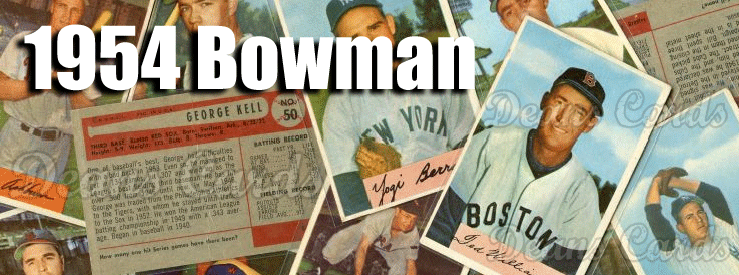
1954 Bowman: A star-packed variation


by +Dean Hanley
The 1954 Bowman baseball card set has 224 total cards that are printed in two series: #1-128 and #129-224. Both series were printed in roughly the same numbers. Bowman employed some creativity in its numbering of the set. There is a sixteen card rotation, meaning that one team, in this case, the Yankees, would have card numbers 1, 17, 33, 49, etc, while the second team, the Red Sox, would have 2, 18, 34, 50, etc. This team rotation arrangement is not seen in any other vintage set.

Variations Galore

While nearly every baseball card set has a few variations, due to misprints and small errors the 1954 Bowman issue easily sets the record for post-war vintage sets. As for the printing mistakes in the 1954 Bowman baseball card set, a surprising 40 out of 224 total cards have some sort of variation.

The most prominent and valuable variation is the #66 Ted Williams card. Williams had been flying jets in Korea and returned to baseball for the 1954 season. Once home, Williams signed an exclusive contract with Topps. The Bowman Company, which had rushed to get its set out before Topps, had to withdraw the Williams card and replace it with Jimmy Piersall, who was already featured on card #210. Due to the extreme rarity and high cost of the #66 Williams card, the standard 1954 Bowman set is considered complete without the Williams card, when it contains both the #66 and #210 Jimmy Piersall cards.

Bowman’s hurry to get its set released before Topps resulted in many other variations in addition to the Williams/Piersall variation on card #66. Variation cards have differences in statistics, birthplaces, trades and even answers to the quiz questions on the back.

One example is the #12 Roy McMillan card. The first card that Bowman released for McMillan has the following stat line: 551 season ABs, 1290 lifetime ABs. The correct stat line should read 557 season ABs, 1290 lifetime ABs. Although this seems like a minute difference to the casual observer, Bowman had to correct similar mistakes 40 different times throughout the set.

Lots of established stars, but few star rookies


With Don Larsen being the only well-known rookie card in the set, Bowman clearly lost the annual battle of “set with the best rookie cards” to Topps. Although rookie cards are much more valued by today’s collectors, the 1954 Topps set featured Hall-of-Famers: Ernie Banks, Hank Aaron, Al Kaline, and Tommy Lasorda. It should be noted, that Lasorda made his name as a manager and added little star power to the Topps set in 1954.

Despite its lack of rookies, Bowman did a superior job of getting commitments of the baseball’s best players to appear on their cards. There were eleven Hall of Fame players that were exclusively in the Bowman set in 1954: Roy Campanella, Bob Feller, Nellie Fox, George Kell, Ralph Kiner, Bob Lemon, Mickey Mantle, Pee Wee Reese, Robin Roberts, Red Schoendiest and Enos Slaughter. Comparatively, the 1954 Topps set only had 3 veteran players signed to exclusive contracts (not counting the rookies) that were eventually elected to the Hall of Fame: Ted Williams, Warren Spahn, and Jackie Robinson.

The loss of Ted Williams in 1954 was a shock to Bowman, despite clearly getting a larger number of the games’ stars to sign exclusive contracts. Some other stars that went exclusively with Bowman in 1954 were: Bobby Avila, Gus Bell, Lew Burdette, Sal Maglie, Smokey Burgess, Billy Cox, Al Dark, Del Ennis, Carl Erskine, Dee Fondy, Carl Furillo, Whitey Lockman, Gil McDonald, Jimmy Piersall, Minnie Minoso, Eddie Yost, Jerry Coleman and Billy Pierce.

One big star was still missing from both the 1954 Topps and Bowman sets. In a declaration reminiscent of Honus Wagner, Stan Musial did not want his picture on a card. He continued to hold out for another four years before finally appearing in the 1958 Topps set.

Completely New Card Design 

The Bowman Gum Co. was still reeling from the loss of market share that they suffered in 1952 and again in 1953. In both 1953 and 1954, Topps took the previous year’s card design and added features to make it even better. Unfortunately, Bowman did not have that luxury in 1954, as the color photography used in 1953 proved to be way too expensive to expand upon.

The 1954 Bowman baseball cards demonstrated a clear attempt to scale back the production costs that derailed the 1953 Bowman in mid-issue. For this set, Bowman again used the painted portrait for the player’s image except chose to put it on the larger-sized card. Bowman tried to emulate the “pure color” concept that they employed on the 1953 Bowman cards, but without the beautiful color photography the technique fell short. As a result, the 1954 Bowman baseball card design was very plain when compared to the exciting design of the Topps issue. The 1954 Bowman card also has a colored box at the bottom of the card that contained a facsimile of the player’s autograph.

The main problem with the portraits on the 1954 Bowman cards is that they make poor use of the entire canvas of the card. The pictures of the player’s faces seem too small and do not pop off the card, especially compared to the 1955 Topps cards. The smaller sized portrait leaves too much “dead” space on the card. Also, whereas the backgrounds on the 1953 Bowman baseball cards catch the viewer’s eye and add to the charm and beauty of the set. The blurry, painted backgrounds on the 1954 Bowman cards have the opposite effect. They completely fail to catch one’s eye or interest. By simply increasing the size of the player’s portrait, the Bowman cards would have been much more appealing.

The back of the 1954 Bowman baseball cards are even more disappointing than the card fronts. The only new features added to the cards were trivia questions, but most of the questions and answers are not interesting enough to bother reading. Although the card backs contain player information and statistics, they fall far short of the exciting card backs of the 1954 Topps set. The grey cardboard that the 1954 Bowman cards were printed on (probably another effort to cut production costs), made the very plain card backs look even darker and less attractive.

Summary

The 1954 Bowman baseball card set was issued at the pinnacle of the Bubble Gum War and was a good representation of the strategies employed by both combatants. Bowman dedicated more effort (and money) to securing the images of the marquee players of the day to place on their cards, while Topps did a better job of signing the young exciting rookies to exclusive contracts. Players such as: Aaron, Banks, Kaline and Kuehn. Topps also focused on designing and producing a more attractive baseball card that had far less printing errors.

Bowman was clearly winning the battle to get the most stars of the game onto their cards, but it is a shame that Bowman did not design a better product on which to display the images of these marquee players. This missed opportunity resulted in yet another second place finish; in both popularity and sales for the Bowman Baseball Card Set in 1954. The clock was ticking for Bowman, both in time and in money, and they were beginning to run both short.


This article is taken from Dean’s  book “The Gum Card War and the Great Bowman & Topps Baseball Card Sets of 1948-1955”, which is now available for sale at Amazon.com. 

Dean Hanley is an authority on vintage sports cards and has written numerous articles on the topic. Mr. Hanley is the founder DeansCards.com, and with well-over one million vintage cards in inventory, DeansCards.com is the largest seller of vintage cards on the web. Dean has also published “Before there was Bubble Gum: Our Favorite Pre-World War I Baseball Cards”, which is also available in eBook form at Amazon.com and has just released a T207 reprint set. For more information, please visit www.DeansCards.com 

 If you are looking to sell your cards we would be happy to hear from you. Please fill out our sell your collection form here and we will be in touch.

Tuesday, August 21, 2012

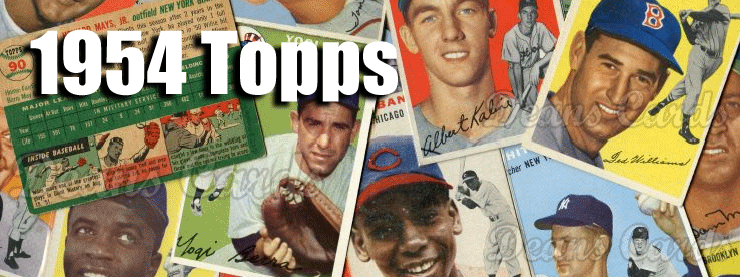
1954 Topps – Topps Gets Busy


This article was written by Dean Hanley and was published in the July 3, 2012 issue of Sports Collectors Digest.

While Bowman was still reeling from its expensive 1953 color venture, Topps was enjoying its newly discovered success in the competitive world of bubble gum baseball cards. Sy Berger refused to lose the initiative and was determined to further improve the Topps product offering.

While Sy Berger had contracted for artists to hand-draw the 1953 cards, he wanted a new and cutting edge design for the 1954 issue. He would borrow from the 1952 set and again use colorized photographs, although this time Berger wanted to include a black-and-white action shot that would lie across part of the colorized portrait. This concept proved to be a tough sell to both Topps executives and artist Woody Gelman, who all initially disliked the concept. Berger, who was never one to be easily discouraged, kept persisting and finally got his way. The result was the most attractive baseball card produced to date.

Years later, Sy Berger recalled, “I had advocated action photography for three or four years. They wouldn’t hear of it, and I had two big file cabinets full of action pictures. They did a survey and found out that the kids wanted action pictures. They came to me in December and said, ‘Where are we going to get color action pictures?’ – and I had them.”

Each of the 1954 Topps cards features a large color image of the player’s upper torso, which shares the remaining space with a smaller full-body black-and-white photo of the player in an action pose. Each card contains a large team logo at the top of the card and a facsimile autograph at the bottom of the card. Located next to the team logo at the top of the card is the player’s name, position, and team name. A bright, colorful background that extended all the way to the card’s top edge sets the design and makes the player’s image appear to jump off the card. The backs of the 1954 Topps cards are just as busy. Printed on the back is personal information, history, statistics and a colorful, eye-catching cartoon about the player.

The 1954 Topps baseball card set includes 250 vintage size cards, each measuring 3⅝” by 3¾”. The year is unique in that it’s a mixture of aging stars from the pre-war era of baseball as well as rookies that would be destined for the Hall-of-Fame. Topps had once again manufactured an exceptional set that would stand out amongst the Gum Cards War chaos of the 1950s.

A Great Rookie Card Class 


The 1954 Topps cards captured the new burst of talent that was beginning to transform the game of baseball. In 1954, Topps (or should we say Sy Berger) was insightful enough to secure the rights to print all the rookie cards of three bright and exciting players who would be perennial All-Stars for the next two decades and eventually be enshrined into the Baseball Hall of Fame. These were: #94 Ernie Banks, #128 Hank Aaron, and #201 Al Kaline.


The 1954 Topps set also contains the rookie cards of #25 Harvey Kuenn – A.L. Rookie of the Year and #132 Tommy Lasorda – who would be enshrined as a manager. This impressive list of baseball giants would prove to have a great impact on the sport for years to come and Banks, Aaron, Kaline and Kuenn would go on to play in a combined total of 63 All-Star games! The 1954 Topps set also features the exclusive cards of Hall of Famers Jackie Robinson and Warren Spahn.

 “Teddy Ballgame” comes home from war

Topps and Bowman were still competing for the baseball card market as well as the player rights to produce the cards. By 1954, Bowman was pulling ahead in the number of players it had signed to exclusive contracts. Sy Berger, a Red Sox fan, had been desperate to sign Ted Williams, who was exclusive with Bowman.

Berger’s coup of 1954 was signing Williams to a five year contract. For the first time, Topps offered a player (Williams) more money than the standard contract in order to get him to appear on a Topps baseball card.

To help justify this cost, Topps featured Williams on both the first and last card in the set (#1 and #250). Bowman also printed a card of Williams without realizing that he had signed an exclusive contract with Topps. Bowman was forced to stop production of the #66 Ted Williams card, thus making it the most scarce and valuable card in the 1954 Bowman set.


Trying to make Chicken Salad without much Chicken

There are 60 cards featuring rookies in the relatively small 1954 Topps Baseball Card Set. Although the set had only 250 cards, Topps once again struggled to fill out the set due to contractual obligations of many of the players. To reach this number of cards, Topps printed cards of 25 coaches and managers. Many of the players and managers featured in the 1954 set would never have another card printed.

 Other characteristics

Instead of an expensive high numbered series, the second series of the 1954 Topps set (#51 - 75) is considered more expensive to collect. Despite a lack of stars featured in this series. The first series (#1-50) has been printed as a gray-backed version that may have been released in Canada. Topps also printed its first multi-player card, which featured twin brothers #139 Ed and John O’Brien.

What frustrates collectors, both in 1954 and today, is that the back of the cards are not oriented in a consistent manner. The 1954 Topps cards do not have a white border on the top of the card, which adds to the card’s beauty. In order to achieve this “bleed” feature the tops of the cards were lined-up against the tops of the cards of the next row on the printing sheet– so that half of the cards would be upside down on the sheet. This is the same technique that Topps used for its 1953 set. However, in 1954, the printer must have forgotten to orient the card backs in the same manner. Therefore, when the front of the cards are stacked to face the same way, half of the card backs have the card oriented to the left and half have the back oriented to the right. When the 1954 Topps cards are sorted in a box, one-half of the cards have the number at the tops of the card and one-half have it at the bottom. Fortunately, Topps never repeated this mistake.

Summary

The 1954 set would stand out from the previous three Topps sets for several other reasons as well. Unlike the 1952 and 1953 sets, there were no short printed cards, making the 1954 Topps set much easier to collect. For the first time, Topps used dual images on their card fronts. The black and white action shots that were superimposed next to the color head shots demonstrated just how innovative Topps was at the time. These dual images would appear on many Topps cards in the years to come. Although their lack of exclusive player contracts put Topps at a disadvantage when compared to Bowman, Topps certainly made up for it with their brightly-colored 1954 set.

 In 1954, there was little doubt that Topps had the most attractive baseball card. Naturally, collectors responded. DeansCards.com sells about five 1954 Topps cards for every three 1954 Bowman cards. I assume that the ratio was about the same with collectors in 1954, as both companies were very cost-conscious and did not want to waste money to print cards that would not sell.1954 was the third consecutive year that Topps outsold Bowman in the baseball card market.


This article is taken from Dean’s book “The Gum Card War and the Great Bowman & Topps Baseball Card Sets of 1948-1955”, which is now available for sale at Amazon.com.

Dean Hanley is an authority on vintage sports cards and has written numerous articles on the topic. Mr. Hanley is the founder DeansCards.com, and with well-over one million vintage cards in inventory, DeansCards.com is the largest seller of vintage cards on the web. Dean has also published Before there was Bubble Gum: Our Favorite Pre-World War I Baseball Cards”, which is also available in eBook form at Amazon.com and has just released a T207 reprint set. For more information, please visit www.DeansCards.com 


If you are looking to sell your cards we would be happy to hear from you. Please fill out our sell your collection form here and we will be in touch.

Tuesday, July 24, 2012

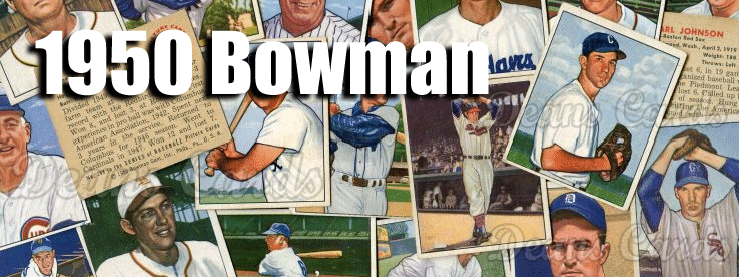
1950 Bowman: Full Color


 The evolution of the baseball card continued in 1950 as the annual edition of the Bowman baseball card set continued to improve in picture quality and set size. Bowman employed artists to produce hand-painted color reproductions of actual black and white photographs.


While the 1950 Bowman cards are still small in size, the size of the set is not. Bowman increased the number of cards in the set to 252. This set was issued in a total of seven series and was again printed on the thirty-six card sheets. Unlike most vintage sets of cards, the first two series (1-72) of the 1950 Bowman is actually the most expensive. This indicates that Bowman underestimated how popular the full-color set was going to be and increased the number of cards printed in later series. The final series (#180-252) were printed with and without copyright lines. The cards from this series that do not contain the copyright labels are even scarcer.

 Unlike their two previous sets, the 1950 Bowman set does not predominately consist of rookie cards. Out of 252 cards, this set has only 66 rookies total, with the best ones being, Don Newcombe and Hank Bauer.


The 1950 Bowman baseball cards are the only Bowman cards to feature the famous five-star logo, which sits on the top right corner on of the card back. The card backs also includes the phrase "Bowman 5-Star Picture Card Collectors Club."

 The 1950 cards turned out to be the only year that the Bowman Gum Company would have a true monopoly on the baseball card hobby. Leaf included cards with their bubble gum in 1948 and 1949 and Topps issued their first card sets in 1951.

Today, the 1950 Bowman set is not as popular or even as widely collected as other Bowman baseball card sets from the early 1950's. The reasons for this are the cards were significantly smaller than those found in the later sets of the decade and also because that year’s rookie class was so weak.


While the 1950 Bowman set may not be as exciting as the other sets they would produce down the road. They’re several aspects that make it unique. Ted Williams had his first baseball card printed since before the war during that year. The Bowman Company also decided to include cards for non-playing managers for the first time. While this might seem like a relatively minor innovation, it was a trend that would catch on and continue to this day.


 This article is taken from Dean’s upcoming book “The Gum Card War and the Great Bowman & Topps Baseball Card Sets of 1948-1955”, which is scheduled to be released in August of this year in both print and eBook forms. Please feel free to contact Dean with any questions or comments at Dean@DeansCards.com 


Dean Hanley is an authority on vintage sports cards and has written numerous articles on the topic. Mr. Hanley is the founder DeansCards.com, and with well-over one million vintage cards in inventory, DeansCards.com is the largest seller of vintage cards on the web. Dean has also published “Before there was Bubble Gum: Our Favorite Pre-World War I Baseball Cards”, which is available in eBook form at Amazon.com

Friday, March 16, 2012

Fist Full of Stars Back From PSA

We just got back a nice batch of cards from PSA this week.  Mantle, Cobb, Mathewson, Aaron, Mays, Banks, Williams, Gehrig and some more Mantle.  None of the cards were super high grades or anything, just decent mid to low grade star cards from a recent collection we purchased.  The thing that always gets you though, is having 10 Mantles hit you at once.  All from the 50s, both Topps and Bowman.  The highest grade we received on any Mantle was a PSA 6 on a 1956 Topps. 


All Mantles aside, we had a handful of Hank Aarons, a Willie Mays, a Lou Gehrig, Ernie Banks, Christy Mathewson and one beat up Cobb.  The Cobb is a T206 with a Polar Bear back, and it looks like it was "loved" pretty hard over it's 100+ years on this earth, leaving us with it only being Authenticated.  The Gehrig card is pretty cool regardless of getting a PSA 1, simply because we don't see 1933 DeLong cards come through the door too often which makes it the only 1933 DeLong we currently have.

Well, we have a couple batches of cards still out with PSA and are adding higher level singles daily right now.  So keep checking back, you never know what we are going to get in.

Full List of Recent PSA Additions:
Mathewson, Christy - White Cap - T206 - PSA 2 Good (MK)
Cobb, Ty - Bat off Shoulder - T206 - PSA Authentic
# 92 Ted Williams - 1939 Play Ball - PSA 3 VG
# 7 Lou Gehrig - 1933 DeLong - PSA 1 Poor
# 253 Mickey Mantle - 1951 Bowman RK - PSA 2 Good
# 101 Mickey Mantle - 1952 Bowman - PSA 5 EX (MC)
# 101 Mickey Mantle - 1952 Bowman - PSA 3 VG
# 82 Mickey Mantle - 1953 Topps - PSA 2 Good
# 82 Mickey Mantle - 1953 Topps - PSA 3 VG
# 82 Mickey Mantle - 1953 Topps - PSA 4.5 VG-EX+
# 82 Mickey Mantle - 1953 Topps - PSA 5 EX
# 135 (Gray Back) Mickey Mantle - 1956 Topps - PSA 3 VG
# 135 (Gray Back) Mickey Mantle - 1956 Topps - PSA 4 VG-EX
# 135 (Gray Back) Mickey Mantle - 1956 Topps - PSA 6 EX-MT
# 244 Willie Mays - 1953 Topps - PSA 3 VG
# 128 Hank Aaron - 1954 Topps RK (3 of them) - PSA 2.5 Good+
# 94 Ernie Banks RC - 1954 Topps - PSA 4 VG-EX


Friday, February 17, 2012

Just Added: 1,200 1956 Topps Baseball Cards

In the past month we have added over 20,000 vintage cards to DeansCards.com.  About 1,200 of those added were 1956 Topps Baseball cards, including an EX/MT set break, at least one of every star card and hundreds more compiled from other collections we bought recently.


Before we added this lot of 1956 Topps Baseball, our inventory was sitting right around 2,000 cards.  With this addition that puts us up to about 1,366 unique singles, changing many of our cards from 0 quantity to 1.  This puts us at about 3,200 total quantity; a 60% increase to the selection of 1956 Topps Baseball Cards.

On a side note, we also recently made sure that our 1956 Topps cards were properly titled according to them being either a Gray Back or a White Back card to help the more detailed collector.  These 1956 Topps were just a small part of what we have been up to at DeansCards.com.  Make sure to check out our Recently Added Cards page to see all of our latest additions.

Highlights of our recent addition:

Complete Sets

Mickey Mantle

Jackie Robinson

Wednesday, December 7, 2011

WWII: The Boys go to War and baseball suffers.

 WWII
The following article was written by Dean and will be published in an upcoming issue of Sports Collectors Digest.


War World II changed almost every aspect of American life and the production of baseball cards was no exception. With America’s entrance into World War II and a national rationing program, which included paper and ink, supporting the war effort, these great Play Ball baseball card sets came to an unfortunate end.

In addition to paper and ink shortages, bubble gum production for domestic use virtually ceased. The reason was the war made it impossible to import the chicle and Siamese jelutong needed to make the gum. Gum, Inc. was forced to temporarily shut down.

As the supply for bubble gum ceased, the demand for it greatly increased. Bubble gum was included in military ration kits. Believed to reduce stress and tension, gum was effective in keeping tired soldiers awake.

Production of gum for domestic consumption stopped and savvy grocers who had accumulated a back stock of gum, marked it up to many times of its pre-war prices. Kids learned that if they put their gum glasses in water overnight, it would stay moist and could be re-used for several more days.

The boys go to war and baseball suffers 

In 1941, Joe DiMaggio hit safely in 56 consecutive games, Ted Williams batted .406, 41-year-old Lefty Grove got his 300th career win, and Dodgers' catcher Mickey Owen capped off an exciting season, by mishandling a pitch that cost Brooklyn the World Series. The popularity of baseball was at an all-time high in 1941, but that momentum would come to a halt with World War II.

By 1942, the players began enlisting in the armed services and going off to war. As a result, the popularity of the game of baseball greatly suffered. Major League teams were forced to fill out their line-up cards with “has-beens” and players who would have never made it to the major leagues under normal circumstances.

By 1944, the level of talent had become so depleted that journeymen like Nick Etten and Bill Nicholson won the home run titles of each league, with 22 and 33 HR’s respectively. That year, the lowly St. Louis Browns also won the only AL pennant in history of the team. The Browns even made a run at the pennant again in 1945, with a one-armed outfielder named Pete Grey in the starting line-up for much of the year, but eventually finished third. In 1945, Snuffy Strinweiss of the Yankees won the AL batting title with a .309 average.

Meanwhile, there were some great baseball games being played overseas. Most military units stationed in Europe and on bases in the Pacific, formed their own baseball teams. They were made up of major league players who were currently serving in those units to entertain the troops. By 1944, the soldiers on active duty and stationed far away, were seeing much better baseball games than the fans at home.

Once the “boys of war” returned home, the diamond stars of the “war years” saw their inflated numbers quickly drop and most disappeared back into civilian life.

Major-league attendance suffers During World War II, the number of people in the stands greatly diminished right along with the level of play on the field. The Brooklyn Dodgers led baseball with an attendance of 661,739 people for the 1943 season. In the seasons of 1943 and 1944, no team could reach the attendance milestone of one million fans.

No one had TV’s at this time and the large revenues that today’s clubs receive from television contracts were non-existent. Almost all of a baseball club’s revenue was created by putting fans in the stands. Once inside the park, the fans could also be sold food, drinks and team merchandise. By the end of the war, few baseball clubs were actually making money.

The boys return and baseball booms

To truly put these anemic attendance numbers into perspective, one must compare baseball attendance during the war to the number of fans in the stands after baseball’s stars had returned to the game. For the five seasons after the end of the WWII, ten of the sixteen major league teams drew over one million fans per season.

During the five-year period between 1946 and 1950, the “haves” and “have-not” of baseball clubs remained very consistent. The Yankees were the only team to draw at least two million fans every one of those years. Four of the six teams that drew less than a million fans each year, did not change. The Browns, A’s, Reds and White Sox never reached the one million attendance mark. Of these lowly teams, all but the Cincinnati Reds had a competing team (from the other league) located in the same city.

The Washington Senators topped one million attendance marks in 1946 for the only time in the club’s history. The Boston Braves just barely missed the one-million mark in 1946, but topped a million fans in 1947, 48 and 49. They barely missed the milestone again in 1950. The Pirates took the Braves spot in the “million plus” attendance club for the 1950 season. Of the six “have-not” teams of the late-1940’s, only three (Pirates, White Sox and my home-town Reds) still remain in their original cities today.

Post-War America and the Baby Boom

When World War II ended, and the soldiers returned home; they married their sweethearts and started families in unprecedented numbers. Thirty-two million babies were born in the United States during the 1940’s, eight million more than were born during the previous decade. The great American “Baby Boom” was under way.

The huge increase in the population of children was a boom for candy and bubble gum manufacturers. By the end of the decade, Americans were consuming 2.5 billion pieces of bubble gum each year, doubling the annual amount consumed before the war. With bubble gum booming in popularity, bubble gum manufacturers were consistently seeking new ways to creatively market their product.

The ink and paper that was rationed during the war, was now readily available. Combined, with the built-up demand for bubble gum and never before seen crowds at the ballparks, the stage was now set. The baseball card hobby was about to explode onto the American scene as never before.

This article is taken from Dean’s upcoming book “The Gum Card War and the Great Bowman & Topps Baseball Card Sets of 1948-1955”, which is scheduled to be released later this year in both print and eBook forms. Please feel free to contact Dean with any questions or comments at Dean@DeansCards.com

Dean Hanley is an authority on vintage sports cards and has written numerous articles on the topic. Mr. Hanley is the founder DeansCards.com, and with well-over one million vintage cards in inventory, DeansCards.com is the largest seller of vintage cards on the web. Dean has also published “Before there was Bubble Gum: Our Favorite Pre-World War I Baseball Cards”, which is available in eBook form at Amazon.com