Showing posts with label Ted Williams Baseball Cards. Show all posts

Wednesday, December 7, 2011

WWII: The Boys go to War and baseball suffers.

 WWII
The following article was written by Dean and will be published in an upcoming issue of Sports Collectors Digest.


War World II changed almost every aspect of American life and the production of baseball cards was no exception. With America’s entrance into World War II and a national rationing program, which included paper and ink, supporting the war effort, these great Play Ball baseball card sets came to an unfortunate end.

In addition to paper and ink shortages, bubble gum production for domestic use virtually ceased. The reason was the war made it impossible to import the chicle and Siamese jelutong needed to make the gum. Gum, Inc. was forced to temporarily shut down.

As the supply for bubble gum ceased, the demand for it greatly increased. Bubble gum was included in military ration kits. Believed to reduce stress and tension, gum was effective in keeping tired soldiers awake.

Production of gum for domestic consumption stopped and savvy grocers who had accumulated a back stock of gum, marked it up to many times of its pre-war prices. Kids learned that if they put their gum glasses in water overnight, it would stay moist and could be re-used for several more days.

The boys go to war and baseball suffers 

In 1941, Joe DiMaggio hit safely in 56 consecutive games, Ted Williams batted .406, 41-year-old Lefty Grove got his 300th career win, and Dodgers' catcher Mickey Owen capped off an exciting season, by mishandling a pitch that cost Brooklyn the World Series. The popularity of baseball was at an all-time high in 1941, but that momentum would come to a halt with World War II.

By 1942, the players began enlisting in the armed services and going off to war. As a result, the popularity of the game of baseball greatly suffered. Major League teams were forced to fill out their line-up cards with “has-beens” and players who would have never made it to the major leagues under normal circumstances.

By 1944, the level of talent had become so depleted that journeymen like Nick Etten and Bill Nicholson won the home run titles of each league, with 22 and 33 HR’s respectively. That year, the lowly St. Louis Browns also won the only AL pennant in history of the team. The Browns even made a run at the pennant again in 1945, with a one-armed outfielder named Pete Grey in the starting line-up for much of the year, but eventually finished third. In 1945, Snuffy Strinweiss of the Yankees won the AL batting title with a .309 average.

Meanwhile, there were some great baseball games being played overseas. Most military units stationed in Europe and on bases in the Pacific, formed their own baseball teams. They were made up of major league players who were currently serving in those units to entertain the troops. By 1944, the soldiers on active duty and stationed far away, were seeing much better baseball games than the fans at home.

Once the “boys of war” returned home, the diamond stars of the “war years” saw their inflated numbers quickly drop and most disappeared back into civilian life.

Major-league attendance suffers During World War II, the number of people in the stands greatly diminished right along with the level of play on the field. The Brooklyn Dodgers led baseball with an attendance of 661,739 people for the 1943 season. In the seasons of 1943 and 1944, no team could reach the attendance milestone of one million fans.

No one had TV’s at this time and the large revenues that today’s clubs receive from television contracts were non-existent. Almost all of a baseball club’s revenue was created by putting fans in the stands. Once inside the park, the fans could also be sold food, drinks and team merchandise. By the end of the war, few baseball clubs were actually making money.

The boys return and baseball booms

To truly put these anemic attendance numbers into perspective, one must compare baseball attendance during the war to the number of fans in the stands after baseball’s stars had returned to the game. For the five seasons after the end of the WWII, ten of the sixteen major league teams drew over one million fans per season.

During the five-year period between 1946 and 1950, the “haves” and “have-not” of baseball clubs remained very consistent. The Yankees were the only team to draw at least two million fans every one of those years. Four of the six teams that drew less than a million fans each year, did not change. The Browns, A’s, Reds and White Sox never reached the one million attendance mark. Of these lowly teams, all but the Cincinnati Reds had a competing team (from the other league) located in the same city.

The Washington Senators topped one million attendance marks in 1946 for the only time in the club’s history. The Boston Braves just barely missed the one-million mark in 1946, but topped a million fans in 1947, 48 and 49. They barely missed the milestone again in 1950. The Pirates took the Braves spot in the “million plus” attendance club for the 1950 season. Of the six “have-not” teams of the late-1940’s, only three (Pirates, White Sox and my home-town Reds) still remain in their original cities today.

Post-War America and the Baby Boom

When World War II ended, and the soldiers returned home; they married their sweethearts and started families in unprecedented numbers. Thirty-two million babies were born in the United States during the 1940’s, eight million more than were born during the previous decade. The great American “Baby Boom” was under way.

The huge increase in the population of children was a boom for candy and bubble gum manufacturers. By the end of the decade, Americans were consuming 2.5 billion pieces of bubble gum each year, doubling the annual amount consumed before the war. With bubble gum booming in popularity, bubble gum manufacturers were consistently seeking new ways to creatively market their product.

The ink and paper that was rationed during the war, was now readily available. Combined, with the built-up demand for bubble gum and never before seen crowds at the ballparks, the stage was now set. The baseball card hobby was about to explode onto the American scene as never before.

This article is taken from Dean’s upcoming book “The Gum Card War and the Great Bowman & Topps Baseball Card Sets of 1948-1955”, which is scheduled to be released later this year in both print and eBook forms. Please feel free to contact Dean with any questions or comments at Dean@DeansCards.com

Dean Hanley is an authority on vintage sports cards and has written numerous articles on the topic. Mr. Hanley is the founder DeansCards.com, and with well-over one million vintage cards in inventory, DeansCards.com is the largest seller of vintage cards on the web. Dean has also published “Before there was Bubble Gum: Our Favorite Pre-World War I Baseball Cards”, which is available in eBook form at Amazon.com 

Wednesday, August 17, 2011

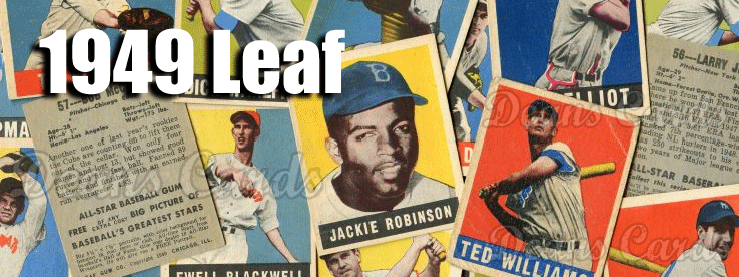
1949 Leaf Baseball Cards

Man!  That's a bright background!

Put on some sunglasses when viewing this set!  These backgrounds are vibrant and in your face.  The 1949 Leaf set is unique in that it was the first to be printed in color post-war.  The lack of image refinement, however, resulted in many slight color deviations and cards out of register. 
Backs promote "All-Star Baseball Gum"
and tell the kids to "Collect this series of Diamond Greats"
Card backs contain offers for a baseball album, all that was needed was to send in 5 wrappers and 25 cents. The card backs are sometimes found with incorrect or blank backs. And some cards were printed with a 1948 copyright date on the card back, but evidence indicates that the set was not released until 1949.
The 1949 Leaf Baseball card set is one of the hardest post war sets to complete. The set was skip numbered from 1-168 and half of the cards issued were printed in limited quantities making them harder to find.  The short prints created by this included stars and rookies such as: # 8 Satchel Paige, # 127 Enos Slaughter, and # 138 Larry Doby.

# 11 Phil Rizzuto - 1949 Leaf Baseball RK Card


Key Rookies for this year include:  
# 8 Satchel Paige, 
# 11 Phil Rizzuto, 
# 38 Ted Kluszewski, 
# 79 Jackie Robinson, 
and # 138 Larry Doby.


Hall-of-Famers featured in the set are: # 1 Joe DiMaggio, # 3 Babe Ruth, # 4 Stan Musial, # 8 Satchel Paige, # 11 Phil Rizzuto, # 32 Warren Spahn, # 46 Johnny Mize, # 59 Luke Appling, # 70 Honus Wagner, # 76 Ted Williams, # 79 Jackie Robinson, # 83 Bobby Doerr, # 91 Ralph Kiner, # 93 Bob Feller, # 98 Hal Newhouser, # 106 Lou Boudreau, # 117 Joe Gordon, # 120 George Kell, # 127 Enos Slaughter, and # 138 Larry Doby.

Need a Checklist???  Click Here!
Price Guide???  Check This Out!

Dean's Cards has an extensive inventory of 1949 Leaf Baseball Cards in stock and ready for purchase.  Also, check out other Leaf Gum Co. vintage cards for sale such as: 1948 Leaf Football Cards, 1949 Leaf Football Cards, 1960 Leaf Baseball Cards, and 1966 Leaf Good Guys and Bad Guys.  And keep an eye out for more Vintage Baseball Cards, Vintage Football Cards, and other Vintage Cards and Collectibles on our Recently Added Cards page!


Tuesday, May 10, 2011

1959 Fleer Ted Williams Baseball Card Set

Card #80
Card #2
One of the most memorable Boston Red Sox players of all time, Ted Williams, was immortalized in the 1959 Fleer baseball card set. The set consists of 80 cards total. Each card commemorates an event or period of time in Williams' life.

After a 17-career that was interrupted twice by military service, Ted Williams was planning on retiring after the 1960 season, so the Fleer Gum Company issued its very first card set after signing a contract with Williams. Topps had signed most of the other players to their contracts at the time, so it was lucky for Fleer that Williams was willing to allow them to print his cards.

Card #68
The set itself has only a few cards that are difficult to find. The #1 card, which shows a young Williams with his friends, presumably in his childhood home of San Diego, can be hard to find in nice condition. Card #2 shows Williams meeting Babe Ruth. Although their playing careers never overlapped, Ruth was supportive of Williams and even declared him to the 1939 Rookie of the Year even though that award did not exist at the time. The #68 card is unusual because of the circumstances that make it rare. Williams is shown signing a contract with Red Sox GM Bucky Harris, who was under contract with Topps for 1959. This forced Fleer to pull the card mid-production and, therefore, very few exist. The final #80 card is also somewhat hard to find. It shows Williams looking at a painting of himself.

This is the first time we've ever had so many Near Mint and Near Mint/Mint 1959 Fleer cards in stock. To see our entire inventory of 1959 Fleer cards, please click here.

Friday, March 25, 2011

Just In: PSA/DNA Authenticated Autographed Cards

Several weeks ago, we received a collection of autographed cards and we just got them back from PSA/DNA as certified authentic. We bought them from a returning seller who went to dozens of autograph signings in North Carolina.

We have signatures from guys who are known to sign autographs frequently, such as Whitey Ford, Enos Slaughter, Bob Feller, Joe Adcock, but we also had signatures from Ted Williams and Mickey Mantle. The Ted Williams autograph is on his 1951 Bowman #165 card. The Mickey Mantle autograph is on the 1953 Bowman Color #59.

We're still working on building our autographed card collection. If you are interested in viewing our full selection of autographed cards, please click here. All of our autographs are either PSA/DNA certified or come with a DeansCards.com certificate of authenticity.

Thursday, December 17, 2009

Ted Williams Baseball Cards

Ted Williams baseball cards are some of the most sought after cards in the hobby.  Since Dean’s Cards is featuring the 1939 Play Ball set break that includes the Ted Williams Rookie Card this week, it is an ideal time for Ted to be our Player of the Week.

Williams was the best pure hitter in the American League for both the decades of the 1940’s and 1950’s.  He was an American Hero that took almost five seasons off to fight in two wars.  If Ted did not take time off to be a fighter pilot, he could have possibly broken Babe Ruth’s All-Time Home Run record.

Ted Williams is often compared to Joe Dimaggio as the most popular players of their day.  That debate will never end, but in terms of the most popular in terms of collectors, the nod has to go to Williams because he played nine years after Joe D retired and had many more cards than the Yankee Clipper.  Joe DiMaggio was never featured on a contemporary Bowman or Topps Card.

Ted Williams has to be the only player to have contemporary cards issued by Play Ball, Bowman, Topps and Fleer.  Williams really seemed to know how to work the card companies for the most money possible.

The 1939 Play Ball #92 Ted Williams Rookie Card is a fresh change for many of the portrait shots of that particular set.  The 1940 Play Ball and 1941 Play Ball Ted Williams cards are case in point.

Williams signed with Bowman in 1950.  The 1950 Bowman and 1951 Bowman Ted Williams baseball cards are nice looking – although similar cards.  Ted was in Korea and did not have cards issued in 1952 or 1953.  Ted Williams reprint cards are available for 1939 Play Ball, 1940 Play Ball, 1941 Play Ball, 1950 Bowman and 1951 Bowman.

The 1954 Bowman #66 Ted Williams card is his most valuable card.  Due to a contract dispute, the card was pulled and very few were printed.  Ted had jumped to Topps in 1954 for the big bucks and is featured on both the first and last cards of the 1954 Topps set.  Years later, Williams was one of the few players to not give permission for his card to be reprinted in the 1954 Topps Reprint Set.

Williams remained with Topps through 1958, until he jumped to Fleer in 1959 to have an entire set of cards printed about his life story.  1959 Fleer #68 "Ted Signs for 1959" is the most expensive card of the set due to being pulled from production, because Bucky Harris did not want Fleer using his image.

Be careful when buying this 1959 Fleer #68 card as it was heavily counterfeited back in the 1970’s.  Dean’s Cards has seen quite a few 1959 Fleer sets where the seller was unaware that his #68 was a fake!  A counterfeit card #68 looks whiter than other 1959 Fleer cards when placed in the stack, has a thicker paper stock and somewhat of a checker board pattern on the front of the card.

Ted's last Topps cards feature him as the Senators manager from 1969 to 1972.