Showing posts with label Baseball Cards. Show all posts

Friday, August 30, 2013

Baseball Card Scans Eliminate Surprises: Dean’s Cards Baseball Card News

by Dean Hanley
Founder and Owner, Dean's Cards

As a long-time baseball card collector, I know how disappointing it can be to buy a baseball card or baseball card set expecting it to be at a certain grade – and then be disappointed when the actual card or set arrives and it is a far lower grade than you expected.

At Dean’s Cards, we try to eliminate surprises by providing scans of the ACTUAL CARDS we sell throughout our site. The policy I put in place is pretty easy to understand – “What you see is what you get!” The high quality scans show any imperfections on the front and back of each baseball card. All vintage cards in our inventory are sleeved and identified with a serial number so we can make sure we send you the actual card you have reviewed and then purchased online.

Our in-house grading team reviews all cards and follows the same standards as PSA as we custom-build Complete Sets, Near Complete Sets, Starter Sets, and Team Sets by hand. But we go one step further by considering the “eye appeal” of a card into the grade we assign. The video below shows an in-house grading  training session to give you a feel for how meticulous our grading process is.

But we also have gone one step further to add value to your baseball card purchases from Dean’s Cards. You can access ACTUAL IMAGES of any vintage card you purchase from Dean’s Cards by scanning the "QR Code" on the sleeve of your baseball card with a smart phone or tablet.

The QR Code is our first step in developing proprietary card collecting software, so you can organize your collections, and view images and vital statistics of the cards in your collection. Our goal is to bring all the advantages of technology to you to help easily share your cards with others and view your cards easily on your smart device.

Bringing Baseball Card Collecting into the 21st Century

Before we introduced QR code tracking, we only had the stock images for the vintage baseball cards listed online, but now each and every vintage baseball card has been professionally graded and is accompanied by a full front and back scan. And for your high end baseball cards, you can use the scans to help insure your collection.
Front and back scans show imperfections so "What you see is what you get!"
As we continue to add more features to the QR scan technology, we will share the news through our website, this blog, email newsletter, Google+Facebook, Twitter and YouTube.

Our goal at Dean's Cards is to provide you with a simple, cost effective and enjoyable way to build your collections. We’re excited about the technological advancements we have made for you and look forward to continue adding value to your purchases from Dean’s Cards.

How to View Baseball Card Images on DeansCards.com

As you search for cards on our site, you will see actual images of the cards in our inventory. When you click on the images, you will see enlarged scans of the front and back of each card. This feature allows you to inspect and compare the condition of each card before you make your purchase.

Dean's Cards has made this investment in advanced technology because we want to take the guesswork out of your baseball card purchase. If you have any suggestions on how we can improve our products and our service to you, please contact Dean’s Cards here.

Dean Hanley, founder and owner of DeansCards.com, is considered one of the foremost experts on the subject of vintage baseball cards, other sports and non-sports cards and has a regular column in the Sports Collectors Digest and publishes articles on his blog. Dean has also written two books on vintage sports cards: The Bubble Gum Card War: The Great Bowman & Topps Sets from 1948 to 1955 and Before There Was Bubble Gum: Our Favorite Pre-World War I Baseball Cards.

Thursday, July 18, 2013

Dean's Cards: 1957 Topps Baseball Cards Loaded With Stars

--> Click here for a complete set of 1957 Topps Baseball Cards
The Boys of Summer featured on the 1957 Topps Dodgers Sluggers card from DeansCards.com
By Dean Hanley
Founder and Owner of Dean's Cards

If you want a baseball card set loaded with Hall of Fame players, the 1957 Topps baseball card set would be a great choice for you. Topps packed the 1st series with a lot of star power, as the set contains seven Hall of Famers in the first 20 cards and 23 HOFers in the first 100 cards.

The 1957 Topps Baseball Card set remains a favorite among collectors for its full card front color photographs and its use of the vintage ballparks as backdrops for the photos. Critics often complain that the photos have a greenish tint, but I personally think that this adds to the charm of the set.

During the 1956 season Topps sent a photographer to take actual color photos of the players that would first appear on the 1957 Topps cards. That is the reason the 1957 Topps baseball card set contains so many great rookie cards, including future Hall of Famers  #338 Jim Bunning, #18 Don Drysdale, #29 Whitey Herzog, #24 Bill Mazeroski, #328 Brooks Robinson & #35 Frank Robinson.
The muscular Ted Kluszewski shows off his arms in this iconic 1957 Topps card from DeansCards.com
Big Klu's Card is a 1950s Collectors Icon

The 1957 Topps set also includes one of the coolest cards ever produced and one that remains extremely popular for collectors: #165 Ted Kluszewski. Big Klu felt his arms were restrained by the undershirt in the Reds’ tunic uniform top so he refused to wear it – and his card shows his unique look in its full glory.

The 1957 Topps set is also well known for the reverse negative of the #20 Hank Aaron card, showing Aaron as a left-handed hitter, a mistake which was never corrected by Topps.

Beginning with the 1957 Topps Baseball Card set, the size of the card was reduced to the standard that we are still using today. With 407 cards, the 1957 Topps Baseball Card set was the largest set that Topps produced up until that time. That said, that number would be bested the following year and again in 1959.

Still No Stan the Man

Even with all the star cards in the 1957 Topps baseball card set, there is still no Stan Musial card in the set. Stan the Man had a $100,000 annual salary, and he felt that he was worth more than the $125 that Topps paid each of the players. Stan would finally consent to having his images put back on cards in 1958.

Dean’s Cards builds hundreds of vintage sets each year, and the 1957 Topps Baseball Card set is definitely one of the tougher sets to assemble. Not only does the 1957 Topps set have eight great rookie cards, but also the 4th series is so scarce that it is tough to complete – especially in higher conditions.
Mickey Mantle and Yogi Berra on one of the first Topps multi-player cards.
The 1957 Topps set contained two multi-player cards of the Dodgers Sluggers #400 and Yankees Power Hitters #407. Topps would continue the trend of the Multi-Player star cards for another dozen years.  It was great way to get the stars of the day on one more card. (By the way did you know you can now search for Multi-Player cards on our website by using the specialty code “MP” in your search for a player card on our website? Click here to see a video and learn about specialty baseball card searches.)

Checklists and Contest Cards Nearly Impossible to Find

Topps also inserted four contest cards, an ad card and four contest cards into its 1957 baseball card set. The checklist cards are nearly impossible to find in nice condition, as many were either marked up or discarded by kids.  Due to the cost of the checklists and ad cards, most collectors consider the set complete without any of these special cards
.
--> Click here to buy 1957 Topps Baseball Cards
1957 Topps Hank Aaron reverse negative card showing him as a left handed hitter. Topps never issued a correction.
1957 Topps Baseball Card Set Facts:
Dean Hanley, founder and owner of DeansCards.com, is considered one of the foremost experts on the subject of vintage baseball cards, other sports and non-sports cards and has a regular column in the Sports Collectors Digest and publishes articles on his blog. Dean has also written two books on vintage sports cards: The Bubble Gum Card War: The Great Bowman & Topps Sets from 1948 to 1955 and Before There Was Bubble Gum: Our Favorite Pre-World War I Baseball Cards.

Tuesday, June 25, 2013

Baseball Card Testimonials from Dean’s Cards Customers

by Dean Hanley
Founder and Owner of Dean's Cards

Who can you trust when you buy baseball cards on the Internet? At a time when many people are concerned about the impersonal nature of doing business online, we are proud of the positive testimonials we continually get from customers who buy baseball cards from Dean’s Cards and sell baseball card collections to Dean’s Cards.
1952 Topps baseball card set custom built by hand for a Dean's Cards customer.
Since I began Dean’s Cards from my basement in 2001, our goal has been to surpass customer expectations in the quality of cards they receive from us and also to deliver personal customer service. We understand that baseball card collecting is a very personal hobby and each customer has different collecting needs. That’s why we developed a website that shows you actual images of the cards you buy to eliminate any surprises -- and it’s why we have grown to a staff of 14 people and 5,000 sq. ft. of office space to meet the growing service needs of collectors.

I am often humbled by the positive testimonials we receive from customers. If you are considering buying baseball cards or selling baseball cards, I encourage you to read our testimonials. Since I am a fellow collector, my goal was to create a store where I would love to shop and that also had the best selection of cards available anywhere.
Vintage baseball card complete sets assembled and sleeved for a Dean's Cards customer.
Dean's Cards works hard to earn the trust and respect of every customer. When it comes to buying vintage sports cards and magazines, I know that condition is critical. We would much rather "under grade" a card than "over grade" it. For that reason, we tend to grade the cards we sell more conservatively than most. Still, I also understand that judging a card's condition can sometimes be subjective, which is why we offer a 100% Money Back Satisfaction Guarantee on all purchases.

Our goal at Dean's Cards is to provide you a simple, cost effective and enjoyable way to build your collections. If you want us to build a custom set of vintage baseball cards or you just need individual cards to complete your set, Dean’s Cards can offer you the following benefits:

  • The largest online vintage card inventory. When it comes to vintage card inventory, size definitely matters. Dean's Cards has the largest online selection of cards and magazines.  
  • Buy all your cards from one source. There are sites that allow hundreds of dealers to list the cards that they have to sell. The problem is that if you need to purchase 50 cards, you will probably be getting cards from three dozen different dealers with varying grading standards. You also have to pay three dozen different shipping charges. When buying from us you get consistent grading, one shipping charge, and a great customer service team.          
  • Scans of the actual cards you buy. When you search our website, you can see scans of the actual cards you buy. And you can compare the condition of cards in different grades to make a wise choice. 
  • Discounts on all orders over $50. The larger the order, the deeper the discount. For more information on our discounts click here.
  • Tough Grading Standards. Dean's Cards grades on par with the professional grading companies – but we go a key step beyond those standards. We take into account a card’s “eye appeal.”
  • 100% money back satisfaction guarantee. Just contact us within 10 days of your purchase date and we will refund your money or replace the card.

But our customers say it best! Dean's Cards is proud of the positive comments we get from customers who buy cards from us – and we look forward to building a long-term relationship with you so we can help you with all of your collecting needs.

We sell our cards at competitive prices -- and we offer top dollar if you're interested in selling your vintage cards.
Star cards in a collection recently sold to Dean's Cards.
Looking for our latest cards and sets added to inventory? Click here!

Please take a moment to read the testimonials below:
--> Testimonials from BUYERS of cards from Dean's Cards <--
--> Testimonials from SELLERS of cards from Dean's Cards <--

Dean Hanley, founder and owner of DeansCards.com, is considered one of the foremost experts on the subject of vintage baseball cards, other sports and non-sports cards and has a regular column in the Sports Collectors Digest and publishes articles on his blog. Dean has also written two books on vintage sports cards: The Bubble Gum Card War: The Great Bowman & Topps Sets from 1948 to 1955 and Before There Was Bubble Gum: Our Favorite Pre-World War I Baseball Cards.

Thursday, June 20, 2013

Sell Baseball Cards for Top Dollar at Dean's Cards: Seller Testimonials

By Dean Hanley
Founder and Owner, Dean’s Cards

Some collectors are understandably concerned about sending their baseball card collections to get a bid from us. But a recent experience from a collector in San Francisco, California will show you how easy the process is.
Part of the collection of star cards and Hall of Fsmers recently sold to Dean's Cards.
This collector did a Google search to find companies that would buy his star baseball cards that went back to the 1950s through the 1980s. He had virtually every baseball card star and Hall of Famer from this era in a rather large collection. He had never done business with Dean's Cards before this.

He completed the form on the sell your baseball cards page, we responded, and he sent us his cards to evaluate. We gave him our generous bid and he accepted it. We then sent the check the next day. So in a matter of days the transaction was complete.

Again, this is another example how we earn trust from baseball card collectors every day.

If you want to sell baseball cards or sell football cards, I encourage you to read testimonials from what baseball card and football card sellers have to say about working with Dean’s Cards. We are proud of the trust we have earned from customers who sell us baseball cards, going back to our founding in 2001.
More star cards from the collection recently sold to Dean's Cards.
Whether you are thinking of selling your boyhood baseball card collection or you have been handed the responsibility of liquidating the collection of a family member, it can be a very daunting task. While there is no shortage of dealers who will buy vintage baseball card collections, Dean's Cards is able to offer a higher percentage of the baseball card collection's actual value than most traditional baseball card dealers. Dean's Cards can usually pay more for vintage baseball card collections simply because what we buy goes directly into our own online inventory of more than 1.5 million baseball cards.

We sincerely hope that we end up writing you a large check! This means you have some nice baseball cards, and we always need the inventory. If the amount that we offer for your baseball cards falls below your expectations, we will pay the postage to return the baseball card collection to you.
Collectors send their cards to Dean's Cards and we quickly provide a bid.
So when you’re ready to sell your baseball cards or sell your football cards, I encourage you to visit our “Sell Baseball Cards” page for more details and complete the form to describe your cards. I promise we will get back to you quickly.

We’re humbled by the trust baseball card collectors and football card collectors place with us and we look forward to you becoming a Dean’s Cards customer.

Click here to Sell your baseball cards

Click here to BUY baseball cards

Dean Hanley, founder and owner of DeansCards.com, is considered one of the foremost experts on the subject of vintage baseball cards, other sports and non-sports cards and has a regular column in the Sports Collectors Digest and publishes articles on his blog. Dean has also written two books on vintage sports cards: The Bubble Gum Card War: The Great Bowman & Topps Sets from 1948 to 1955 and Before There Was Bubble Gum: Our Favorite Pre-World War I Baseball Cards.

Friday, May 31, 2013

Great Value Baseball Card Sets for 1960 -- 1963 Added at Dean's Cards

by Dean Hanley
Owner of Dean's Cards

In 2012, we introduced a "value added" product for card collectors that has proven to be very popular -- our exclusive Near Complete Sets. Since many collectors enjoy the challenge of building their own sets, we wanted to give you a way of obtaining most of the baseball cards in a set at a more reasonable price and then let you build the rest of the set on your own.

We just added Near Complete Sets for the following years:
But you also can click here to find baseball card Near Complete Sets for other years in the 1950s and 1960s.
Ron Santo from the 1961 Topps Near Complete Set.
Depending on the year and the grade, our Near Complete Sets consist of 60%-80% of the baseball cards you would get in a Complete Baseball Card Set. This leaves collectors like you plenty of room to go in and individually purchase the last 100-300 cards in the set.

The best feature of our exclusive Near Complete Sets is the discount. While most of our Complete Sets are priced at 20-30% off of our individual card prices, our Near Complete Sets are priced even lower. Our Near Complete Sets are priced so that you receive 35%-45% off of the individual card prices.
Duke Snider and Gil Hodges from the 1963 Near Complete Set.
Dean's Cards Near Complete Sets are a great way to get a majority of the cards in a particular set for just a fraction of the cost. Our Near Complete Sets are custom built by hand by our team of baseball card grading professionals to give you a consistent grade. For collectors who shy away from purchasing complete sets because they like the challenge of finding and buying the cards individually, Near Complete Sets are a fun challenge -- and a great value.

Please click here to see the Near Complete Sets we currently have in our online inventory.
Mickey mantle and Ken Boyer from the 1960 Topps baseball cards Near Complete Set.
And if you are looking for a Near Complete Set from a year that we currently don't have available online, please Contact Us and we will try our best to accommodate your specific needs.

Here at Dean's Cards, we’re always trying to think up new and unique products to bring even more fun to the baseball card collecting hobby, and Near Complete Sets have proven to be very popular for our customers.

Dean Hanley, founder and owner of DeansCards.com, is considered one of the foremost experts on the subject of vintage baseball cards, other sports and non-sports cards and has a regular column in the Sports Collectors Digest and publishes articles on his blog. Dean has also written two books on vintage sports cards: The Bubble Gum Card War: The Great Bowman & Topps Sets from 1948 to 1955 and Before There Was Bubble Gum: Our Favorite Pre-World War I Baseball Cards.

Thursday, May 23, 2013

Dean's Cards Recently Added Cards (RAC): The Hottest Cards Are Here First

by Dean Hanley
Owner of Dean’s Cards

Every week we add thousands of cards to our Dean’s Cards inventory of vintage baseball cards, football cards, basketball cards, hockey cards, other sports cards and non-sports cards – but there is one place where you can easily find the hottest additions to our inventory. Just go to the Recently Added Cards (RAC) page, which you can find linked on the right side of our Home page.

Our Recently Adds Cards (RAC) page shows our latest vintage cards.
Since we are always buying card collections, our team of card experts first personally inspects and grades all cards. Then the cards are scanned so you can see the actual cards that you buy – that takes the guesswork out of knowing how your cards will look when you receive them.

Our customers routinely tell us that are very pleased with the quality of the cards they purchase from us since we use the Grading Standards of PSA as the minimum baseline for grading the cards in our inventory. One positive aspect of Dean's Cards grading standards is that we take into account a card's "eye appeal."  Other grading companies, such as PSA do not always take "eye appeal" into account when grading cards. As collectors ourselves, we tend to be a bit more critical of a card's eye appeal than the professional grading companies. Collectors who are accustomed to purchasing ungraded cards from other vendors are usually amazed at our tough grading standards.

I encourage you to visit our RAC page regularly to find the latest additions to our inventory, since many cards go quickly. Here are a few recent “Star Card” additions that may interest you:

And, of course, you can find all the latest Mickey Mantle baseball cards by visiting this special page we created to celebrate The Mick’s career in baseball cards. You'll also see a special video about Mickey Mantle baseball cards.

If you’re looking for early 20th century baseball cards, the RAC page will show you our latest additions, including T3 Turkey Red baseball cards, T206 baseball cards, T204 Ramly baseball cards, and T205 Gold border cards.

If you are a set collector, you’ll also find our latest complete sets, near complete sets, starter sets, near complete sets, and additions to sets on the RAC page. Some of the latest additions include:

The RAC page is updated many times throughout the week, so we hope you will visit often to see the latest and greatest we have to offer you at Dean’s Cards!

Dean Hanley, founder and owner of DeansCards.com, is considered one of the foremost experts on the subject of vintage baseball cards, other sports and non-sports cards and has a regular column in the Sports Collectors Digest and publishes articles on his blog. Dean has also written two books on vintage sports cards: The Bubble Gum Card War: The Great Bowman & Topps Sets from 1948 to 1955 and Before There Was Bubble Gum: Our Favorite Pre-World War I Baseball Cards.


Friday, May 17, 2013

Selling Baseball Cards: Earning Your Trust at Dean's Cards

By Dean Hanley
Owner of DeansCards.com

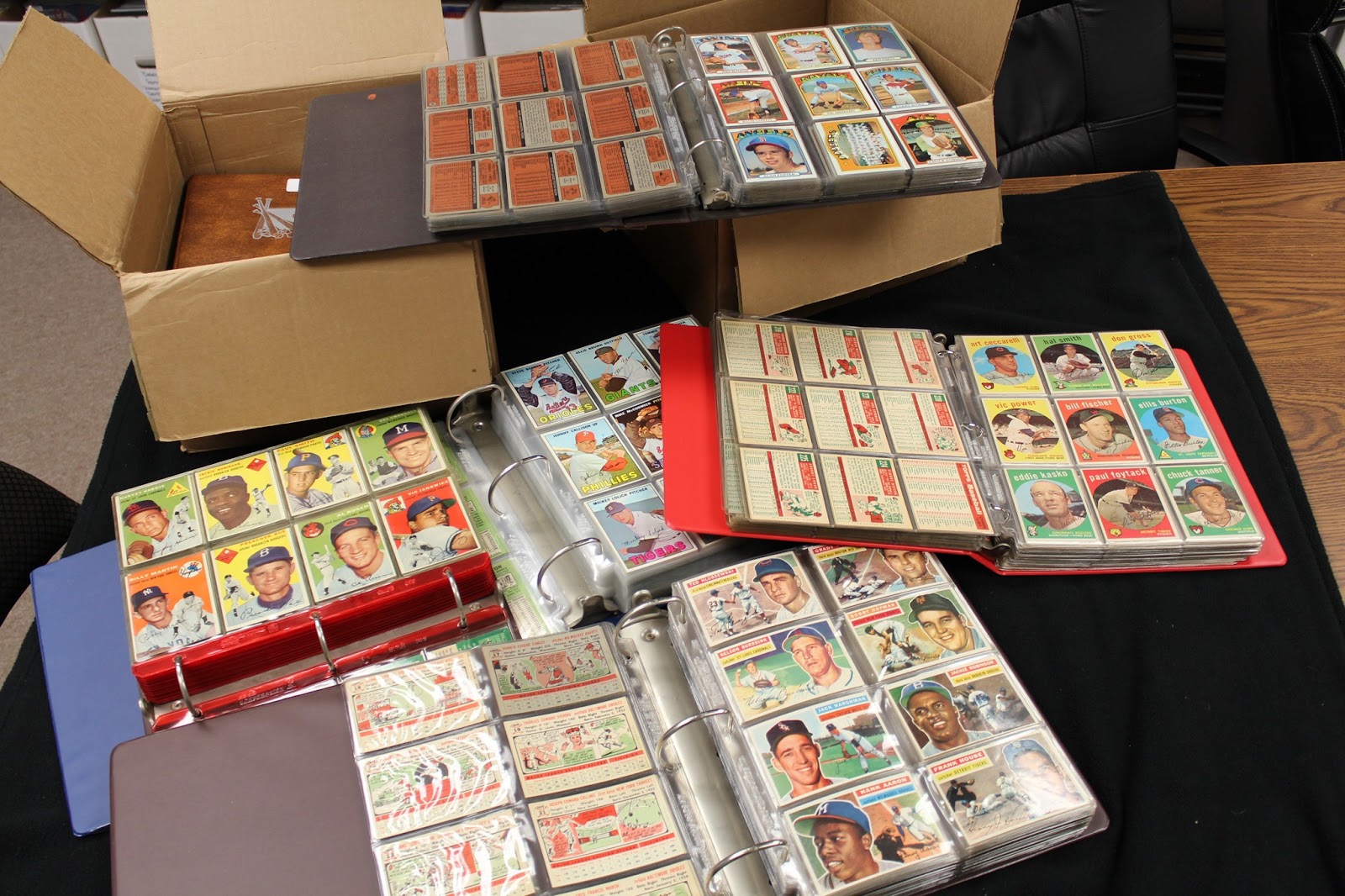
Dean’s Cards recently purchased a large baseball card collection from a collector that included full sets of baseball cards from the 1950s and 1960s, as well as various baseball star cards and rookie cards, which you can see in the photos in this blog.
Part of a collection we recently purchased from a Seller. Click here to sell your baseball cards to Dean's Cards.
Even though this was a large baseball card collection that we purchased for a cost well into five figures, it was handled with the same, simple, trusting and personal process as all collections we buy:
  • The seller completed the form on our Sell Baseball Cards page with details of baseball cards in his collection.
  • Elana, the head of our baseball card buying team, replied to the seller by email, and then Elana and I spoke to him by phone to get further details on the baseball card collection.
  • The seller then sent us the baseball cards by mail so Elana and I could personally evaluate them.
  • We offered a bid for the collection based on our review of the seller’s collection.
  • The bid was accepted, and we mailed the seller a check.
Dean’s Cards buys more than 500 card collections every year, and we are proud that sellers trust us to send their collections for our evaluation that they often personally have built over many years.
Some of the baseball star cards in a recent large collection we purchased. To sell your baseball cards to Dean's Cards, please click here.
Of course, it is a valid concern to be skeptical of sending anything of value to someone that you do not know personally. That’s why we work so hard to earn trust from our customers – which is proven by the fact that we receive card collections worth thousands of dollars almost every day, as well as glowing testimonials form sellers.

The best reason that I can give you for why we try so hard to treat people fairly is that it is simply good business. We do all our business by mail -- both buying and selling -- and I have taken great care to protect the reputation of our business. Dean's Cards has never kept a card that does not belong to us, and we never will. If we treated people wrong, we would be finished as a business.

As far as giving you a firm offer on your collection, there is simply no way to do it without physically seeing your cards. For us to determine the value of your cards, you need to send them to us. Any reputable dealer will tell you the same thing. Bidding on scanned images of cards is way too uncertain and would force me us bid very conservatively – and that would just cost you money.
We are proud to sellers trust us to send their collections. Please contact us if you are ready to sell your baseball card collection.
It usually costs a dealer about $1000 (not counting at least a day of his time) to fly out to bid on a collection. No matter what a dealer says, this expense has to be passed along to the seller. What about the people who decide NOT to sell their collections? Guess who pays for those trips? If you said, "the seller,” you are correct. We would much rather give the travel money saved to a seller for cards, than to the airlines for transportation costs.

Our "secret" to buying so many baseball card collections is that we simply pay more for cards. Our goal is to keep our costs down, so that we can continue to pay a higher dollar amount than other dealers. We have the bidding process down to a science and an art and it works extremely well for us – and for sellers. Please understand, we are very motivated to buy your cards, which is why we offer more than other dealers – simply put, if we can’t buy cards, we can’t sell cards.

If sending the cards by mail makes you uncomfortable, then we suggest sending us part of your collection first.  We will value the cards and contact you with an offer. If you agree to our offer, I will send you a check. Usually, after sellers receive the first couple of checks, mailing the cards becomes a non-issue. If my offer is unsatisfactory, then I will pay for the postage to send the collection back to you.
More star cards in a recently acquired collection. Please visit our Sell Baseball Cards page if you are ready t sell your  baseball cards.
The bottom line is that there is nothing that I can really say to totally assure you, the seller. At some point it will take an element of trust on your part. In reality, it all comes down to business ethics. If you do decide to send us your collection, we will certainly not violate your trust – and you can visit our testimonials page to read the positive comments from sellers and see how they feel about doing business with us.

If you have a collection of baseball cards, football cards, other sports cards or non-sports cards from 1869-1969 and you’re ready to sell, please fill out the form on our Sell Baseball Cards page so can begin talking. You have my personal guarantee that we will work hard to earn your trust, just as we have for thousands of sellers since I started Dean’s Cards in 2001.

We look forward to learning more about your card collection!

Sincerely,

Dean Hanley
Owner of Dean's Cards

Dean Hanley, founder and owner of DeansCards.com, is considered one of the foremost experts on the subject of vintage sports cards and has a regular column in the Sports Collectors Digest and publishes articles on his blog. Dean has also written two books on vintage sports cards: The Bubble Gum Card War: The Great Bowman & Topps Sets from 1948 to 1955 and Before There Was Bubble Gum: Our Favorite Pre-World War I Baseball Cards.

Click here if you have vintage baseball cards to sell -- 1869-1969.


Wednesday, November 9, 2011

1948 Bowman - The Return of the Baseball Card

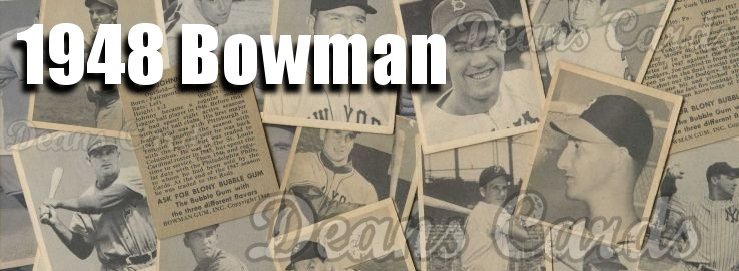
With the men home from war and the economy booming, the first major post-World War II baseball card set was released by the Bowman Gum Company in 1948. The 1948 Bowman baseball cards were issued in one-card penny packs that included a piece of bubble gum. The cards were much smaller than today’s baseball cards, and measured only 2-1/16” by 2½” and were printed in black and white. The front of the cards are very plain and contain no text, just a basic black and white photograph.

#18 Warren Spahn
Exactly one-half of the cards in the 1948 Bowman set were of players that played for the Giants or Yankees, while the NL champion Brooklyn Dodgers only had 3 players represented. This was probably a smart move from a business standpoint, as New York traditionally had the best teams, the most fans, and was the nation’s biggest market. Although, the 1948 Bowman baseball card was issued nationally, it is clear that Bowman was targeting its first post-war set at the island of Manhattan and would be watching from Philadelphia with great interest.

Because this was first major set of baseball cards issued since before World War II, the majority of the cards (62%) are rookie cards. Among the 30 players making their first appearance on a card, nine would be elected to baseball's Hall-of-Fame, which is a record for post-war sets. These future Hall-of-Fame players in the 1948 Bowman set include: #3 Ralph Kiner, #4 Johnny Mize, #5 Bob Feller, #6 Yogi Berra, #8 Phil Rizzuto, #17 Enos Slaughter, #18 Warren Spahn, #36 Stan Musial and #38 Red Schoendienst.

In 1948, Bowman was forced to use the photos that they had available to create the cards. The results were very mixed. Warren Spahn's card is probably the most disappointing rookie card of a Hall-of-Famer ever printed. Evidently, this was the best photo of Spahn that could be found before the printing deadline. The strangest card in the 1948 set has to be the one of Phil Rizzuto. This photo gives the impression that Rizzuto has a pillow tucked inside of his shirt.


Short-Prints, Double-Prints, and High Numbers 

As the first baseball cards produced in seven years, the 1948 Bowman set has some unique quirks. The 1948 Bowman baseball card set was designed to be issued in one series of 48 cards. The problem is that a printing sheet contained 36 cards, so the set would have to be printed in two separate sheets. It is unclear as to why Bowman decided to issue a set with only 48 cards. It could be that Bowman had signed contracts with only 48 players, which would explain the large number of players from the New York-based teams. A more likely scenario is that after a seven-year break in producing cards, Bowman had to re-educate themselves on the manufacturing process.

#8 Phil Rizzuto
The first printing sheet contained cards numbered 1 through 36. It was the second sheet that created the dilemma. The second printing sheet contained the remaining dozen cards of the 1948 Bowman set, but still had spaces for another 24 cards. The cost of a printing a sheet of cards is basically the same, regardless of the number of images or cards it contains. Since there were no additional costs involved, Bowman executives decided "double print" 24 of the cards that had already been included on the first sheet of cards.

According to most traditional price guides, the 1948 Bowman baseball card set contains 12 short-printed cards and 12 high-numbered cards. After consulting the DeansCards.com inventory, the surviving population of 1948 Bowman Short-Print and High Number cards seems about the same. It also appears that the same number of sheets were printed for both of the print runs, so my conclusion is that one-half of the cards in the 1948 Bowman baseball card set had twice the number of cards printed as the other half of the set.

Bowman quickly discovered that the printing costs for a 72-card set is almost the same as that of a 48-card set, so they quickly corrected their mistake by the time they issued their football card set that fall.. Bowman used this card size for several more baseball, football, and non-sports card sets until they eventually increased the size of their cards in 1951. It is interesting to note that the number of cards in each of these sets is divisible by 36, eliminating the problem of short-printed cards.

Luckily for collectors of the short-printed cards, the only superstar is #8 Phil Rizzuto. Even with 24 "short-printed” cards in the set, the 1948 Bowman set only ranks as "moderately difficult" to complete.


All Part of a Bigger Plan 

The Bowman Gum Co. knew exactly what they were trying to accomplish in 1948, therefore they were able to succeed. Bowman wanted to issue a “national” set and not be limited to just one region of the country; and that they did. The 1948 Bowman baseball card set contains players from 10 of the 16 major league teams.

The 1948 Bowman baseball card set was a very modest offering by all standards. Considered the most basic of all the Bowman sets, 1948 Bowman set was an important first step in the evolution of the baseball card. It was the first set of the modern era of baseball cards, and ultimately ushered in a decade great sets. By doing things on a small scale in 1948 – a plan that Topps would replicate in 1951 - Bowman learned some very valuable lessons and was then able to come out with a much larger and better set of cards the following season. Even with a virtual monopoly on the bubble gum baseball card market, Bowman would steadily improve its product offering over the next five years.

By Dean Hanley
Owner of DeansCards.com


This article is taken from Dean’s upcoming book The Gum Card War and the Great Bowman & Topps Baseball Card Sets of 1948-1955, which is scheduled to be released later this year in both print and eBook forms. Please feel free to contact Dean with any questions or comments at Dean@DeansCards.com 

Dean Hanley is an authority on vintage sports cards and has written numerous articles on the topic. Mr. Hanley is the founder DeansCards.com, and with well-over one million vintage cards in inventory, DeansCards.com is the largest seller of vintage cards on the web. Dean has also published Before there was Bubble Gum: Our Favorite Pre-World War I Baseball Cards, which is available in eBook form at Amazon.com 

Friday, August 19, 2011

2012 Topps Baseball Cards: A Sneak Peek


Topps is already thinking ahead to 2012's baseball release.

On August 18, 2011 Topps tweeted a sneak peek of what to expect when it comes to its 2012 baseball set. Click here to see the tweet.  The new design announcement comes on the heels of the 2011 Topps Baseball Factory Set release, which was July 20.  It's safe to say that Topps wasted no time giving us a taste of great things to come.

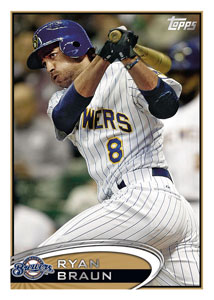
Pictured to the left is Ryan Braun in an example released by Topps to show the design of the 2012 release. Similar to the previous year's release, the white border returns along with a circular style to the bottom that contains the name and logo.  While this is not a huge departure from the recent past, Topps new design looks clean and it feels like the player name and team logo are more accentuated and easier to read.

Along with cards from the base set, whose design is pictured above,  there will be plenty of inserts and autographs to chase.  Topps has said the inserts will include:  Autographed Gold Coin Cards, Epic Walkoffs, Golden Greats, Golden Moments Cut Signatures, Golden Moments, Gold Standard, Gold Futures, Generations Duals, and World Champions.  Hopefully you can see the theme here.....GOLD!  And so far it looks like Topps is on it's way to give us a golden 2012.

Check out Dean's Cards for all your Topps Baseball Card needs.  Whether you're into buying Topps Baseball Cards, Topps Football Cards, or trying to complete that 2011 Topps Baseball Set, DeansCards.com has an extensive offering of Topps Singles, Sets, and Insert Cards.

Wednesday, August 17, 2011

1949 Leaf Baseball Cards

Man!  That's a bright background!

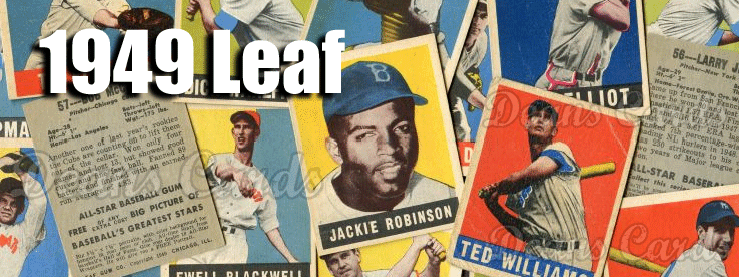
Put on some sunglasses when viewing this set!  These backgrounds are vibrant and in your face.  The 1949 Leaf set is unique in that it was the first to be printed in color post-war.  The lack of image refinement, however, resulted in many slight color deviations and cards out of register. 
Backs promote "All-Star Baseball Gum"
and tell the kids to "Collect this series of Diamond Greats"
Card backs contain offers for a baseball album, all that was needed was to send in 5 wrappers and 25 cents. The card backs are sometimes found with incorrect or blank backs. And some cards were printed with a 1948 copyright date on the card back, but evidence indicates that the set was not released until 1949.
The 1949 Leaf Baseball card set is one of the hardest post war sets to complete. The set was skip numbered from 1-168 and half of the cards issued were printed in limited quantities making them harder to find.  The short prints created by this included stars and rookies such as: # 8 Satchel Paige, # 127 Enos Slaughter, and # 138 Larry Doby.

# 11 Phil Rizzuto - 1949 Leaf Baseball RK Card


Key Rookies for this year include:  
# 8 Satchel Paige, 
# 11 Phil Rizzuto, 
# 38 Ted Kluszewski, 
# 79 Jackie Robinson, 
and # 138 Larry Doby.


Hall-of-Famers featured in the set are: # 1 Joe DiMaggio, # 3 Babe Ruth, # 4 Stan Musial, # 8 Satchel Paige, # 11 Phil Rizzuto, # 32 Warren Spahn, # 46 Johnny Mize, # 59 Luke Appling, # 70 Honus Wagner, # 76 Ted Williams, # 79 Jackie Robinson, # 83 Bobby Doerr, # 91 Ralph Kiner, # 93 Bob Feller, # 98 Hal Newhouser, # 106 Lou Boudreau, # 117 Joe Gordon, # 120 George Kell, # 127 Enos Slaughter, and # 138 Larry Doby.

Need a Checklist???  Click Here!
Price Guide???  Check This Out!

Dean's Cards has an extensive inventory of 1949 Leaf Baseball Cards in stock and ready for purchase.  Also, check out other Leaf Gum Co. vintage cards for sale such as: 1948 Leaf Football Cards, 1949 Leaf Football Cards, 1960 Leaf Baseball Cards, and 1966 Leaf Good Guys and Bad Guys.  And keep an eye out for more Vintage Baseball Cards, Vintage Football Cards, and other Vintage Cards and Collectibles on our Recently Added Cards page!


Monday, December 14, 2009

Bringing Today’s Kids into the Hobby of Sports Collectables

Bringing Today’s Kids into the Hobby of Sports Collectables

The untapped market and how to get a piece of it

by Dean of Dean’s Cards

Originally written published November 20, 2005

The question that seems to be on everyone’s tongue for 2006 is “How do we bring the kids back into the Sports Card Hobby and then keep them for a lifetime?” 

The market potential for this segment is ripe.  Today’s kids have more time and money than any previous generation.  So why aren’t kids buying sports cards?  Many people have theories on the subject and the two most popular theories on why kids no longer buy baseball cards that we keep hearing are: a) there are so many card issues each year, and b) that kids are distracted by other options for their free time. Although there is some truth to each argument, I think that both of the above reasons miss the main point. 

The purpose of this brief is to address each of the popular theories on why young people are not buying sports cards, present a new perspective on the challenge and then offer a solution on how to bring the kids back into our hobby.

Argument #1:  For those that jumped up and yelled “There are too many cards issued every year.  Kids can not figure out what to buy!” 

 OK, I hear you. Now please kindly sit back down and consider the following.  So, is the number of products issued confusing kids?  The answer is “Maybe So”, but more products, also means more competition.  More competitors in a market offer a better selection for the buyer, improved products and competitive pricing.  Economics 101 taught us that these economic factors are all good things for the consumer in any industry. 

 The argument of “too many choices of cards to buy” makes as much sense as saying “Life was much better when the only cola choices were only Coke and Pepsi”.  Was life simpler? – Sure, but better? – Definitely Not.  What percentage of us still drink only Coke or Pepsi?  It may be a little more confusing these days when buying cola, but we seem to make out alright and the result has been ever increasing soda sales.  

 Back in the “good ole days, we had only had only three TV channels to watch, one type of sedan from each car manufacturer and could only buy plain potato chips. Who as a consumer wants to go back to that?  Competition has produced a great selection of products, more specific niches and greater overall sales.

 The people that get most frustrated with the number of sports card issues are often the old time collectors – myself included.  We remember when there was just one issue of cards, but today’s kids do not.  This multi-set environment is all that they have ever known.

 It is not realistic to blame the troubles in the hobby strictly on the numbers of products available for purchase. We have been hearing the “too many cards – the buyer is confused” excuse for so long that we now except it as a fact.  The truth is that this theory violates most economic principles.

 Economic Laws dictate that having more products for buyers to choose from has more positives for the consumer than negatives and will eventually produce and overall result of higher sales.  Economics principles also say that reducing the number of products may benefit the seller (not the buyer) through improved economies of scale.

 The number of card issues will finally begin to decline in 2006, but I doubt the gross number of cards sold will increase because there are less cards for buyers to choose from.  If economic principles hold true, the total number of sports cards sold in 2006 should decline compared to the cards sold in 2005! 


 Argument #2:  “There is too much neat stuff (other than sports cards) for kids to buy today…”

 There is a lot more competition these days for a young person’s dollars, but please remember the average child also has more money to spend than we did as kids.  The sports cards market can still get a smaller piece of the overall pie and still expand the hobby.

 I do not agree with the statement that sports cards have lost their appeal to kids.  It is just not true.  Kids still love to play with cards.  The Pokemon craze proves that.  When my son was 5 years old, he and his friends would sit around for hours playing Pokemon. 

 I love games and spent several hours one afternoon trying to figure out how to play the game of Pokemon.  I eventually staggered away dazed and confused.  The game is truly incomprehensible – not to mention BORING.  No one on planet Earth seems to really understand the rules to this senseless game, but lack of formal rules does not even slow the kids down.  They just make up their own rules and imagination takes over.  The pleasure for the boys seems to be collecting and then playing with the cards.

 No one is saying that external factors have not affected the sports card industry – but the bottom line is that these are factors that we as dealers can not influence in any big waySo even if I am wrong about this, our most productive course of action is to focus on factors within the hobby that we dealers can change, improve and innovate.

 The real issue facing our hobby is that sports cards are difficult for the kids to physically get to and buy. 

The problem is that the industry is still trying to sell baseball cards in the same way they were sold fifty years ago.  Most dealers insist on using the same tired “Point of Sale” techniques that were in place when we ourselves were kids.  It is time to wake up and smell the bubble gum!  The buying patterns of kids have changed.  

The ole “Sales are low because the product stinks” line is the oldest excuse in the book.  This excuse removes the blame from both the dealers and the manufacturers.  Could it be that dealers have not changed their marketing strategy to suit the contemporary consumer? 

In our particular industry, the product is established and proven.  Baseball cards have thrived for a century.  Manufacturers have done their part in continuing to develop products that kids want but the baseball card “is what it is”.  The card itself has even evolved and more attractive today than anytime in the past.  

This point is simple to prove.  Just hand any sports minded a boy a pack of sports cards and watch the kids tear them open!  They love them just as much as we did as kids. 

The product is still good.  It is the outdated marketing and sales model that needs to be brought into the 21st Century. 

Let’s explore how we bought baseball cards when we were kids.  We earned a couple dollars from doing our chores, then hopped on our bike and rode a mile or two to the local “Five & Dime”.  When we got there – we spent some of the money on candy.  After that, there was usually money left over for cards. 

America has changed.  Today, few kids even live near a local drug store and the “Five and Dime” has gone the way of the Milk Man.  Enter the Wal-Mart Super Center!  Even if kids live within two miles of a place that sold cards, which the vast majority do not, most parents would not let them go that far alone due to modern safety concerns.  Kids are now dependent of parents to drive them to either the Wal-Mart or across town to the local baseball card store.  That –in my humble opinion- is a real problem. 

Solution: If we want kids to buy sports cards then we must first market directly to the kids and then provide them an easier way to buy the product.   

For the last twenty years, the marketing effort for sports cards has been directed at the existing adult collectors, mainly because they have much more money to spend.  Today, the problem is that baseball card sales are declining in the adult segment in the hobby.  Tougher economic conditions force companies to focus to develop new markets.  The only logical new target market for sports cards is the young boys.  (How strange does it sound that “Kids are an untapped market for baseball cards?”) 

So how do we address this changed environment?  There is a simple answer that has been used in so many industries through out history: We implement new technology. In this case the improved technology is the Internet.   So why not sell cards to the kids online?  In fact, there is not another viable option.  

The main reasons that dealers should market online and target kids are clear and overwhelming: 

  1. Boys (as a market segment) are a much more computer literate market segment than the middle aged men that we currently market to and look how successful online sales to men have been over the last decade. 

  2. Kids know how to spend money online.  They all buy everything from toys to e-tunes.

  3. Today’s youth have money to spend. 

  4. Kids have much more free time to spend on hobbies than middle aged adults.

  5. Just like the “Baby Boomers” that the Sports Card Hobby has historically targeted, the children in the U.S. are a very large segment of the population. i.e. There are a lot of them out these to sell to.

  6. Young people are less mobile than our adult customers–as most are too young to drive.  It is far easier for them to buy online than to ask one of their working parents to drive across town to the nearest store.

  7. Baseball Card Collecting remains one of the few things that a father and son can do together and both enjoy. 


The “kid” market is ripe, has plenty of dollars and it just waiting to be tapped – but for all the noise about bringing kids back into the hobby, no one markets directly to this market segment.  This is probably more the fault of the vendors than the manufacturers.  How many dealers have created websites designed to attract the 8 to 15 year old card collector?  If there is one - I have not seen it. 

The internet loves and rewards specific niches and this one is wide open.  An ideal kid friendly site would have games, chat boards, free downloads and lots of graphics.  It would not be that hard to design.  Just visit the sites that are most popular with kids and you can get some great ideas.  We do not have to “reinvent the wheel”, but only copy what is working to other industries.  Kids could find scans of the cards of their favorite players and buy them online.

 At some point a sports card dealer will be innovative enough to figure this out.  The first dealer that clues in on this and acts on it - will be rewarded.  Manufacturers would be wise to support these efforts.  I feel that we could do it at Dean’s Cards, but we have our hands full with vintage cards.

It is possible for card store owners get in the game and start selling to small niches of the hobby. It could be games, figures, statues, etc. Use promotions that you have been successful in your store and tested within your community.  If these programs work on a local level, why wouldn’t they work (with a few modifications) on the regional or even national level?  Think BIG!  Conquer the World. 

The e-store should be treated as a separate business for card dealers, but it could also benefit walk-in traffic for the store. Internet sales would allow stores to keep a wider selection of product to offer your walk-in customers.  This would attract people to your store from much further away and it is proven that the number of miles that a person drives to get to a store is directly correlated with the amount that he spends when he arrives. 

A simple website can be designed in a few hours for several hundred dollars.  Start slow and expand as business dictates. 

Examples in other industries

 This is the same basic trend that has revolutionized the music industry over the last two years.  The music executives fought innovation for years and insisted that kids physically go to the mall to buy their music.  IT DID NOT WORK!  The result was Napster.  Kids started buying tunes online and the music industry was forced to adapt its 20th Century point-of-sale marketing techniques or die.  

Please notice that the music did not reduce the number of albums that are released – but increased the number of issues! The sports card hobby has now reached that same point as music industry was at a couple years ago - modernize or continue to decline.  The good news is the many of the old music stores have adapted, survived and thrived by expanding the type of products they carry. Baseball card stores must adopt the same type strategy or the current trend of store closures will continue. 

Conclusion 

Most of us realize that the traditional sports card store is under tremendous economic pressure.  This current buying trend in the card collecting hobby first appeared a decade ago.  As the internet and e-commerce has become more popular, the local “physical” card stores have steadily disappeared.  There is a strong correlation between the two events.  Unfortunately, for the physical sports card store there is no quick fix to this long-term trend.  But this trend has also opened new possibilities for innovative entrepreneurs. 

The recent reduction of new card issues market may eventually help the hobby – but if anyone thinks reducing the number of new card issues from 120 to 60 – is going to reverse the current collecting trends and its effect on the local card store - they are mistaken.  

The economic change in the sports card hobby is a classic business school case of innovation affecting an existing industry.  New technology changes the consumer’s buying habits.  Vendors either adapt or disappear. 

Overall eCommerce sales are doubling every year.  It is faster, cheaper and easier for the collector to buy baseball cards online.  Many baseball card buyers have proven they are willing forgo the personal interaction given in card stores in order to obtain the convenience, increased selection and discounts of buying online.  

The store owners who thrive in the coming years are going to be the ones that embrace technology and use it to promote and their stores.  Card stores can certainly maintain their local presence, but to they must become more “national” in the way that they sell their products.  

The baseball card store is not disappearing - it is just becoming “virtual” instead of physical. The e-store has a better selection, is more cost efficient and is more convenient via the internet.   The Physical Location of the store was very important twenty years ago.  Owners would pay top dollar for a prime location in a busy mall.  This is no longer the case.  Dean’s Cards is the “case and point”.  We sell to all fifty states. 

I believe that Dean’s Cards is a model of the 21st Century Sports Card StoreThat said, if we do not continue to improve and adapt – Dean’s Cards will also get pushed aside by more innovative entrepreneurs. 

The dealer that does not implement new technology will be at a huge competitive disadvantage and will have a very hard time competing in the 21st century.  The few select sports cards stores that survive will serve specific niches.  The exception to this rule will be a few stores in the major metropolitan areas. 

If it is possible for Dean’s Cards to come out of nowhere and lead the vintage card niche in online sales – it is certainly possible the progressive “brick and mortar” card store dealer to do the same thing within other niches of the hobby. If it is possible to market vintage cards to middle aged men online – then it should be much easier to pick online themes that will attract younger collectors (who are much more computer literate) to the hobby.   

Closing Comments

 The goal of this brief is to bring some self-awareness to the hobby that I love.  There is no way we can fix what is wrong in the sports cards hobby until the real problems facing us are clearly defined. 

The consumer is always the ultimate judge.  Sports cards dealers are slowly figuring out the things discussed in this paper and will adapt in time.  The innovative dealers will continue to thrive.  The weak will disappear. 

I am not discouraged by the negative comments that I sometimes hear about the sports card hobby.  The balance of power has shifted.  Many of the “old guard” that has dominated baseball card collecting for decades is being replaced by a new breed of innovative dealers.  

The displaced always make the most noise.  The card dealers that are doing well are the ones quietly going about improving and growing their businesses by giving cards collectors what they want. 

Less new card sales may be a little frustrating to some, but will hopefully have the long-term result of a stronger hobby.  If this paper can assist anyone associated with the hobby in “parting the fog” and then craving out a new niche, then the paper has served its purpose.  I truly believe that the best times for the sports card hobby are still ahead of us and kids will still be collecting baseball cards a century from now. 

Take Care,

Dean


 Dean’s Background

 Dean’s background includes an Undergraduate Business Degree from Auburn University and Masters in Business from the University of Southern California.  He also has 15 years of product marketing and sales experience in the software industry, where he helped businesses use technology to achieve sales.

 Dean escaped Corporate America and started Dean’s Cards in 2002.  In a few years, Dean’s Cards www.deanscards.com has become the largest online store for vintage sports cards.  Dean’s Cards features an online vintage card inventory in excess of 100,000 cards.  No other site compares.  

****Update to original article****


 As I was cleaning up the hard drive on my computer this weekend, I came across this article that I wrote four years ago.  The article was originally written as a submission for a contest held by Sports Co0llector’s Digest to win a free scholarship to the Hawaii trade conference that they sponsor.   The theme of that year’s show was “How to bring kids back into cards collecting”. 

 Someone else was awarded the free scholarship.  The Hawaii conference was originally created for the sports card shops and it seemed that the judges were looking for marketing solutions that would reserve the trend of the disappearing retail sports card store – without really asking shop owners to make any major changes.  The conclusions included ideas for special events and ways to give better customer service at the card stores and card shows.  In short, keep doing the same thing, but do it harder. 

 In fairness, I am not sure anything can halt the decline of the sports card shop. The real problem facing the card stores is that technology has changed the hobby and America’s buying patterns.  The internet has provided a faster, better and cheaper way to collect sports cards and goes together like beer and hot dogs. 

 It is very interesting to me to see what I was thinking back then, how much of it that we have implemented into Dean's Cards and also how much has changed in the hobby.

 The following things have happened in the four years since I wrote the original article: 

  1. The card manufacturers have greatly decreased the number of card issues.

  2. Overall sales of sports cards continue to decline.

  3. The professional sports leagues (MLB, NFL, NBA) have all reduced the number of manufacturers licensed to produce cards.

  4. Sports card stores continue to disappear.  According to SCD there are now less than 500 card stores, down from over 5000 in the early 1990’s.

  5. The Hawaii Trade Conference was moved to the mainland several years ago.

  6. The SCD magazine continues to shrink in size. Some of the recent issues are now under 40 pages.

  7. Dean’s Cards has since moved out of my basement into a 1500 sq ft office in 2006 and moved again to our current 3000 sq. ft. office in 2007.

  8. Dean’s Cards (is the only dealer that I know of that) offers representative scans of almost all of the cards that we sell.

  9. Dean’s now has 800,000 cards online and has grown several times over in both sales and number of employees.


Thanks,

Dean

December 14, 2009