The 1939 Goudey Premiums include in three variations - A, B & C.
For the A variation, a full set includes 48 cards that measure 4 inches by 6 3/16 inches and have a brown tone to them. The R303-B and R303-C sets are larger, approximately
4 3/4 inches by 7 1/4 inches but only have 24 cards in the set. The
R303-B cards have a red color and the R303-C cards have a black and
white color.
How To Pitch Floater
The front of the cards include a nice facsimile autograph to identify the player but what truly makes the 1939 Goudey Premiums so special are the backs of the cards. The backs of 1939 Goudey Premiums feature "how to" instructions for learning baseball for the kids who purchased them. These valuable baseball lessons cover topics like "How to bunt," "How to field ground balls," "How to steal bases," and "How to pitch a floater" using written instructions along with truly helpful sketches for any youngster who loves to play baseball. Even today, the 1939 Goudey Premiums are an excellent baseball teaching tool.
After purchasing multiple collections of 1939 Goudey Premium (R303-A and R303-B) this summer, Dean's Cards currently has a more in stock than any other time in our history.
Dean Hanley is the founder of DeansCards.com. Dean’s Cards is the #1 seller of vintage sports cards and has over a million cards posted online for sale. If you are looking to sell your cards we would be happy to hear from you. Please fill out our sell your collection form here and we will be in touch.
It's been an exciting summer at Dean's Cards. In addition to starting the process of scanning our entire inventory for our customers (that's over 1.3 million cards!) and we haven't stopped adding cards either. This summer we have bought many fantastic collections from pre-war years as well as the 1950's and 1960's.
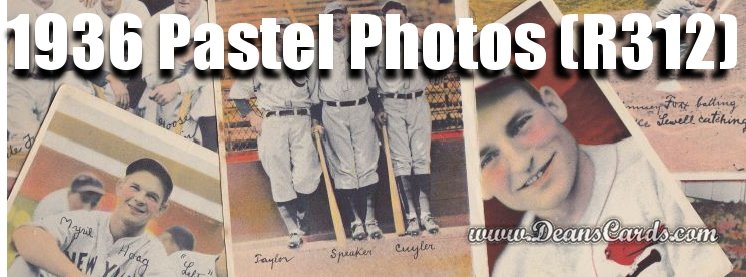
One office favorite from these collections are the 1936 National Chicle Premiums (R312). Also known as Pastels or Color Tints, these cards earn their nickname with exceptional use of color and design. With such eye-catching appeal, it's hard to believe collectors don't go wild for the 1936 Pastel baseball cards - which makes them a great value.
The 1936 Pastels are 4 inches by 5 3/8 inches or approximately the size of a postcard. A complete set of 1936 National Chicle Premiums consists of twenty-five individual player cards, fourteen multi-player cards and eleven in-action photos. In addition, the fifty card set includes stunning images and facsimile autographs for twenty-six Hall of Fame players, including Hank Greenberg, Rogers Hornsby, Honus Wagner, Jimmie Foxx, Lefty Grove, Tris Speaker and one of the earliest Joe DiMaggio cards in a Yankee uniform.
This summer, Dean's Cards has purchased multiple collections of 1936 Pastels and now have more in stock than any other time in our history.
Dean Hanley is the founder of DeansCards.com. Dean’s Cards is the #1 seller of vintage sports cards and has over a million cards posted online for sale. If you are looking to sell your cards we would be happy to hear from you. Please fill out our sell your collection form here and we will be in touch.
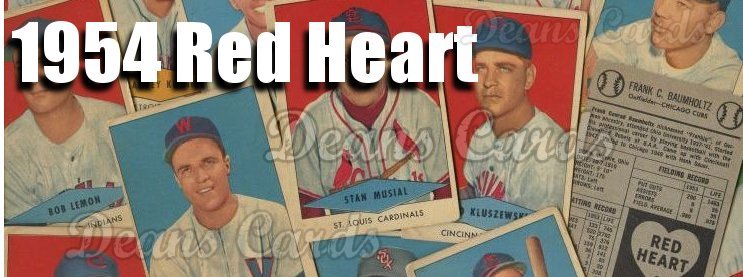
Back in 1954, if your dog ate Red Heart Dog Food, then acquiring these baseball cards was easy. As a premium for serving your dog Red Heart, kids could mail two Red Heart Dog Food labels along with 10 cents to the John Morrell & Company in exchange for one eleven-card series. Each series can be identified by the background color on the front of the card, either red, blue or green; however, cards with a red background do exist in smaller populations.
In keeping with the dog days of summer, Dean's Cards recently added abeautiful 1954 Red Heart Dog Food complete set that grades out in Excellent Plus condition. The cards in this impressive set have very little wear and very nice centering, especially the signature card in the set, #18 Mickey Mantle, which grades out in Excellent/Mint condition.
Dean Hanley is the founder of DeansCards.com. Dean’s Cards is the #1 seller of vintage sports cards and has over a million cards posted online for sale. If you are looking to sell your cards we would be happy to hear from you. Please fill out our sell your collection form here and we will be in touch.
Here at DeansCards.com we’re always trying to think up new, “unique” products. Over the course of the past 6-8 months we’ve spent a lot of time and efforts focusing on our complete set inventory. Our hard work has paid off, as we have nearly every vintage set in at least 2-3 different grades. However, Complete Sets are not for everyone- there is still a large group of individuals who like the challenge that comes with building their own sets. This is where our newest product comes into play: Near Complete Sets.
Depending on the year and the grade, our Near Complete Sets consist of 60%-80% of the cards you would get in a Complete set. This leaves collectors plenty of room to go in and individually purchase the last 100-300 cards. The best part about Near Complete Sets: the discount.
While most of our Complete Sets are priced at 20-30% off of our individual card prices, our Near Complete Sets are priced even lower. Our Near Complete Sets are priced so that sellers receive 35%-45% off of the individual card prices.
To see the Near Complete Sets we currently have in our online inventory please Click Here. If you are looking for a Near Complete Set from a year that we currently don't have online, feel free to Contact Us and we will try our best to accommodate your needs.
Sometimes you have the singles and sometimes you don't. When we don't have the singles at DeansCards.com we turn to our Complete Sets to see what we can do. We had a gorgeous Near Mint 1968 Topps Football complete set and decided to bust it so we could fill in the high grade singles we were missing. The lowest grade of any card from the break was Excellent/Mint, making this a really great addition to our singles.
The following article was written by Dean and published in the November 18, 2011 issue of Sports Collectors Digest.
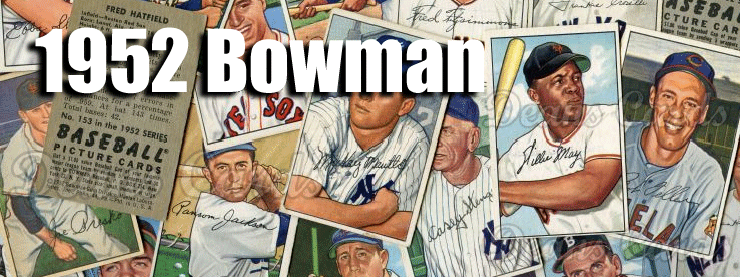
While 1952 Topps card set stole the spotlight for that particular year, the 1952 Bowman card set was anything but boring. It was simply overshadowed by the grandeur of the 1952 Topps issue. Bowman continued to slowly and steadily improve their product offering each year and 1952 was no exception.
While Bowman scaled back the number of cards in their 1952 set to 252 (their 1951 set featured 324 cards), the card size remained the same: 2 1/16” by 3 1/8”. The card fronts feature color player drawings, rendered by artists from black and white player photos. The main change that Bowman made from the previous year, was removing the black box on the card front that contained the player’s name. Overtop the player drawings are facsimile autographs, a design detail that Topps employed that very same year.
The 1952 Bowman are more attractive than the 1951 cards, but identifying a player from his signature can be a bit tricky on some of the cards, forcing a collector to consult the card’s back for identification. The simple card backs feature player statistics and an advertisement for the Bowman Gum Company, a first for the company since 1949.
The 1952 Bowman low number cards, cards 1-216, are very affordable and therefore more collectable than the 1952 Topps cards. However, the high number series of cards from 217-252 cost on average four times as much as the low numbers. Conversely, a 1952 Bowman high number common card will cost you virtually the same as a low number Topps common card from the same year.
This article is taken from Dean’s upcoming book “The Gum Card War and the Great Bowman & Topps Baseball Card Sets of 1948-1955”, which is scheduled to be released later this year in both print and eBook forms. Please feel free to contact Dean with any questions or comments at Dean@DeansCards.com
Dean Hanley is an authority on vintage sports cards and has written numerous articles on the topic. Mr. Hanley is the founder DeansCards.com, and with well-over one million vintage cards in inventory, DeansCards.com is the largest seller of vintage cards on the web. Dean has also published “Before there was Bubble Gum: Our Favorite Pre-World War I Baseball Cards”, which is available in eBook form at Amazon.com
This article was written by Dean Hanley and was featured in the Jan 13, 2012 issue of Sports Collectors Digest.
The 1951 Topps Red Back and Blue Back baseball card sets were the first pure baseball card sets ever issued by the Topps Gum Company. Due to the cards being small size and total number, as well as plain in design, the 1951 Topps Red and Blue Back cards appear somewhat elementary when compared to the later Topps issues. However, despite their simplicity, the two 52-card sets managed to lay the strong foundation on which the company would build their baseball card empire.
Topps realized that their first attempt at producing baseball cards would fall short of the product that Bowman had continued to perfect over the last three years. With that said, Topps decided to use a gimmick in order to differentiate themselves from their competition. Thus Topps produced their 1951 Topps Red and Blue back cards in a way that created a game that kids could play. The cards measure 2” by 2 ⅝” and have a background and back design similar to playing cards.
The red back set has a total of 52 cards with two variations (#36 Gus Zernial and #52 Tommy Holmes have two possible teams), while the blue backs also have 52 total cards, but with no variations. The front of the card has the game printed on the corners and the player’s head printed in black and white in the center. The card number appears on a slant in the middle of the card. The cards also include a short paragraph of statistics in the lower left corner.
The most expensive cards in the 1951 sets include Yogi Berra from the Red Back set and Richie Ashburn from the Blue Back set. Of the 104 cards in both 1951 Topps sets, thirteen of the players would eventually be enshrined in the National Baseball Hall-of-Fame. Topps included all of the major league teams in these sets, ensuring that at least four players from each club were represented in the sets. For this year, the Indians had the most players on cards with eleven, closely followed by the Yankees with ten. The Reds, Tigers, and Athletics each had only four players pictured on 1951 Topps cards.
Sales of the 1951 Topps Blue Back and 1951 Topps Red Back cards were extremely disappointing. Ultimately, boys were the judges of which company made the best baseball card and in 1951, the boys placed their votes by giving their hard-earned pennies to Bowman instead of spending them on the inferior Topps cards.
Today, there are many more 1951 Topps Red Back cards in circulation compared to the blue backs. However, this was not necessary the case back in 1951. This is partially due to the discovery of cases of red backed cards in a warehouse in the 1980’s. The red back cards that were found in this particular discovery are usually easy to identify because they are in such great condition and the perforations can still be seen on the card edges. By the time the red back cards were discovered, the card collecting hobby had matured. Now more than ever, collectors were aware of the financial wisdom that stemmed from keeping cards in pristine condition. The blue back common cards are up to ten times more expensive than the red backs, particularly in the nicer conditions.
DeansCards.com has over a million cards in stock and our online inventory is a great indicator of card populations in the hobby. The current online inventory at DeansCards.com confirms that there are many more of the red back cards in existence today when compared to their blue backed counterparts. While DeansCards.com will usually have a nice selection of the 1951 Topps Red Back cards, we generally only have a few of the Blue Back cards in stock. Despite the major the Red Back discovery, there are far fewer 1951 Topps cards in circulation than any other Topps issue.
In most cases, a low card population means that the cards will have a high value. We all learned in Economics 101 that: low supply + high demand = high price. Both the 1951 Topps Blue Back and Red Back Sets certainly have a very low population (or supply) which helps to increase their value. The problem however, lies in the notion that despite their overall scarcity, demand for the 1951 Topps sets is low when compared to the other sets of the 1950’s. Very few kids collected the set back in 1951 and few collectors choose to pursue it today. As a result, the two 1951 Topps sets are still affordable, especially the more plentiful red back cards.
Bowman clearly had the best baseball card in 1951
Meanwhile, back in Philadelphia, Bowman was busy making improvements to the baseball and football card sets that they issued in 1950. In one year, Bowman managed to increase both size of the cards, and number of cards in the set. In 1951, Bowman produced a very attractive set with hand-drawn action shots and a full paragraph description about the player on the back of the card.
The 1951 Bowman baseball card set also had the advantage of star power. Two of the biggest stars of the 1950s, Willie Mays and Mickey Mantle, were under contract with Bowman. Thus these two superstar's rookie cards premiered in the 1951 Bowman set, once again giving Bowman an edge up on the competition. The product that Bowman presented to the market in spring of 1951 was clearly superior in every way to the Topps offering.
Recently, I was speaking with one of our customers who is in the process of buying every Topps vintage complete set ever produced from us. He is buying the complete vintage sets for investment purposes. With the uncertainly of real estate, stocks, bonds and cash and with the price of gold near record highs, buying vintage sets as a long-term investment is becoming much more popular option with investors than it has been in the past.
We are down to the last few Topps sets, with 1951, 1952 and 1967 remaining. After considering the 1951 sets in terms of appearance versus cost, our customer decided to break the trend and purchase the 1951 Bowman Baseball card set instead. This story is typical and speaks volumes about the hobby’s opinion of the Red and Blue Back Topps sets of 1951.
Topps Toxic Taffy
As if the design disadvantages of the Topps sets were not bad enough, the taffy that came with the cards turned out to be toxic. The cards were printed with a glossy varnish on them that rubbed off onto the taffy, resulting in a chewy substance that both smelled and tasted like paint. It was said that upon opening the packs of cards, you were almost overcome by the terrible odor.
At that time, the 1951 Topps Red and Blue Back sets were remembered more for the unpleasant odor of the taffy, than the cards themselves. Few card sets ever produced turned out to be such a complete disaster. If the dull and boring look of the 1951 Topps sets didn’t cause the kids to puke, the toxic taffy certainly did.
The vastly inferior product produced by Topps in 1951 failed to make a dent in Bowman’s dominance of the baseball card market. Topps lost money on its 1951 baseball card sets and sued the company that printed the cards that ruined the taffy. This would be the first and last time Topps included taffy alongside of their baseball cards.
Aftermath of the 1951 Topps sets
Topps clearly had the inferior product in 1951. The Topps cards were second-rate in terms of design, card size, set size and the confection that accompanied the cards. In order to compete with Bowman in 1952, Topps decided that they had no choice but to take their legal chances and issue baseball cards with bubble gum instead of taffy. The “giant sized cards,” with colorful card fronts that placed an emphasis on the player’s face and attractive card backs that were packed with statistics from the previous year. Topps also gave up trying to make a game out of its cards and instead focused on creating a product so superior, that kids would abandon Bowman’s baseball cards altogether.
The 1951 Topps Red Back and Blue Back Sets may be failures if judged solely on design or profitability; however, the 1951 sets marked an invaluable developmental step on the way to the production of the modern baseball card. By the next spring, all American eyes would be back on baseball and Topps would be ready to take the sports card market by storm- forever changing the hobby.
This article is taken from Dean’s upcoming book “The Gum Card War and the Great Bowman & Topps Baseball Card Sets of 1948-1955”, which is scheduled to be released later this year in both print and eBook forms. Please feel free to contact Dean with any questions or comments at Dean@DeansCards.com
Dean Hanley is an authority on vintage sports cards and has written numerous articles on the topic. Mr. Hanley is the founder DeansCards.com, and with well-over one million vintage cards in inventory, DeansCards.com is the largest seller of vintage cards on the web. Dean has also published “Before there was Bubble Gum: Our Favorite Pre-World War I Baseball Cards”, which is available in eBook form at Amazon.com
The following article was written by Dean and published in the November 4, 2011 issue of Sports Collectors Digest.
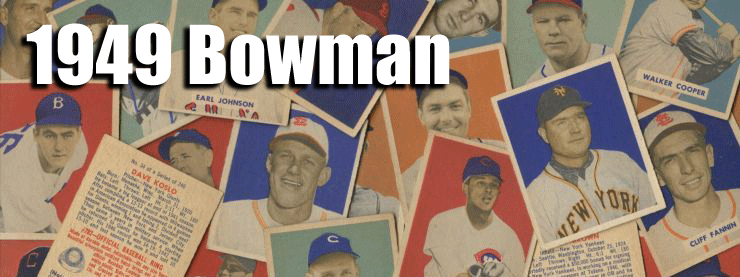
In comparison to their 1948 set, the 1949 Bowman baseball card set was an improvement in both picture quality and quantity. The 1949 Bowman cards are the same size as their predecessor, but, instead of a bland black and white coloring, Bowman tinted the photographs of the players and added a colored the background. Bowman also drastically increased the size of the 1949 set, reaching 240 cards. This set also includes a high number series of cards (#145-240) that were issued in fewer numbers and are harder for collectors to find.
#50 Jackie Robinson
The 1949 Bowman set increased to 240 cards, therefore “rookie cards” account for nearly three-quarters of this set. For the first time, African-Americans appeared in a major issue of cards. The most prominent rookie cards in the 1949 Bowman set include are Jackie Robinson, Roy Campanella, Satchel Paige and Duke Snider.
The 1949 Bowman set also has several different variations for many of the cards. The variations for this set include things like: “name on the front”, “no name on the front”, “print name on back”, and “script name on back”.
The 1949 Bowman cards were issued with both white and grey backs. Both backs were issued in roughly the same numbers and therefore have approximately the same value. The 1949 Bowman baseball card set was issued in seven series, consisting of 36 cards each. This was extremely efficient because each of the printing sheets contained 36 cards. The result is a very clean set with an equal population for each of the cards.
Not only was Bowman getting better at producing cards, they were also getting better at selling their cards. In 1949, Bowman tried a clever “marketing trick” to help increase sales for the 1949 set. Bowman intentionally “removed” card # 4 from of the 1st series printing sheet, by simply renumbering it as card #73.
This marketing ploy was designed to trick boys to waste some of their hard-earned change on first series packs of cards in the hopeless effort to obtain that elusive 1949 Bowman # 4 card. Collectors eventually discovered that they had to wait until the 3rd Series, which was released several months later, if they wanted to obtain card #4.
To the disappointment of many young collectors, Bowman had not been saving a superstar for card # 4, instead choosing to feature Jerry Priddy, a St. Louis Browns infielder with a less than remarkable playing career. Another benefit of this deception was that by including a card #73 in the 1st series, it was a clear signal to the kids that the set was going to contain more than 36 cards.
My guess is the ruse involving the #4 was treated with some distain by collectors, if it was even noticed by collectors. It is doubtful that this trick increased Bowman’s 1949 card sales by a large amount. As a business owner, I would imagine that the trust lost after pulling a trick like on their customers, far outweighed any extra profit made by increased sales. Either way, this ploy would never be intentionally repeated by Bowman (or Topps) again.
Left Coast Cards
Bowman also tried to tap into the rapidly growing population on the west coast by releasing a 36-card Pacific Coast League baseball card set in 1949 that looked identical to the regular 1949 issue. These cards were distributed only on the west coast and in Bowman’s hometown of Philadelphia. The Pacific Coast League players were particularly popular in the 1940's and early part of the 1950's because there was no major league team playing there until 1957.
#28 Lee "Jeep" Handley
#28 Lee "Jeep" Handley
The Pacific Coast League cards can be easily distinguished by the "PCL" before the card number. Unfortunately, the PCL cards were not very well received and idea was discontinued after one series of cards; therefore, because they were issued in much smaller numbers, the 1949 Bowman PCL cards are much more expensive and difficult for today’s collectors to find than compared to the regular 1949 Bowman set.
This article is taken from Dean’s upcoming book “The Gum Card War and the Great Bowman & Topps Baseball Card Sets of 1948-1955”, which is scheduled to be released later this year in both print and eBook forms. Please feel free to contact Dean with any questions or comments at Dean@DeansCards.com
Dean Hanley is an authority on vintage sports cards and has written numerous articles on the topic. Mr. Hanley is the founder DeansCards.com, and with well-over one million vintage cards in inventory, DeansCards.com is the largest seller of vintage cards on the web. Dean has also published “Before there was Bubble Gum: Our Favorite Pre-World War I Baseball Cards”, which is available in eBook form at Amazon.com.
The 1949 Bowman Article is dedicated to Rocky, a regular SCD reader, who was kind enough to sell us is 1949 Bowman complete set. Earlier in the year he also parted with his beloved 1950 Bowman set. Rocky, Please enjoy!
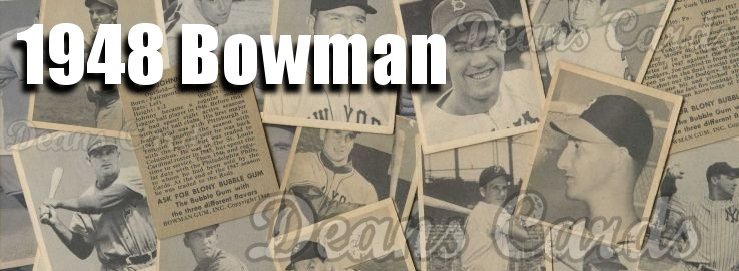
With the men home from war and the economy booming, the first major post-World War II baseball card set was released by the Bowman Gum Company in 1948. The 1948 Bowman baseball cards were issued in one-card penny packs that included a piece of bubble gum. The cards were much smaller than today’s baseball cards, and measured only 2-1/16” by 2½” and were printed in black and white. The front of the cards are very plain and contain no text, just a basic black and white photograph.
#18 Warren Spahn
Exactly one-half of the cards in the 1948 Bowman set were of players that played for the Giants or Yankees, while the NL champion Brooklyn Dodgers only had 3 players represented. This was probably a smart move from a business standpoint, as New York traditionally had the best teams, the most fans, and was the nation’s biggest market. Although, the 1948 Bowman baseball card was issued nationally, it is clear that Bowman was targeting its first post-war set at the island of Manhattan and would be watching from Philadelphia with great interest.
In 1948, Bowman was forced to use the photos that they had available to create the cards. The results were very mixed. Warren Spahn's card is probably the most disappointing rookie card of a Hall-of-Famer ever printed. Evidently, this was the best photo of Spahn that could be found before the printing deadline. The strangest card in the 1948 set has to be the one of Phil Rizzuto. This photo gives the impression that Rizzuto has a pillow tucked inside of his shirt.
Short-Prints, Double-Prints, and High Numbers
As the first baseball cards produced in seven years, the 1948 Bowman set has some unique quirks. The 1948 Bowman baseball card set was designed to be issued in one series of 48 cards. The problem is that a printing sheet contained 36 cards, so the set would have to be printed in two separate sheets. It is unclear as to why Bowman decided to issue a set with only 48 cards. It could be that Bowman had signed contracts with only 48 players, which would explain the large number of players from the New York-based teams. A more likely scenario is that after a seven-year break in producing cards, Bowman had to re-educate themselves on the manufacturing process.
#8 Phil Rizzuto
The first printing sheet contained cards numbered 1 through 36. It was the second sheet that created the dilemma. The second printing sheet contained the remaining dozen cards of the 1948 Bowman set, but still had spaces for another 24 cards. The cost of a printing a sheet of cards is basically the same, regardless of the number of images or cards it contains. Since there were no additional costs involved, Bowman executives decided "double print" 24 of the cards that had already been included on the first sheet of cards.
According to most traditional price guides, the 1948 Bowman baseball card set contains 12 short-printed cards and 12 high-numbered cards. After consulting the DeansCards.com inventory, the surviving population of 1948 Bowman Short-Print and High Number cards seems about the same. It also appears that the same number of sheets were printed for both of the print runs, so my conclusion is that one-half of the cards in the 1948 Bowman baseball card set had twice the number of cards printed as the other half of the set.
Bowman quickly discovered that the printing costs for a 72-card set is almost the same as that of a 48-card set, so they quickly corrected their mistake by the time they issued their football card set that fall.. Bowman used this card size for several more baseball, football, and non-sports card sets until they eventually increased the size of their cards in 1951. It is interesting to note that the number of cards in each of these sets is divisible by 36, eliminating the problem of short-printed cards.
Luckily for collectors of the short-printed cards, the only superstar is #8 Phil Rizzuto. Even with 24 "short-printed” cards in the set, the 1948 Bowman set only ranks as "moderately difficult" to complete.
All Part of a Bigger Plan
The Bowman Gum Co. knew exactly what they were trying to accomplish in 1948, therefore they were able to succeed. Bowman wanted to issue a “national” set and not be limited to just one region of the country; and that they did. The 1948 Bowman baseball card set contains players from 10 of the 16 major league teams.
The 1948 Bowman baseball card set was a very modest offering by all standards. Considered the most basic of all the Bowman sets, 1948 Bowman set was an important first step in the evolution of the baseball card. It was the first set of the modern era of baseball cards, and ultimately ushered in a decade great sets. By doing things on a small scale in 1948 – a plan that Topps would replicate in 1951 - Bowman learned some very valuable lessons and was then able to come out with a much larger and better set of cards the following season. Even with a virtual monopoly on the bubble gum baseball card market, Bowman would steadily improve its product offering over the next five years.
This article is taken from Dean’s upcoming book “The Gum Card War and the Great Bowman & Topps Baseball Card Sets of 1948-1955”, which is scheduled to be released later this year in both print and eBook forms. Please feel free to contact Dean with any questions or comments at Dean@DeansCards.com
Dean Hanley is an authority on vintage sports cards and has written numerous articles on the topic. Mr. Hanley is the founder DeansCards.com, and with well-over one million vintage cards in inventory, DeansCards.com is the largest seller of vintage cards on the web. Dean has also published “Before there was Bubble Gum: Our Favorite Pre-World War I Baseball Cards”, which is available in eBook form at Amazon.com
Dean's Cards is currently scheduling appointments to meet with sellers at the NSCC show. Dean and his gang will be in Chicago for 2011 National Card Collectors Convention on August 4th and 5th and we are looking to buy just about any card from 1869 to 1969.
With over one million vintage cards for sale, Dean’s Cards sells more vintage cards than any other dealer.To do so, we must buy a lot of cards.Dean’s Cards buys over 500 vintage collections each year and is looking to add to that number in Chicago this summer.
What you may not know is that we do not set up a booth at the show and buy collections by appointment only.In order to book an appointment to sell your collection in Chicago please email orders@deanscards.com or call us at (513) 898-0651.
Last Thursday, Dean got the chance to sponsor anotherGreen Diamond Gallery event, this time featuring Cincinnati Reds starting pitcher Bronson Arroyo. Dean got to introduce Bronson, who has been with the Reds for the past six seasons and won at least nine games each year. Bronson got to talk about his time playing for the Boston Red Sox and winning the 2004 World Series. He also showed the audience how to throw one of his famous curve balls and even got to sing and play guitar. Dean said he thoroughly enjoyed the stories about the current Reds team and pitching staff.
The next day, Bronson started the game against the St. Louis Cardinals, and, although he didn't get the W, the Reds won in extra innings. Please click here to view our entire selection of Bronson Arroyo baseball cards. Click here to read about Dean's previous Green Diamond Event experience hosting Dave Parker.
What does the owner of Dean's Cards collect for fun? This year it is the 1969 Topps Baseball card set - completely autographed. I have posted the set online so everyone can enjoy it. Please click here to view the Autographed 1969 Topps baseball card set.
The mailman just delivered the June 4th copy of the Sports Collectors Digest. The cover story and featured set is this issue is my personal favorite – the 1969 Topps Set. T.S O’Connell was kind enough to ask me to help contribute to his 1969 Topps baseball card article.
SCD also published a short article my me about my 1969 Topps autographed set. It was a total surprise to me. Please feel free to check it out.
I am not sure that I will ever get the set completed, but it sure has been fun. I have posted scans of the partially completed 1969 Topps Baseball Card set online for everyone’s enjoyment.
Six of my favorite 1969 Topps autographed cards include:
#95 Johnny Bench’s Topps All-Star Rookie Card signed in pen. This is my personal favorite of all of Bench's cards. Take notice of the #55 on his jersey. The uniform that Bench is wearing is the home jersey that the Reds wore up through the 1966 season. This photograph was most likely taken in spring training of 1966 when Bench was 18 years old.
#147 Leo Durocher - I admire the time and care that Leo took in signing the card. Leo was once described as the “most hated man in baseball”. Although “Leo the Lip” looks fairly tame on his 1969 card, he was known for his combative nature. As a player, Leo would constantly get into fist fights with players, umpires and fans. (To Leo's credit, he never came to blows with the peanut vendor.) In 1969, his Cubs were in 1st place by 5 games on Sept 1st. The Cubs went 8-17 during the month and finished 8 games behind the Mets. Someday, after everyone that knew him personally is dead and gone, Leo may make it into the Hall-of-Fame.
# 215 Rico Petrocelli – A nice pen signature. Rico had his career in 1969 and set an AL record with most HR’s by a Shortstop with 40. His fielding average that year was a .981, so he could not have been that bad of a fielder. The poor guy only finished 7th in voting for the MVP. Great year Rico!
#260 Reggie Jackson – Look at this signature! I love (hate) this card, because it seems to go with everything that we read and hear about this guy. Who else (Willie Mays excluded) would have the guts to deface his expensive rookie card with a signature like this? I guess that they were not paying Reggie enough money at this particular show. That said, Jackson did have a great year in 1969. The 23 year old Jackson hit 47 HR’s and had 118 RBI’s.
#601 Tug McGraw – You can’t talk about 1969, without including at least one of the 1969 Amazing Mets. The 24 year old McGraw had a break out year in 1969 and helped the Mets pull off a major upset. Up to that point, the Mets would not let him throw the screwball. I am missing quite a few of the Mets 1969 Topps autographed cards from my set. It is not that they are hard to find. They are not. There have been many cards shows featuring this team. They are expensive!
#573 Jim Palmer - This was my favorite card as a kid. I always wore my index finger outside my glove because of this card. Most fans do not realize that Palmer's carreer was considered finished. Jim hurt his arm in 1967 and did not pitch in the majors in 1968. He was left unprotected for the first two rounds of the 1969 expansion draft, but even these start-up teams were afraid to take a chance on him. Palmer bounced back and went 16-4 with a 2.34 ERA in 1969 and was on his way to the Hall-of-Fame.
I currently have 546 cards autographed by different players, with 134 more to obtain. 42 of the players that appear in the 1969 Topps set are currently in the Baseball Hall-of-Fame and 116 are now deceased. Click Here to view the whole 1969 Topps autographed set.
We just bought a very nice collection of mid-1930’s Baseball Cards. This collection contained 1934 Goudey Baseball Cards, 1936 Goudey Black & White Baseball Cards, 1936 Goudey Wide Pen Premiums, 1934-36 Diamond Stars Baseball Cards, 1934 Goudey Indian Gum Cards, and some 1933-34 National Chicle Sky Birds Cards.
The cards are great by themselves, but what makes this collection so cool is that the actual collector brought in the cards (with a little help from his family). Even though Dean’s Cards buys close to 1,000 collections a year, all but just a few are sent to us through the mail.
An older gentleman came in with the cards and told us stories from his childhood of buying the cards to get the gum. He described how big and thick the chunks of gum were and how great it tasted as a kid. The whole Dean’s Cards gang stopped what they were doing to listen in on the stories. This gentleman walked with the help of a cane and must have been close to ninety, but he almost looked like a kid again as we discussed boyhood heroes, bubble gum and baseball cards.
He then went into stories about Dizzy Dean and the Gashouse Gang. The Cardinals were definitely the most popular team of the era. His team was the Cleveland Indians and I heard stories about Bob Feller and Lou Boudreau, too. I can listen to stories like this all day long and into the night!
Days like these are why I got into this hobby. This is pure Americana! I feel really lucky and blessed to be fortunate enough to play with sports cards every day. Please check out the video for a look at the cards.
When collectors contact Dean’s Cards about selling their sets, the e-mails go directly to Dean. But what most people don't realize is that someone else usually goes through all the cards to determine the value of the collection.
Dean's Cards goal is to have one million cards posted online by the end of the year. In order to accomplish this goal, we aggressively buy vintage sports cards: nearly 1000 collections a year. No one pays more and no one is more trustworthy. The word on how much Dean's Cards pays for collections is getting out!
Evaluating A Collection
At Dean’s Cards, we pride ourselves on both our accuracy and our speediness when bidding on collections. Our goal is to submit an offer to the seller within two business days after the package arrives at the office.
Please click here for more information about what we buy or to watch Dean’s video on selling your sports card collection.
My favorite sports cards publication is Sports Collector's Digest. I look forward to SCD's arrival every week. SCD is a great way for me to keep up with happenings in the hobby because Dean's Cards does not attend card shows.
T.S. O'Connell has featured a different vintage set in every publication of SCD over the past year. I never miss his articles.
Last week, T.S. emailed me to ask if I would like to contribute to his upcoming article on the 1957 Topps Football Card set. I was truly honored by the invitation, so I typed up a few thoughts and e-mailed them to him. Evidently, he was searching the internet for resources when he stumbled upon Dean's Cards and one of my collecting blogs.
T.S. called a few days later and we had a great conversation over the phone. I thoroughly enjoyed chatting with such a knowledgeable guy about our hobby.
The 1957 Topps Football article came out in this week's issue of SCD. I hope you enjoy reading it as much as I did contributing to it.
The 1957 Topps Baseball Card set remains a favorite among collectors for its color photographs and its use the vintage ballparks as backdrops. Critics often fuss that the photos have a greenish tint, but I personally think that this adds to the charm of the set. Beginning with the 1957 Topps Baseball Card set, the size of the card was reduced to the standard that we are still using today.
Topps packed the 1st series with a lot of star power, as the set contains 7 Hall of Famers in the first 20 cards and 23 HOFers in the first 100 cards. With 407 cards, the 1957 Topps Baseball Card set was the largest set that Topps produced up until that time. That said, that number would be bested the following year and again in 1959.
There is still no Stan Musial card in the set. Stan had a $100,000 a year salary and felt that he was worth more than the $125 that Topps paid each of the players. Stan would finally consent to having his images put back on cards in 1958.
Dean’s Cards builds over 100 vintage sets each year and the1957 Topps Baseball Card set is definitely one of the tougher sets to put together. Not only does the 1957 Topps set have eight great rookie cards, but also the 4th series is so scarce that it is tough to complete – especially in higher conditions.
The 1957 Topps set contained two multi-player cards of the Dodgers Sluggers #400 and Yankees Power Hitters #407. Topps would continue the trend of the Multi-player star cards for another dozen years. It is was great way to get the stars of the day on one more card.
Topps also inserted 4 contest cards, an ad card and 4 contest cards into the set. The checklist cards are near impossible to find in nice condition, as many were either marked up or discarded by the kids. Because of the cost of the checklists and ad cards, most collectors consider the set complete without any of these special cards or the Baker Error Card.
Innovations: Color photographs, smaller card size, complete player stats on back of the card & largest # of cards in a set to date.
Rookie Cards: 18 (including Rocky Colavito & Bobby Richardson)
7 Hall-of-Famer Rookie cards: #338 Jim Bunning, #18 Don Drysdale, #29Whitey Herzog, #312 Tony Kubek, #24 Bill Mazeroski, #328 Brooks Robinson & #35 Frank Robinson.
Toughest Series: The 4th Series (Cards #265-352)
33 Cards of Hall-of-Famer Players
Coolest Card: #165 Ted Kluzewski
Most Expensive Card: #95 Mickey Mantle
Rare Error Card: #176 Gene Baker (spelled Bakep on back)
Hardest to card find: The checklist cards in nice condition
Most Interesting card: #20 Hank Aaron with the reversed image
The 1952 Topps Baseball Card set was the first mainstream set issued by the Topps Gum Company and far surpassed all earlier sets in size, quality and quantity. The giant sized cards symbolized America’s new postwar prosperity and became an instant hit with collectors and set a new benchmark for the hobby.
The upstart Brooklyn based Topps company carefully planned their attack on Bowman’s dominant position in the baseball card market. The 1952 Topps Baseball Cards were the first set that was issued in six series. Each series was carefully proportioned with a fairly equal number of stars and players from each team. The 1952 Topps cards were 52% bigger in size than the 1952 Bowman cards and had 61% more cards in the set.
Topps clearly saved the best for the last series that aimed directly at their hometown and biggest market. Series #6 was a Who’s Who of Gotham stars starting with the first card in the series, #311 Mickey Mantle. This was followed by #312 Jackie Robinson, 1951 Giants “Shot heard around the world” Hero #313 Bobby Thompson, #314 Roy Campanella and #315 Leo Durocher.
Most people can name the most valuable post-war baseball card as the 1952 Topps #311 Mickey Mantle, but few realize that it was "double printed", which means that the printed sheets contained two Mantle cards and twice as were printed when compared to normal cards. (The first three cards of the 6th series were double prints.) One can only guess what the value of Mickey's 1952 card would be if it were not a double print!
These cards were soon followed in the 6th Series by more stars from New York City, such as Bill Dickey and the rookie cards of Gil McDougald, Joe Black, Hoyt Wilhelm and Boston’s Eddie Mathews. Unfortunately, most collectors would never get a chance to purchase these great cards of Series 6. Many retailers, who had not yet become accustomed to late season attraction of the super stars in the last series, refused to buy more product in September and did not place orders for the sixth series of cards.
The 1952 Topps 6th series was distributed in such low numbers that it is the toughest and most expensive high number series in the history of collecting and the hardest set to complete. For the next decade, Topps tried to give away these cards at various promotions, until they finally gave up and dumped the remaining 1952 Topps cards into New York Harbor! Just think, in 1960 someone could have purchased these cards from Topps for pennies on the dollar.
Dean’s Cards is currently offering the best selection of 1952 Topps cards that we have ever seen. We have just added about 400 of the 1952 Topps baseball cards to our inventory, including many high numbers. Although the cards vary in condition, many grade PSA 6, PSA 7 and PSA 8. One of the #261 Willie Mays came back as a PSA 7.5!
PSA graded the Mantle as a 5, which is a joke. (In my humble, yet biased opinion.) If it were any other card, it would bet it came back as a 6 or 7. Please feel free to take a look at the scan and video and see if you can see a flaw.
The very nice 1952 Topps Reprint set is available at Dean’s Cards for the budget collector. The 1952 Topps Reprint Baseball Cards are an affordable way to buy a Complete Set or build a Team Set at an affordable price. Here is your chance to own a 1952 Topps Mantle.