“In 1951, Bowman's short-lived baseball card monopoly was broken by Topps and the great Baseball Gum Card War was in full swing. Consumers almost always benefit from competition in the marketplace and the card collectors were no exception during the Baseball Bubble Gum Card War. The result was the birth and rapid evolution of the modern baseball card.
Each spring during the years of 1952 to 1955, American boys had their choice between two great sets of baseball cards. The boys would cast their votes for their favorite issue of the year by sliding nickels across the counter of America's dime-stores to purchase baseball cards from either Topps or Bowman. These wonderful Topps and Bowman sets of the early 1950s sparked the addiction of an entire generation of boys to the hobby of collecting baseball cards.By the end of the decade, 89% of American boys would be collecting baseball cards.
This battle between Topps and Bowman, for control of the baseball card market, became known as "The Great Baseball Card Bubble Gum War." This contest was fought with such ferocity, that shortly after the war began it became clear that only one company would be left standing at the conclusion of hostilities. The winner would take all.
This epic conflict for the control of America's favorite collectible is brought to life by the author, Dean Hanley, who is a long-time collector and the founder of DeansCards.com, which has the largest online inventory of vintage sports cards ever assembled. Dean writes a popular blog and has had dozens of articles about vintage baseball cards published in the "Sports Collectors Digest."
Mr. Hanley combines his love of vintage sports cards, over forty years of card collecting experience, and extensive research to bring to life this fascinating battle for control of the bubble gum card market. Hanley examines each of these vintage baseball card sets from the era, details the evolution in the design of the cards, the companies that produced them, and the two visionary men that made these wonderful cards a reality and started a hobby that continues to this day.
Dean Hanley is the founder of DeansCards.com Dean’s Cards is the #1 seller of vintage sports cards and has over a million cards posted online for sale. If you are looking to sell your cards we would be happy to hear from you. Please fill out our sell your collection form here and we will be in touch.
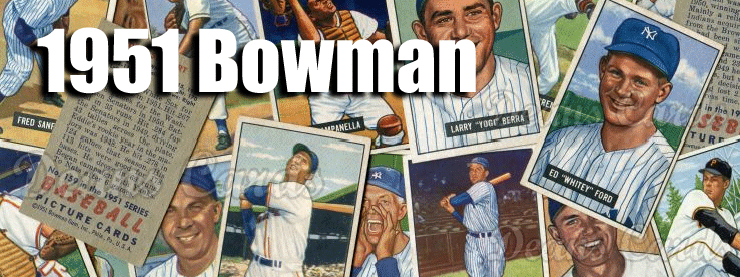
Although the 1951 Bowman baseball card set increased in both card size and number of cards, it ultimately maintained the attractive design of the 1950 set. The only real design difference between the two sets are that the player names were now located on the card fronts. There are 324 cards in total, each measuring 2-1/16” by 3-1/8.” Cards from the 1951 set can also be identified by the distinctive coloring of the words on the back. The text is printed in blue ink except for the word “baseball,” which is printed in red ink at the bottom of the card.
Bowman used the same printing technique in 1951 that they had used in the previous set. They had artists colorize black-and-white photographs.There is one card with original artwork: #195 Paul Richards, the White Sox manager who was hired after Bowman had already started production on the set.
Many collectors feel that the 1951 Bowman baseball card was the company’s best effort. Bowman had the good fortune of printing the rookie cards of two of the biggest stars of the decade in its 1951 set: Mickey Mantle and Willie Mays.
Furthermore, both of these cards are part of the high number series (#253-324), making them even harder to find and more expensive to collect. Lastly, its operations became so smooth that aside from a few mistakes spelling last names, there are very few pricy error cards.
This article is taken from Dean’s upcoming book “The Gum Card War and the Great Bowman & Topps Baseball Card Sets of 1948-1955”, which is now available for sale at Amazon.com.
Dean Hanley is an authority on vintage sports cards and has written numerous articles on the topic. Mr. Hanley is the founder DeansCards.com, and with well-over one million vintage cards in inventory, DeansCards.com is the largest seller of vintage cards on the web. Dean has also published “Before there was Bubble Gum: Our Favorite Pre-World War I Baseball Cards”, which is also available in eBook form at Amazon.com and has just released a T207 reprint set. For more information, please visit www.DeansCards.com.
The following article was written by Dean Hanley and will be published in an upcoming issue of Sports Collectors Digest.
1951 Topps had proceeded very cautiously when they issued the 1951 Topps sets, much as Bowman had done with their first national post-WWII issue of cards in 1948. The main reason for packaging the 1951 cards with taffy was to protect the company from a potential legal attack from Bowman. Topps had gotten their feet wet with a very simple set. Topps had learned from its numerous mistakes and would never go to market with such a tawdry product again.
Topps catches some luck: Location
Although Topps got off to a very inauspicious start in the baseball card market in 1951, they did not let the failures of their first major set discourage them. They kept pushing forward and as a result, Topps did manage to catch a few breaks.
While Bowman was headquartered in Philadelphia, Topps was located in New York City, the epicenter of the baseball world. The Yankees, Dodgers, and Giants all called New York City home, which would prove to be a significant advantage for Topps in the early part of the 1950’s. The New York teams were at their peak and at least one New York-based team would appear in each World Series from 1949 to 1958.
More luck: Baseball reaches the heights of popularity
Topps also had the fortune of great timing. Baseball had reached a new peak in popularity. Baseball games were setting new attendance records and the number of local, small-town radio stations that broadcast games soon doubled. No longer was it imperative to live in a major city in order to enjoy a ballgame.
Baseball was further popularized by new technology. As televisions started appearing in homes across America, local stations began televising games. The first nation-wide broadcast of a baseball game was in 1951. A record number of people now had access to the sport. The very same children who once popularized the art of collecting baseball cards decades before, now had the ability to watch their favorite players in action, with lights and sounds.
Baseball’s exciting new stars
Baseball’s popularity had soared when the games great stars returned from war in 1946. The higher level of play on the field continued as the color-barrier was broken in 1947 by Jackie Robinson. Robinson led the Dodgers to the World Series that year and clubs began signing the best player available – regardless of skin color – in order to compete.
The year of 1951, the nation’s epicenter, New York City saw the arrival of two most exciting baseball stars, who would dominate the game for the next two decades: Mickey Mantle and Willie Mays.
Miracle of Coogan’s Bluff
Topps timing was also fortunate because America would tune into baseball just in time to witness something very special. The 1951 National League pennant race, considered one of the most exciting of all-time. On August 11th, the Dodgers were 13 ½ games ahead of the Giants. Dodgers’ manager Chuck Dressen was over-confident and proclaimed, “the Giants are dead!” However, the Giants proceeded to feed Dressen his words when they won 37 of their last 44 games, including the last seven, tying the Dodgers at the season’s end and forcing a three-game playoff.
The Giants’ Bobby Thomson hit a home run off of Ralph Branca to win Game one at Ebbets Field. The teams then moved to the Polo Grounds where the Dodgers won Game two, 10-0 behind Clem Labine. The stage was set for Game three. The teams were locked in a 1-1 tie until the eighth inning, when the Dodgers rallied for three runs. Dodgers Ace Don Newcombe sailed through the bottom of the 8th inning and looked to be in total control as the Giants came up to bat in the ninth inning.
Newcombe then ran into trouble, surrendering three hits and a run to the Giants. The score was now 4-2, with Game one Hero, Bobby Thompson coming up to bat. Dressen brought in Ralph Branca to face Thompson and Bobby responded by hitting Branca’s second pitch into the left field bleachers, on what has become known as the “Shot heard ‘round the world.”
The Giants immense joy was short-lived, as the dominant Yankees then proceeded to beat them in the World Series and also did the same to the Dodgers the following year. The World Series never left New York City for those three years.
If you think that big city teams dominate baseball today, in the decade between 1947 and 1956, the three New York teams made a combined 16 World Series appearances. The Yankees won seven rings and the N.L. clubs each took one home as well.
The popularity of the game of baseball was more popular than it had ever been. The fans could not get enough of the sport, which was also driving the sales of baseball cards to all-time highs.
Meanwhile back in Philadelphia
By 1951, Bowman was selling 200 million baseball cards and generating almost one million dollars in baseball card sales, which accounted for almost one-third of Bowman Gum’s total sales for the year. Even with the appearance of the Topps Blue and Red Backs sets in 1951, Bowman still had no serious competition in the baseball card market. Although Topps was making an effort to produce baseball cards, it was far from certain how that would play out. It was very possible that Topps could retreat from the baseball card market, as Leaf had done after 1949.
Bowman Gum had steadily improved its product, market position and profits since they re-entered the baseball card market in 1948. The Bowman baseball cards had improved in quality and quantity in each of the four issues. The 1951 Bowman baseball card set included 324 cards, the most that there would ever be in a Bowman set.
Although no one realized it in 1951, Bowman reached its zenith. Well, almost no one.
J. Warren Bowman was not the type of man to let his bubble gum empire slip away without a fight. When the 1951 Topps baseball cards appeared in stores, the Bowman Gum Co. was quick to take legal action to protect their dominant position in the baseball card market. Bowman Gum filed a lawsuit against Topps, just as they had done against Leaf two years earlier.
Issuing sets of sports cards alongside their gum products gave the Bowman Gum Company a huge advantage over the competition. Warren Bowman had the foresight to lock the professional players of both baseball and football, whose images were essential in producing a successful set of cards, into exclusive multi-year contracts. These exclusive contracts prohibited Bowman’s competitors from selling cards with gum products, giving Bowman a virtual monopoly on this fast-growing market.
Seeing the 1951 Topps baseball cards sets as a threat, Bowman went all out to secure exclusive contracts for as many of the baseball players as he possibly could. Believing that Joan Crosby was going to be the answer to signing players, Bowman contracted with Art Flynn, one of baseball’s first super agents, in July of 1951, to start signing players to contracts to appear on Bowman baseball cards. Flynn was authorized to sign a minimum of 15 players from each team to appear on Bowman baseball cards.
More Luck for Topps: Warren Bowman takes a bow
Given the business genius of J. Warren Bowman, it is doubtful if this chain of events was lost upon him. Bowman knew that Sy Berger had spent the summer signing hundreds of baseball players to contracts to appear on Topps baseball cards. Although he never publicly commented on it, Bowman knew what most of the public did not: a Bubble Gum Baseball Card War was about to begin.
In the 1930’s, Bowman had built his bubble gum company into the market leader, only to lose control of it a few years later. J. Warren eventually regained control of the company and Bowman Gum continued to be the leading producer of bubble gum, but things were different. Two decades had passed and Warren Bowman was no longer a young man. The value of the Bowman Gum Co. was at an all-time high and Mr. Bowman knew that even if Bowman Gum could defeat the Topps challenge to the baseball card market, that it may take years for Bowman Gum’s profits to return to 1951 levels.
Warren Bowman’s advantage was that he had inside information that was not yet apparent to the market. J. Warren Bowman decided that it was time for him to “cash out”. So in April of 1952, the Bowman Gum Co. was sold to Haelan Laboratories, Inc.
No matter how much due diligence that is performed by someone purchasing a company, the seller almost always has more knowledge and understanding regarding the company and its markets that it is selling, than the buyer can uncover.
On the surface, it appeared that Haelan Labs was acquiring:
1. The undisputed market leader - The Bowman Gum Co.
2. In a highly profitable market niche - Bubble Gum.
3. With an exploding target market – the kids of the Baby Boom Generation.
4. With a legally protected monopoly on a marketing advantage to sell its product – Baseball Cards.
5. Based on a sport that was at the peak of its popularity – Baseball.
The stark reality of this situation would turn out to be far different.
Haelan Laboratories had purchased all the assets that J. Warren had built, except leadership and creativity. Especially in emerging markets like baseball cards,is the most valuable asset that a company possesses. Jacob Warren Bowman would fade away into history, and with him went much of the company’s creative thought and competitive spirit. Those traits would be sorely missed in the next few years, as the Baseball Card Bubble Gum war continued to increase in ferocity.
With Bowman’s retirement, Topps had just caught its biggest piece of luck yet. That luck was also shared by Warren Bowman, who had made a great fortune of selling his company while it was at its highest value. Few entrepreneurs are wise enough and lucky enough to accomplish this feat. J. Warren Bowman had staged his last, in a long line of coups.
Sometimes, there is no substitute for good timing.
The Perfect Storm
By the end of 1951, by both circumstance and design, several drastic changes had all collided at the exact same time:
1. Baseball was at an all-time highin popularity, thanks to an infusion of new exciting talent and also by the 1951 N.L. pennant race that was climaxed by the “Miracle of Coogan’s Bluff”.
2. The nation’s best baseball teams – the Yankees, Dodgers, and Giants - were all located in New York City, which was also the largest U.S, market for bubble gum.
3. Baseball card sales were also at an all-time high, thanks to Warren Bowman.
4. The oldest of the huge U.S. Baby Boom population of boys was turning 6 years old – and now old enough to begin buying baseball cards.
5. The most experienced and successful seller of baseball cards ever, Warren Bowman had sold his company and retired.
6. J.E. Shorin had finally turned the Topps baseball cards efforts over to Sy Berger.
The stage was set. With assistance from an artist named Woody Gelman, Sy Berger spent the winter designing the 1952 Topps cards, on the kitchen table of his apartment in Brooklyn.
By the time that the big 1952 Topps baseball cards reached the shelves of candy stores in April of 1952, the ink that the executives of Haelan Labs had used to sign the purchase agreement, of the Bowman Gum Company, had barely dried. Haelan would be in for the surprise and the fight of its life!
This article is taken from Dean’s upcoming book “The Gum Card War and the Great Bowman & Topps Baseball Card Sets of 1948-1955”, which is scheduled to be released later this year in both print and eBook forms. Please feel free to contact Dean with any questions or comments at Dean@DeansCards.com
Dean Hanley is an authority on vintage sports cards and has written numerous articles on the topic. Mr. Hanley is the founder DeansCards.com, and with well-over one million vintage cards in inventory, DeansCards.com is the largest seller of vintage cards on the web. Dean has also published “Before there was Bubble Gum: Our Favorite Pre-World War I Baseball Cards”, which is available in eBook form at Amazon.com
This article was written by Dean Hanley and was featured in the Jan 13, 2012 issue of Sports Collectors Digest.
The 1951 Topps Red Back and Blue Back baseball card sets were the first pure baseball card sets ever issued by the Topps Gum Company. Due to the cards being small size and total number, as well as plain in design, the 1951 Topps Red and Blue Back cards appear somewhat elementary when compared to the later Topps issues. However, despite their simplicity, the two 52-card sets managed to lay the strong foundation on which the company would build their baseball card empire.
Topps realized that their first attempt at producing baseball cards would fall short of the product that Bowman had continued to perfect over the last three years. With that said, Topps decided to use a gimmick in order to differentiate themselves from their competition. Thus Topps produced their 1951 Topps Red and Blue back cards in a way that created a game that kids could play. The cards measure 2” by 2 ⅝” and have a background and back design similar to playing cards.
The red back set has a total of 52 cards with two variations (#36 Gus Zernial and #52 Tommy Holmes have two possible teams), while the blue backs also have 52 total cards, but with no variations. The front of the card has the game printed on the corners and the player’s head printed in black and white in the center. The card number appears on a slant in the middle of the card. The cards also include a short paragraph of statistics in the lower left corner.
The most expensive cards in the 1951 sets include Yogi Berra from the Red Back set and Richie Ashburn from the Blue Back set. Of the 104 cards in both 1951 Topps sets, thirteen of the players would eventually be enshrined in the National Baseball Hall-of-Fame. Topps included all of the major league teams in these sets, ensuring that at least four players from each club were represented in the sets. For this year, the Indians had the most players on cards with eleven, closely followed by the Yankees with ten. The Reds, Tigers, and Athletics each had only four players pictured on 1951 Topps cards.
Sales of the 1951 Topps Blue Back and 1951 Topps Red Back cards were extremely disappointing. Ultimately, boys were the judges of which company made the best baseball card and in 1951, the boys placed their votes by giving their hard-earned pennies to Bowman instead of spending them on the inferior Topps cards.
Today, there are many more 1951 Topps Red Back cards in circulation compared to the blue backs. However, this was not necessary the case back in 1951. This is partially due to the discovery of cases of red backed cards in a warehouse in the 1980’s. The red back cards that were found in this particular discovery are usually easy to identify because they are in such great condition and the perforations can still be seen on the card edges. By the time the red back cards were discovered, the card collecting hobby had matured. Now more than ever, collectors were aware of the financial wisdom that stemmed from keeping cards in pristine condition. The blue back common cards are up to ten times more expensive than the red backs, particularly in the nicer conditions.
DeansCards.com has over a million cards in stock and our online inventory is a great indicator of card populations in the hobby. The current online inventory at DeansCards.com confirms that there are many more of the red back cards in existence today when compared to their blue backed counterparts. While DeansCards.com will usually have a nice selection of the 1951 Topps Red Back cards, we generally only have a few of the Blue Back cards in stock. Despite the major the Red Back discovery, there are far fewer 1951 Topps cards in circulation than any other Topps issue.
In most cases, a low card population means that the cards will have a high value. We all learned in Economics 101 that: low supply + high demand = high price. Both the 1951 Topps Blue Back and Red Back Sets certainly have a very low population (or supply) which helps to increase their value. The problem however, lies in the notion that despite their overall scarcity, demand for the 1951 Topps sets is low when compared to the other sets of the 1950’s. Very few kids collected the set back in 1951 and few collectors choose to pursue it today. As a result, the two 1951 Topps sets are still affordable, especially the more plentiful red back cards.
Bowman clearly had the best baseball card in 1951
Meanwhile, back in Philadelphia, Bowman was busy making improvements to the baseball and football card sets that they issued in 1950. In one year, Bowman managed to increase both size of the cards, and number of cards in the set. In 1951, Bowman produced a very attractive set with hand-drawn action shots and a full paragraph description about the player on the back of the card.
The 1951 Bowman baseball card set also had the advantage of star power. Two of the biggest stars of the 1950s, Willie Mays and Mickey Mantle, were under contract with Bowman. Thus these two superstar's rookie cards premiered in the 1951 Bowman set, once again giving Bowman an edge up on the competition. The product that Bowman presented to the market in spring of 1951 was clearly superior in every way to the Topps offering.
Recently, I was speaking with one of our customers who is in the process of buying every Topps vintage complete set ever produced from us. He is buying the complete vintage sets for investment purposes. With the uncertainly of real estate, stocks, bonds and cash and with the price of gold near record highs, buying vintage sets as a long-term investment is becoming much more popular option with investors than it has been in the past.
We are down to the last few Topps sets, with 1951, 1952 and 1967 remaining. After considering the 1951 sets in terms of appearance versus cost, our customer decided to break the trend and purchase the 1951 Bowman Baseball card set instead. This story is typical and speaks volumes about the hobby’s opinion of the Red and Blue Back Topps sets of 1951.
Topps Toxic Taffy
As if the design disadvantages of the Topps sets were not bad enough, the taffy that came with the cards turned out to be toxic. The cards were printed with a glossy varnish on them that rubbed off onto the taffy, resulting in a chewy substance that both smelled and tasted like paint. It was said that upon opening the packs of cards, you were almost overcome by the terrible odor.
At that time, the 1951 Topps Red and Blue Back sets were remembered more for the unpleasant odor of the taffy, than the cards themselves. Few card sets ever produced turned out to be such a complete disaster. If the dull and boring look of the 1951 Topps sets didn’t cause the kids to puke, the toxic taffy certainly did.
The vastly inferior product produced by Topps in 1951 failed to make a dent in Bowman’s dominance of the baseball card market. Topps lost money on its 1951 baseball card sets and sued the company that printed the cards that ruined the taffy. This would be the first and last time Topps included taffy alongside of their baseball cards.
Aftermath of the 1951 Topps sets
Topps clearly had the inferior product in 1951. The Topps cards were second-rate in terms of design, card size, set size and the confection that accompanied the cards. In order to compete with Bowman in 1952, Topps decided that they had no choice but to take their legal chances and issue baseball cards with bubble gum instead of taffy. The “giant sized cards,” with colorful card fronts that placed an emphasis on the player’s face and attractive card backs that were packed with statistics from the previous year. Topps also gave up trying to make a game out of its cards and instead focused on creating a product so superior, that kids would abandon Bowman’s baseball cards altogether.
The 1951 Topps Red Back and Blue Back Sets may be failures if judged solely on design or profitability; however, the 1951 sets marked an invaluable developmental step on the way to the production of the modern baseball card. By the next spring, all American eyes would be back on baseball and Topps would be ready to take the sports card market by storm- forever changing the hobby.
This article is taken from Dean’s upcoming book “The Gum Card War and the Great Bowman & Topps Baseball Card Sets of 1948-1955”, which is scheduled to be released later this year in both print and eBook forms. Please feel free to contact Dean with any questions or comments at Dean@DeansCards.com
Dean Hanley is an authority on vintage sports cards and has written numerous articles on the topic. Mr. Hanley is the founder DeansCards.com, and with well-over one million vintage cards in inventory, DeansCards.com is the largest seller of vintage cards on the web. Dean has also published “Before there was Bubble Gum: Our Favorite Pre-World War I Baseball Cards”, which is available in eBook form at Amazon.com

 “In 1951, Bowman's short-lived baseball card monopoly was broken by Topps and the great Baseball Gum Card War was in full swing. Consumers almost always benefit from competition in the marketplace and the card collectors were no exception during the Baseball Bubble Gum Card War. The result was the birth and rapid evolution of the modern baseball card.