Showing posts with label Mickey Mantle. Show all posts

Tuesday, September 18, 2012

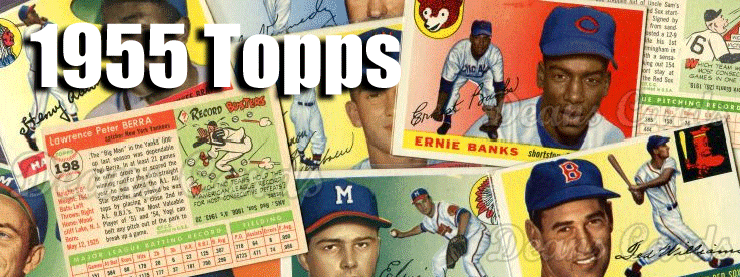
1955 Topps – Going Horizontal


 The 1955 Topps set is also printed on the large size cards that measure 3¾” by 2⅝”, but Topps kept their offering fresh by employing a horizontal layout on the front of their cards for the first time. While the 1952 Topps cards featured horizontal backs, Topps never attempted a horizontal front until 1955. Fortunately for Topps, they had learned so much about what card consumers wanted since 1951, that they had enough interesting material to fill the large canvas.

 As in 1954, the 1955 Topps baseball cards have two different pictures of the players on each card. A close-up portrait and an action shot set further away, which was an improvement on the idea formulated in 1954. Topps also incorporated a facsimile autograph as they did in their 1954 set. Topps continued the use of the Major League logos, which had become a unique signature of their sets. This was a concept that Bowman never adopted. The 1955 Topps can be distinguished by the panel at the bottom, which features the players’ name, position, and team.

 Losing the contract battle, but winning the war

The entire 1955 Topps baseball card set consists of only 206 cards. Although Bowman was losing the gum card war in terms of sales, they were actually winning the battle for exclusive contracts with the players. As a result, Mickey Mantle, Whitey Ford, and Bob Feller are conspicuously absent from the 1955 Topps set.

By 1955, the battle lines in the Great Baseball Card Gum War were stabilizing and as a result only 41 players appeared in both the Topps and Bowman baseball card sets. Only 144 players appeared exclusively on the 1955 Topps cards, while a record 210 players appeared exclusively in the Bowman set. Topps had already printed cards for some players who signed with Bowman in the 1955 set, just as they (Topps) had done in 1953. As a result, four numbers from the 1955 Topps set were never issued: Cards numbered 175, 186, 203 and 209.

There are no major variations in the 1955 Topps set, making it somewhat easier to collect. However, 1955 Topps does include a high number series (#161-210) that is more expensive than the low number series. Duke Snider (#210) is particularly difficult to find; it was the very last card issued by Topps in 1955 and is known to have centering and condition issues.

 Topps again has better rookie cards

Another reason the 1955 Topps set is popular with today’s collectors is the three rookie cards of future Hall-of-Fame players that can be found in this set: Sandy Koufax (#123), Roberto Clemente (#164) and Harmon Killebrew (#124). Unlike the Topps Rookie Class of the previous year, the performance of these rookies would not be a factor in card sales in 1955. The reason was that none of these three players were considered any more than prospects with raw potential in 1955 and none would become stars for at least another four years.

 Results

Topps was on a roll. Just one year after they issued their first set of baseball cards with dual images, Topps built on their momentum and took their 1955 set to the next level by including not one, but two color player images on the card fronts.

Although Bowman still laid claim to the most famous player of the day, Mickey Mantle, Topps made up for his absence in its 1955 set by issuing a solid first series that included: Hank Aaron, Jackie Robinson, Ted Williams, Warren Spahn, Al Kaline, and Ernie Banks. This dealt a heavy blow to the Bowman Gum Company. Topps issued their final series late in the summer, filling it with the likes of Willie Mays, Duke Snider, Yogi Berra, and Phil Rizzuto.

The result was that collectors again preferred the exciting and attractive Topps cards over the Bowman issue, and Topps sold more cards for the fourth consecutive year. Although few collectors realized it at the time Bowman had lost money each of those years and their losses had reached a critical point.


This article is taken from Dean’s book “The Gum Card War and the Great Bowman & Topps Baseball Card Sets of 1948-1955”, which is now available for sale at Amazon.com.

 Dean Hanley is an authority on vintage sports cards and has written numerous articles on the topic. Mr. Hanley is the founder DeansCards.com, and with well-over one million vintage cards in inventory, DeansCards.com is the largest seller of vintage cards on the web. Dean has also published Before there was Bubble Gum: Our Favorite Pre-World War I Baseball Cards”, which is also available in eBook form at Amazon.com and has just released a T207 reprint set. For more information, please visit www.DeansCards.com

 If you are looking to sell your cards we would be happy to hear from you. Please fill out our sell your collection form here and we will be in touch.

Monday, September 10, 2012

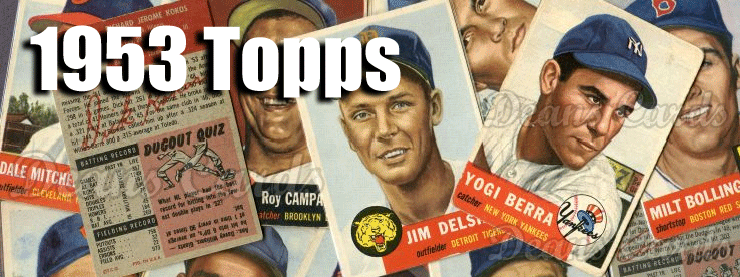
1953 Topps – Up Close and Personal


The 1953 Topps baseball card set is considered the most personal set of the 1950s. Everything, from the hand drawn sketches on the front, to the signature, biographical paragraph and thorough statistics on the back, demonstrates that Topps had hit their stride with the 1952 set and now was ready to push the envelope with the 1953 set. While these cards do not have the notoriety of their predecessor, they have their own special place in sports card history.

With the exciting success of the 1952 Topps set, Sy Berger and Topps wanted to refine what they had already done so well in 1952. Instead of colorizing black and white photographs as they did for the 1952 set, Topps went to the expense of paying artist Gerry Dvorak $25 per card to sketch and paint the players. Although the 1953 Topps baseball card set contains some attractive action shots, the set is primarily noted for its carefully drawn expressions, which are chronicled on the head shot cards.

 The major drawback of the 1952 Topps set was that many of the players depicted in it inaccurately look very similar, particularly in terms of hair and skin color. The 1953 Topps set rectifies this flaw, especially on the head shots.The color paintings of the player’s faces have warm, relaxed and friendly expressions and completely dominate the large cards. The 1953 Topps cards showcase more “flesh” than any other set ever made.

 In order to fully appreciate the beauty of the 1953 Topps baseball card set, one should take a complete set and go through it card-by-card. The players’ faces are so large and life-like, that the cards give the impression of standing right in front of the players at the ballpark. Rarely, even today, can we see so much detail in players’ faces. The 1953 Topps Archive (or reprint) set, with its wider white borders, smaller card-size, and shiny gloss, does not offer the same experience as one gets looking at an original 1953 Topps set.

 A perfect example of a detailed head shot is card #220, Satchel Paige. The Topps artist captures the forty-seven year old Negro League star perfectly. He looks like the wise, well-travelled pitcher that was playing for the St. Louis Browns in 1953. The only imperfection with the card however is that Topps misspelled his first name as “Satchell”, by adding an extra “L,” making it the only real error card in the set.

 Although the 1952 Topps cards did have stadium settings and natural backgrounds, there was little emphasis on making the background look as good as the players. However, that was not the case in 1953. When making this set, the Topps artists paid close attention to every detail on the cards, including the backgrounds. When looking at the 1953 set, you will see that many cards feature fully occupied stadiums with the colorful advertisements on the outfield walls behind the player.

The 1953 Topps set also features a number of innovations on the card backs, starting with the vertical orientation. The banner on the top with the card number, the player’s name, height and weight were similar to the 1952 cards; however this time they were enlarged to make them easier to read. The biographical paragraph was updated and features a facsimile signature over the black text in red ink. Topps kept its statistical information consistent with the previous year’s table but also included a “Dugout Quiz” on the back of each card.

Fewer cards than in 1952 

Due to the court ruling, the 1953 Topps Baseball Card Set significantly decreased in size, down to only 280 cards, from the previous year’s 407 cards. The 1953 Topps set was issued in four series: cards #1-85, #86-165, #166-220, and #221-280.

The competition for player contracts between Bowman and Topps would create a unique problem for Topps in 1953. Topps would begin to print a series of the set and then find out that they had failed to secure the contractual rights for a player whose card was about to be printed. There was no sense in wasting a valuable spot on the printing sheet, so Topps would either promote a player from the next series or “double print” one of the current cards in the series.

None of the series were actually fully completed, as five cards each from the first and second series were "bumped" back to later series. This action created what is known in the hobby today as chase cards. With no printed checklist available, set collectors of the day probably went crazy looking for the missing cards, only to have them appear in a wax pack of the next series of cards.

The five cards skipped in the 1953 first series were: #10 Smokey Burgess, #44 Ellis Kinder, #61 Early Wynn, #72 Fred Hutchinson and #81 Joe Black. The skipped cards of series two included: #94 William Kennedy, #107 Danny O’Connell, #131 Harry Byrd, and #156 Jim Rivera.

This makeshift practice continued up until the fourth and final series of the set, when Topps finally ran out of players under contract and was forced to leave a total of six holes in the set. Cards numbered 253, 261, 267, 268, 271, and 275 were never printed. These spaces in the printing sheet were again filled with plates of current cards in the series, thus adding even more “double printed” cards to the set. There were no checklists available in 1953. Set collectors had no idea that these cards were not forthcoming and most likely bought a couple dozen extra packs of cards before giving up on finding the six missing cards.

The fourth and last series in the 1953 Topps set was also distributed late, making those cards several times more expensive than the earlier series. Card #244, Willie Mays, is in the fourth series and unfortunately for collectors was not “double printed”. Therefore Willie Mays proves to be the most difficult card to find in the 1953 Topps set.

 Double-Print confusion

There were three “double printed” cards in the last series of the 1952 Topps sets and they made perfect sense. In all my life, I have never heard a collector complain about Topps printing too many Mickey Mantle, Jackie Robinson or Bobby Thomson cards in its 1952 set. While Thomson is not as popular today, in 1951 he hit the shot heard ‘round the world and was a hot property in 1952.

The major flaw of the 1953 Topps cards were the underwhelming “bush-leaguers,” who were printed in greater quantities and have a higher population of 1953 Topps cards. So unlike the 1952 double printed cards of stars, the cards chosen to be double printed in 1953 did not make logical sense in terms of the player’s popularity.

There were a few exceptions to this however. The few Hall-of-Fame player’s cards that were randomly double-printed in 1953 were #37 Eddie Mathews, #54 Bob Feller and #77 Johnny Mize. But most of the “DP’s” are of very forgettable players; starting at the beginning of the set.

We’re overwhelmed with the likes of double-printed no-names such as #7 Bob Borkowski, #8 Clem Koshorek, #12 Howie Judson, and #13 Connie Marrero. Next we get the likes of #15 the “awesome” Bobo Newsom, #16 the “immortal” Harry Lowery and #18 the “unforgettable” Ted Lepico. A cool exception to this of no name DP’s is #1 card in the set - the great Jackie Robinson.

I could continue on for several more paragraphs with more examples of players such as these, but it seems a crime to waste the ink. As a card collector and dealer, it’s very frustrating to have the DeansCards.com inventory bloated with cards of these types of players, as I’m sure the kids felt the same way back in the day.

Knowledge Quiz: Just for fun, out of those last seven cards, Borkowski to Lepico, how many of these guys could you match to the team that they played for in 1953 without looking at their cards? If you could correctly name four or more teams, you’re “good”. If you can name six teams correctly, then you’re a vintage baseball card expert.

Knowing the care and attention that Sy Berger typically gave to these early sets, it makes me think that the double-printed cards were randomly chosen by the printer, who likely knew little to nothing about baseball. As a set builder, I consider these random “double prints” a missed opportunity for the 1953 Topps set. Just think of how collectible (and affordable) the 1953 Topps baseball card would be today, if the 40 double-printed cards were strategically selected and used on the stars of the set like: #76 Pee Wee Reese, #82 Mickey Mantle, #104 Yogi Berra, #114 Phil Rizzuto, #147 Warren Spahn, #220 Satchel Paige, and #244 Willie Mays.

 Demand Scarcity - A cold case discovery

The 1953 Topps set is a challenge for set builders 

Despite all the “double-printed” cards, the 1953 Topps baseball card set still ranks “moderately difficult” to build and complete. I rank the 1953 Topps set as the third-hardest Topps set of the 1950’s to build in low to mid-grade conditions, behind only the 1952 and 1957 sets. Building the 1953 set in “Excellent” condition or better is a real challenge and will require quite a bit of time and money. As the condition of the set increases, the difficulty level to complete the set increases exponentially. My dad’s comment on this set is that the cardboard did not wear well, and was inferior to other years.

The condition of most existing vintage complete sets will vary greatly. Many vintage sets were built decades ago when condition was not a major consideration. Some early post-war sets will have cards in it that vary in condition from “Near Mint/Mint” all the way down to “Poor.” In my opinion, having this wide of a range detracts from the eye appeal of the set. A set looks much nicer when all of the cards are as close as possible to being consistent in grade. While a card in “Near Mint” condition may add to the cost of the set, it also brings out the flaws of the mid-grade cards, detracting from the sets overall appeal and value.

Dean’s Cards builds and sells hundreds of vintage sets each year. When Dean’s Cards builds vintage sets, we try to build three to five at a time. We break down several existing sets and then assimilate the cards of like conditions. Our million card inventory allows us to supplement the sets with needed cards if necessary.

 DeansCards.com tries to maintain a constant inventory of at least one set of each grade, for every year from 1953 to present. For sets from 1952 and older, it’s often not possible. For these years, we build sets upon request.

 When Dean’s Cards grades a post 1954 set “Excellent,” we are usually able to have at least 90% of the cards exactly meet that particular grade and the other 10% of the cards grading no higher or lower than one grade off. It’s not unusual for DeansCards.com to have 10,000 to 20,000 cards listed online for just one Topps year. Of course, this standard is much tougher to implement for pre-1954 sets simply because we do not have as many cards from those years.

Jackie, Mickey and Willie

Another challenge to building a 1953 Topps set is that the value is so heavily influenced by three high-dollar star cards: #1 Jackie Robinson, #82 Mickey Mantle and #244 Willie Mays.The 1953 Topps “big three” represent about half of the set’s total value. The first card, Robinson is condition sensitive, Mays is a “high-number” and Mickey Mantle is a baseball card god whose cards are always in high demand.

 Finding the 1953 Topps “big three” in the same particular condition, at the same time and at a fair price, is usually a challenge. Once accomplished, you then have to locate the scarce high number cards.

 Condition Scarcity


 The 1953 Topps cards also have a red partial border on the bottom of the cards for the American League players and a black border on the bottom of the cards for National League players. These borders have been known to chip much easier than cards with white borders. This is another reason that it’s hard to find 1953 Topps cards in better conditions.

American League
A survey of the DeansCards.com inventory confirms the condition scarcity of the 1953 Topps set. Of the 1689 cards from the 1953 Topps set that we have in stock, we have only one card that grades higher than Excellent/Mint! The DeansCards.com inventory has 41 Ex/Mt cards (2%), 237 in EX (14%), 826 cards in VG (49%), 562 cards in Good (33%), and 11 cards in Fair or Poor condition. This means 83% of the 1953 Topps card population grade “Very Good” condition. No other post-war set suffers from this degree of condition scarcity. This is why putting together a 1953 Topps set in pristine condition is a costly challenge for hobbyists.

 Missing a few stars

Although stars like Willie Mays and Mickey Mantle were featured in the 1953 Topps set, Topps was still missing quite a few stars that had also been omitted from their 1952 set. Ted Williams and Stan Musial were noticeably absent from the 1953 Topps set. Williams would give into Topps the next year, an especially satisfying victory for Berger, who is a lifelong Red Sox fan. Musial, on the other hand, would not sign a contract with Topps until 1958

 The 1953 Topps Archives set was issued in 1991. Topps again omitted the numbers that were left out of the original set; however, this time they were legally able to include cards of Hall-of-Famers’ Hank Aaron, Richie Ashburn, Larry Doby, Leo Durocher, Gil Hodges, Bob Lemon, Robin Roberts, Duke Snider, Casey Stengel, and Ted Williams.

 The 1953 Topps rookie card of an over-looked closer

The one thing that keeps the 1953 Topps set semi-affordable is that it was the only Topps set produced before 1970 to not contain a rookie card of a future Hall-of-Fame player. However, this may someday change if the Veterans Committee ever decides to recognize Elroy Face. Along with Hoyt Wilhelm in the American League, Face was a true pioneer of closing out baseball games.

Starting in 1955, Face would be the premier National League relief pitcher for the next 14 years. Back when relievers were hardly ever invited to All-Star games, Face was selected to three consecutive All-Star games. Roy Face literally forced an invitation to the mid-summer classic in 1959. Please consider his first-half stats: Face appeared in 32 games, finishing 29 of them. He pitched 56 innings. His record at the all-star break was 12-0, with 9 saves (this was before anyone knew what a save was) and a 1.13 ERA. Face did cool off a bit, but finished 1959 with an 18-1 record (all in relief) to give him a win/loss percentage of .947, a single season record that has yet to be broken.

 A short side trip

 Looking at Face’s 1959 stats made me wonder, “How is an 18-1 win/loss record for a relief pitcher even possible?” After some research, I concluded that five things were needed: 1) several below average starting pitchers, 2) a great closer who can pitch multiple innings, 3) a couple of good starting pitchers who can throw complete games and not force the manager to burn up his closer to save too many games, 4) a mediocre hitting team that would not blow out their opponents, but could manufacturer a game-winning run when needed and 5) lots of luck. If the team’s hitting is too good, the closer would only be in position to save games. If the hitting is too bad, the team would never score the winning run. In 1959, the Pirates and little Elroy Face were the perfect combination.

The Pirate starting pitcher would often allow a few runs and be lifted for a pinch-hitter in the 7th or 8th inning. Face would then enter the game tied or a couple runs down, putting him in a position to win it. In 1959, Face’s “fork ball” was extra nasty and he would keep throwing it for as many as five innings, if necessary - until the Pirates finally scored a run. Because few modern closers pitch more than one inning per game, this is going to be a tough record to surpass.

 Aftermath


 The 1953 Topps Baseball Card set was certain proof that Topps knew how to manufacture innovative and high-quality sports cards. Bowman had gone to great expense to produce their 1953 “Pure Color” Bowman Baseball Card Set in an effort to win back the market share that they lost to Topps in 1952. Not only had Topps survived the Bowman counter-attack, Topps once again sold more cards in 1953. The Topps Gum Company had proven that they were in the baseball card market to stay.

This article is taken from Dean’s book “The Gum Card War and the Great Bowman & Topps Baseball Card Sets of 1948-1955”, which is now available for sale at Amazon.com.

Dean Hanley is an authority on vintage sports cards and has written numerous articles on the topic. Mr. Hanley is the founder DeansCards.com, and with well-over one million vintage cards in inventory, DeansCards.com is the largest seller of vintage cards on the web. Dean has also published Before there was Bubble Gum: Our Favorite Pre-World War I Baseball Cards”, which is also available in eBook form at Amazon.com and has just released a T207 reprint set. For more information, please visit www.DeansCards.com 

 If you are looking to sell your cards we would be happy to hear from you. Please fill out our sell your collection form here and we will be in touch.          

Monday, July 30, 2012

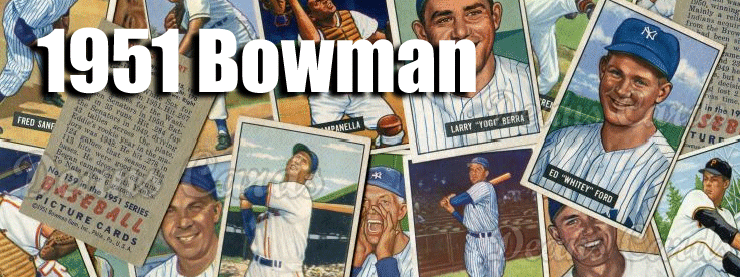
The 1951 Bowman Baseball Card Set: Bigger, Better and More of them.


 Although the 1951 Bowman baseball card set increased in both card size and number of cards, it ultimately maintained the attractive design of the 1950 set. The only real design difference between the two sets are that the player names were now located on the card fronts. There are 324 cards in total, each measuring 2-1/16” by 3-1/8.” Cards from the 1951 set can also be identified by the distinctive coloring of the words on the back. The text is printed in blue ink except for the word “baseball,” which is printed in red ink at the bottom of the card.

 Bowman used the same printing technique in 1951 that they had used in the previous set. They had artists colorize black-and-white photographs.There is one card with original artwork: #195 Paul Richards, the White Sox manager who was hired after Bowman had already started production on the set.

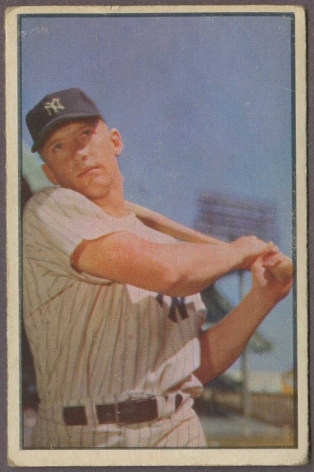
Many collectors feel that the 1951 Bowman baseball card was the company’s best effort. Bowman had the good fortune of printing the rookie cards of two of the biggest stars of the decade in its 1951 set: Mickey Mantle and Willie Mays.


Furthermore, both of these cards are part of the high number series (#253-324), making them even harder to find and more expensive to collect. Lastly, its operations became so smooth that aside from a few mistakes spelling last names, there are very few pricy error cards.


This article is taken from Dean’s upcoming book “The Gum Card War and the Great Bowman & Topps Baseball Card Sets of 1948-1955”, which is now available for sale at Amazon.com. 

 Dean Hanley is an authority on vintage sports cards and has written numerous articles on the topic. 
 Mr. Hanley is the founder DeansCards.com, and with well-over one million vintage cards in inventory, DeansCards.com is the largest seller of vintage cards on the web. Dean has also published “Before there was Bubble Gum: Our Favorite Pre-World War I Baseball Cards”, which is also available in eBook form at Amazon.com and has just released a T207 reprint set. For more information, please visit www.DeansCards.com.

Friday, March 16, 2012

Fist Full of Stars Back From PSA

We just got back a nice batch of cards from PSA this week.  Mantle, Cobb, Mathewson, Aaron, Mays, Banks, Williams, Gehrig and some more Mantle.  None of the cards were super high grades or anything, just decent mid to low grade star cards from a recent collection we purchased.  The thing that always gets you though, is having 10 Mantles hit you at once.  All from the 50s, both Topps and Bowman.  The highest grade we received on any Mantle was a PSA 6 on a 1956 Topps. 


All Mantles aside, we had a handful of Hank Aarons, a Willie Mays, a Lou Gehrig, Ernie Banks, Christy Mathewson and one beat up Cobb.  The Cobb is a T206 with a Polar Bear back, and it looks like it was "loved" pretty hard over it's 100+ years on this earth, leaving us with it only being Authenticated.  The Gehrig card is pretty cool regardless of getting a PSA 1, simply because we don't see 1933 DeLong cards come through the door too often which makes it the only 1933 DeLong we currently have.

Well, we have a couple batches of cards still out with PSA and are adding higher level singles daily right now.  So keep checking back, you never know what we are going to get in.

Full List of Recent PSA Additions:
Mathewson, Christy - White Cap - T206 - PSA 2 Good (MK)
Cobb, Ty - Bat off Shoulder - T206 - PSA Authentic
# 92 Ted Williams - 1939 Play Ball - PSA 3 VG
# 7 Lou Gehrig - 1933 DeLong - PSA 1 Poor
# 253 Mickey Mantle - 1951 Bowman RK - PSA 2 Good
# 101 Mickey Mantle - 1952 Bowman - PSA 5 EX (MC)
# 101 Mickey Mantle - 1952 Bowman - PSA 3 VG
# 82 Mickey Mantle - 1953 Topps - PSA 2 Good
# 82 Mickey Mantle - 1953 Topps - PSA 3 VG
# 82 Mickey Mantle - 1953 Topps - PSA 4.5 VG-EX+
# 82 Mickey Mantle - 1953 Topps - PSA 5 EX
# 135 (Gray Back) Mickey Mantle - 1956 Topps - PSA 3 VG
# 135 (Gray Back) Mickey Mantle - 1956 Topps - PSA 4 VG-EX
# 135 (Gray Back) Mickey Mantle - 1956 Topps - PSA 6 EX-MT
# 244 Willie Mays - 1953 Topps - PSA 3 VG
# 128 Hank Aaron - 1954 Topps RK (3 of them) - PSA 2.5 Good+
# 94 Ernie Banks RC - 1954 Topps - PSA 4 VG-EX


Friday, February 17, 2012

Just Added: 1,200 1956 Topps Baseball Cards

In the past month we have added over 20,000 vintage cards to DeansCards.com.  About 1,200 of those added were 1956 Topps Baseball cards, including an EX/MT set break, at least one of every star card and hundreds more compiled from other collections we bought recently.


Before we added this lot of 1956 Topps Baseball, our inventory was sitting right around 2,000 cards.  With this addition that puts us up to about 1,366 unique singles, changing many of our cards from 0 quantity to 1.  This puts us at about 3,200 total quantity; a 60% increase to the selection of 1956 Topps Baseball Cards.

On a side note, we also recently made sure that our 1956 Topps cards were properly titled according to them being either a Gray Back or a White Back card to help the more detailed collector.  These 1956 Topps were just a small part of what we have been up to at DeansCards.com.  Make sure to check out our Recently Added Cards page to see all of our latest additions.

Highlights of our recent addition:

Complete Sets

Mickey Mantle

Jackie Robinson

Friday, January 27, 2012

Just In: A Stack of 1967 Mickey Mantle Cards


While putting up a box of 1967 Topps Baseball Cards today, we hit card #150 and liked what we saw.  It is never a dull sight to see a stack of Mantles just hanging out in front of you.  There weren't any super high grades, and most of them were Very Good just due to some mild things like questionable corners or being slightly off center.  Just a decent stack of mid-grade Mantles.


As always, we are adding new inventory every single day.  Make sure to keep an eye on the Recently Added Cards page to stay up to date.

Tuesday, December 20, 2011

Results of Year One of the Great Bubble Gum Card War: 1951


 The following article was written by Dean Hanley and will be published in an upcoming issue of Sports Collectors Digest.


1951 Topps had proceeded very cautiously when they issued the 1951 Topps sets, much as Bowman had done with their first national post-WWII issue of cards in 1948. The main reason for packaging the 1951 cards with taffy was to protect the company from a potential legal attack from Bowman. Topps had gotten their feet wet with a very simple set. Topps had learned from its numerous mistakes and would never go to market with such a tawdry product again.

Topps catches some luck: Location

Although Topps got off to a very inauspicious start in the baseball card market in 1951, they did not let the failures of their first major set discourage them. They kept pushing forward and as a result, Topps did manage to catch a few breaks.

While Bowman was headquartered in Philadelphia, Topps was located in New York City, the epicenter of the baseball world. The Yankees, Dodgers, and Giants all called New York City home, which would prove to be a significant advantage for Topps in the early part of the 1950’s. The New York teams were at their peak and at least one New York-based team would appear in each World Series from 1949 to 1958.

More luck: Baseball reaches the heights of popularity

Topps also had the fortune of great timing. Baseball had reached a new peak in popularity. Baseball games were setting new attendance records and the number of local, small-town radio stations that broadcast games soon doubled. No longer was it imperative to live in a major city in order to enjoy a ballgame.

Baseball was further popularized by new technology. As televisions started appearing in homes across America, local stations began televising games. The first nation-wide broadcast of a baseball game was in 1951. A record number of people now had access to the sport. The very same children who once popularized the art of collecting baseball cards decades before, now had the ability to watch their favorite players in action, with lights and sounds.

Baseball’s exciting new stars

Baseball’s popularity had soared when the games great stars returned from war in 1946. The higher level of play on the field continued as the color-barrier was broken in 1947 by Jackie Robinson. Robinson led the Dodgers to the World Series that year and clubs began signing the best player available – regardless of skin color – in order to compete.

The year of 1951, the nation’s epicenter, New York City saw the arrival of two most exciting baseball stars, who would dominate the game for the next two decades: Mickey Mantle and Willie Mays.

Miracle of Coogan’s Bluff

Topps timing was also fortunate because America would tune into baseball just in time to witness something very special. The 1951 National League pennant race, considered one of the most exciting of all-time. On August 11th, the Dodgers were 13 ½ games ahead of the Giants. Dodgers’ manager Chuck Dressen was over-confident and proclaimed, “the Giants are dead!” However, the Giants proceeded to feed Dressen his words when they won 37 of their last 44 games, including the last seven, tying the Dodgers at the season’s end and forcing a three-game playoff.

The Giants’ Bobby Thomson hit a home run off of Ralph Branca to win Game one at Ebbets Field. The teams then moved to the Polo Grounds where the Dodgers won Game two, 10-0 behind Clem Labine. The stage was set for Game three. The teams were locked in a 1-1 tie until the eighth inning, when the Dodgers rallied for three runs. Dodgers Ace Don Newcombe sailed through the bottom of the 8th inning and looked to be in total control as the Giants came up to bat in the ninth inning.

Newcombe then ran into trouble, surrendering three hits and a run to the Giants. The score was now 4-2, with Game one Hero, Bobby Thompson coming up to bat. Dressen brought in Ralph Branca to face Thompson and Bobby responded by hitting Branca’s second pitch into the left field bleachers, on what has become known as the “Shot heard ‘round the world.”

The Giants immense joy was short-lived, as the dominant Yankees then proceeded to beat them in the World Series and also did the same to the Dodgers the following year. The World Series never left New York City for those three years.

If you think that big city teams dominate baseball today, in the decade between 1947 and 1956, the three New York teams made a combined 16 World Series appearances. The Yankees won seven rings and the N.L. clubs each took one home as well.

The popularity of the game of baseball was more popular than it had ever been. The fans could not get enough of the sport, which was also driving the sales of baseball cards to all-time highs.

Meanwhile back in Philadelphia

By 1951, Bowman was selling 200 million baseball cards and generating almost one million dollars in baseball card sales, which accounted for almost one-third of Bowman Gum’s total sales for the year. Even with the appearance of the Topps Blue and Red Backs sets in 1951, Bowman still had no serious competition in the baseball card market. Although Topps was making an effort to produce baseball cards, it was far from certain how that would play out. It was very possible that Topps could retreat from the baseball card market, as Leaf had done after 1949.

Bowman Gum had steadily improved its product, market position and profits since they re-entered the baseball card market in 1948. The Bowman baseball cards had improved in quality and quantity in each of the four issues. The 1951 Bowman baseball card set included 324 cards, the most that there would ever be in a Bowman set.

Although no one realized it in 1951, Bowman reached its zenith. Well, almost no one.

J. Warren Bowman was not the type of man to let his bubble gum empire slip away without a fight. When the 1951 Topps baseball cards appeared in stores, the Bowman Gum Co. was quick to take legal action to protect their dominant position in the baseball card market. Bowman Gum filed a lawsuit against Topps, just as they had done against Leaf two years earlier.

Issuing sets of sports cards alongside their gum products gave the Bowman Gum Company a huge advantage over the competition. Warren Bowman had the foresight to lock the professional players of both baseball and football, whose images were essential in producing a successful set of cards, into exclusive multi-year contracts. These exclusive contracts prohibited Bowman’s competitors from selling cards with gum products, giving Bowman a virtual monopoly on this fast-growing market.

Seeing the 1951 Topps baseball cards sets as a threat, Bowman went all out to secure exclusive contracts for as many of the baseball players as he possibly could. Believing that Joan Crosby was going to be the answer to signing players, Bowman contracted with Art Flynn, one of baseball’s first super agents, in July of 1951, to start signing players to contracts to appear on Bowman baseball cards. Flynn was authorized to sign a minimum of 15 players from each team to appear on Bowman baseball cards.

More Luck for Topps: Warren Bowman takes a bow

Given the business genius of J. Warren Bowman, it is doubtful if this chain of events was lost upon him. Bowman knew that Sy Berger had spent the summer signing hundreds of baseball players to contracts to appear on Topps baseball cards. Although he never publicly commented on it, Bowman knew what most of the public did not: a Bubble Gum Baseball Card War was about to begin.

In the 1930’s, Bowman had built his bubble gum company into the market leader, only to lose control of it a few years later. J. Warren eventually regained control of the company and Bowman Gum continued to be the leading producer of bubble gum, but things were different. Two decades had passed and Warren Bowman was no longer a young man. The value of the Bowman Gum Co. was at an all-time high and Mr. Bowman knew that even if Bowman Gum could defeat the Topps challenge to the baseball card market, that it may take years for Bowman Gum’s profits to return to 1951 levels.

Warren Bowman’s advantage was that he had inside information that was not yet apparent to the market. J. Warren Bowman decided that it was time for him to “cash out”. So in April of 1952, the Bowman Gum Co. was sold to Haelan Laboratories, Inc.

No matter how much due diligence that is performed by someone purchasing a company, the seller almost always has more knowledge and understanding regarding the company and its markets that it is selling, than the buyer can uncover.

On the surface, it appeared that Haelan Labs was acquiring:
1. The undisputed market leader - The Bowman Gum Co.
2. In a highly profitable market niche - Bubble Gum.
3. With an exploding target market – the kids of the Baby Boom Generation.
4. With a legally protected monopoly on a marketing advantage to sell its product – Baseball Cards. 5. Based on a sport that was at the peak of its popularity – Baseball.

The stark reality of this situation would turn out to be far different.

Haelan Laboratories had purchased all the assets that J. Warren had built, except leadership and creativity. Especially in emerging markets like baseball cards,is the most valuable asset that a company possesses. Jacob Warren Bowman would fade away into history, and with him went much of the company’s creative thought and competitive spirit. Those traits would be sorely missed in the next few years, as the Baseball Card Bubble Gum war continued to increase in ferocity.

With Bowman’s retirement, Topps had just caught its biggest piece of luck yet. That luck was also shared by Warren Bowman, who had made a great fortune of selling his company while it was at its highest value. Few entrepreneurs are wise enough and lucky enough to accomplish this feat. J. Warren Bowman had staged his last, in a long line of coups.

Sometimes, there is no substitute for good timing.

The Perfect Storm

By the end of 1951, by both circumstance and design, several drastic changes had all collided at the exact same time:
1. Baseball was at an all-time highin popularity, thanks to an infusion of new exciting talent and also by the 1951 N.L. pennant race that was climaxed by the “Miracle of Coogan’s Bluff”.
2. The nation’s best baseball teams – the Yankees, Dodgers, and Giants - were all located in New York City, which was also the largest U.S, market for bubble gum.
3. Baseball card sales were also at an all-time high, thanks to Warren Bowman.
4. The oldest of the huge U.S. Baby Boom population of boys was turning 6 years old – and now old enough to begin buying baseball cards.
5. The most experienced and successful seller of baseball cards ever, Warren Bowman had sold his company and retired.
6. J.E. Shorin had finally turned the Topps baseball cards efforts over to Sy Berger.

The stage was set. With assistance from an artist named Woody Gelman, Sy Berger spent the winter designing the 1952 Topps cards, on the kitchen table of his apartment in Brooklyn.

By the time that the big 1952 Topps baseball cards reached the shelves of candy stores in April of 1952, the ink that the executives of Haelan Labs had used to sign the purchase agreement, of the Bowman Gum Company, had barely dried. Haelan would be in for the surprise and the fight of its life!

This article is taken from Dean’s upcoming book “The Gum Card War and the Great Bowman & Topps Baseball Card Sets of 1948-1955”, which is scheduled to be released later this year in both print and eBook forms. Please feel free to contact Dean with any questions or comments at Dean@DeansCards.com 

Dean Hanley is an authority on vintage sports cards and has written numerous articles on the topic. Mr. Hanley is the founder DeansCards.com, and with well-over one million vintage cards in inventory, DeansCards.com is the largest seller of vintage cards on the web. Dean has also published “Before there was Bubble Gum: Our Favorite Pre-World War I Baseball Cards”, which is available in eBook form at Amazon.com

Wednesday, April 6, 2011

1953 Bowman Baseball Card Complete Set

We've written a lot about the 1953 Bowman baseball cards because they are so visually pleasing and include, in our opinion, one of the best cards ever made (#33 Pee Wee Reese turning a double play). However, it has been a long time since we put a complete 1953 Bowman baseball set.

The set we just got in, which grades "Very Good", came from a local collector who was selling it on behalf of his father, who had a large collection of early 1950's cards from both Topps and Bowman. It is definitely one of the most consistent 1950's sets that we have ever had.

This set does have one unique aspect: #114 Bob Feller is autographed. Bob Feller signed quite a bit of memorabilia during his lifetime, so we were not at all surprised to find that his card had been autographed.

Although we have written an article about these cards in the past, this is one of the first times that we have had a full set.  Click here to see Dean's 1953 Bowman baseball card article, which appeared in the October 15, 2010 issue of Sports Collector's Digest.

Thursday, March 31, 2011

2011 Opening Day

As we celebrate our Opening Day here in Cincinnati, Ohio, we know that many of you will be celebrating your own team’s Opening Day in the coming days. DeansCards.com got in our 2011 Topps Opening Day cards just in time for the first pitch! The 2011 Topps Opening Day base sets contain a total of 220 cards.  The 2011 Opening Day cards are available for purchase both individually and as a set on our website.

The set features numerous Rookies, including big names such as Aroldis Chapman and Freddie Freeman. Card #7 Mickey Mantle, is sure to be popular amongst collectors as well. To see a complete list of all the big names in the 2011 Topps Opening Day set, please visit our website at DeansCards.com

Tuesday, March 29, 2011

1965 Topps Embossed Baseball Cards

You Can't Get a Good Scan!
The 1965 Topps Embossed insert set consists of 72 cards that were once inserted into the regular ’65 series card packages. The cards themselves are relatively tall and skinny, measuring 2 1/8" by 3 1/2". The card fronts feature profile-view player portraits on gold foil. The images are slightly raised, and are often found with scratches and flaws, because the gold foil is so thin and easily damaged.

The player portraits can be found on either a blue background (denoting an American League player), or a red background (denoting a National League player). There are various rumors circulating the industry, suggesting that there are 1965 Topps Embossed cards that feature silver foil as opposed to gold. DeansCards.com, like many others, is in the majority that has never seen one of these supposed silver foil cards. If you have any information on these cards, or if you have seen one of these cards personally, feel free to drop us a line and tell us about it!

Unlike so many expensive 60's Star Cards, the stars in the '65 Embossed set are actually quite affordable.  The complete set as well as our DeansCards.com inventory alike, are both filled with 1965 Embossed stars including big names like Mickey Mantle, Roberto Clemente, Hank Aaron, and Willie Mays.

We just added a 1965 Topps Embossed Set to our website this morning!