by
+Dean Hanley
By 1954, baseball card collecting continued to achieve new heights. A new magazine,
Sports Illustrated, debuted in August of 1954. The first issue of SI featured an article about the Bubble Gum War between Topps and Bowman.
The SI article details how the hobby of collecting cards had become the obsession of American boys. The first two issues of SI also featured Topps baseball cards. The cards were getting better each year and most kids were collecting the cards of both manufacturers, but as more players began to sign exclusive contracts the number of players appearing in both sets was steadily decreasing each year.
Some historical perspective
While the kids of the day were enjoying the selection of the beautiful new baseball cards available, Topps and Bowman were locked in a competitive death struggle. Topps and Bowman cards sat side-by-side on every local candy counter across America, each desperately trying to grab the attention of the boys that would appear every day after school with coins in hand.
Production costs were high for both Bowman and Topps because of the competitive environment. Since the Baseball Gum Card War had begun, Bowman was forced to make their cards bigger and better. The nickel packs now contained seven cards instead of five. Both companies were under pressure to sign the best players to contracts, then to out-design, produce, innovate and market the other in order to survive.
It had become clear to both companies that the gum card market would be much more profitable with only one company making cards. Unlike many industries, a monopoly was possible because the most important ingredient to the cards, the images of the professional athletes, could be signed to exclusive contracts that courts would uphold.
If a monopoly could be re-established by either company, kids would only have one type of baseball and football card to buy and that company would get all the sales. The winning company could steadily reduce design, production and marketing costs and increase the price of the product.
Bowman bounces back from 1953
It had been three years since Topps had launched its surprise attack on the Philadelphia-based Bowman Gum Company, shaking up the entire card collecting hobby with its groundbreaking 1952 Topps baseball card set. It was the
1952 Topps Baseball card set that catapulted Topps into a lead over Bowman in the baseball card market, one that they would never relinquish. By 1954, Topps baseball card related gum sales had surpassed the one million dollar mark.

The good news for Bowman was that their revenues from baseball cards rebounded in 1954 to $602,000, which was exactly double the sales of 1953, but far less than their 1951 sales revenues, back in the days before Topps was a serious competitor. Bowman had also reduced production costs in 1954 by issuing a more cost effective set of cards.
As noted earlier, Bowman was also doing a better job of signing the star players of the day to exclusive contracts than Topps, but Bowman was still finishing second in sales. Second place is not a good position to finish, especially when it is a two team race.
Bowman as a company was still strong, but was definitely feeling the competitive pressure around it in the market. Sales of all Bowman products had declined from over $3 million in 1951 to just less than $2.5 million in 1954.
When Haelan Labs bought the Bowman Gum Co. in 1952, they ended up getting much more than they initially bargained for. In 1951, Bowman Gum was the leading bubble gum producer in a growing, profitable market niche, including the sports cards business that was well-protected by exclusive contracts. This was the company Haelan thought that they were buying, but when Topps issued its 1952 set, everything had changed. Bowman was now losing money and was locked in the fight of its life, with an aggressive and innovative competitor. Worse yet, baseball cards and bubble gum were an area market in which Haelan executives had little experience.
Warren Bowman had succeeded at one of the hardest decisions that any entrepreneur has to make. He had cashed out of the business that he built at just the right time.
This article is taken from Dean’s book “The Gum Card War and the Great Bowman & Topps Baseball Card Sets of 1948-1955”, which is now available for sale at Amazon.com.
Dean Hanley is an authority on vintage sports cards and has written numerous articles on the topic. Mr. Hanley is the founder DeansCards.com, and with well-over one million vintage cards in inventory, DeansCards.com is the largest seller of vintage cards on the web. Dean has also published “Before there was Bubble Gum: Our Favorite Pre-World War I Baseball Cards”, which is also available in eBook form at Amazon.com and has just released a T207 reprint set. For more information, please visit www.DeansCards.com
If you are looking to sell your cards we would be happy to hear from you. Please fill out our sell your collection form here and we will be in touch.

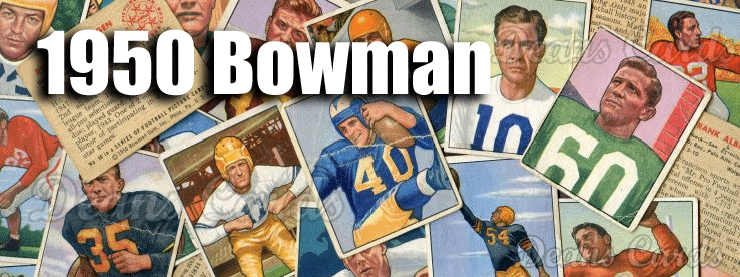

 The photos on these cards have one of four possible
positions/poses. The card features either a close up, kicking pose, catching
pose or the player running. When you flip the card over you can tell that
Bowman still had not changed what the backs of the cards looked like. The back is
on a very plain piece of cardboard paper with the players name in red. Below
that, in black ink is a short bio with the
position the player had at the time.
The photos on these cards have one of four possible
positions/poses. The card features either a close up, kicking pose, catching
pose or the player running. When you flip the card over you can tell that
Bowman still had not changed what the backs of the cards looked like. The back is
on a very plain piece of cardboard paper with the players name in red. Below
that, in black ink is a short bio with the
position the player had at the time. The key rookie cards in this set are